Within Ghana Panics
Are Ghana's Witch Camps Refuges or Prisons?
Northern Ghana's witch camps can protect accused women from violence while also trapping them in poverty, separation and effective exile.
On this page
- How accusations lead to banishment and flight
- Daily life in Gambaga and other settlements
- Why closure, protection and reintegration remain difficult
Page outline Jump by section
Introduction
Northern Ghana’s so-called witch camps present a difficult moral paradox. They are neither ordinary villages nor formal detention centres. For many of the women who live in them, they are the only places where they can escape assault or death after being accused of witchcraft. Yet the same settlements also represent exile, poverty and the loss of ordinary family life. Most residents are older women who have been blamed for illness, deaths, poor harvests or family misfortune and driven from their communities. They often remain for years or decades because returning home is considered too dangerous. Human rights organisations, Ghanaian campaigners and many traditional leaders increasingly agree that no one should have to choose between violence at home and lifelong isolation in a camp, but they also recognise that simply closing the camps without guaranteeing safety could expose vulnerable people to renewed attacks.[amnesty.org]amnesty.orgAmnesty InternationalGhana: Branded for life: Witchcraft accusations and the fight for dignity in the north of Ghana - Amnesty Internatio…
How accusations lead to banishment and flight
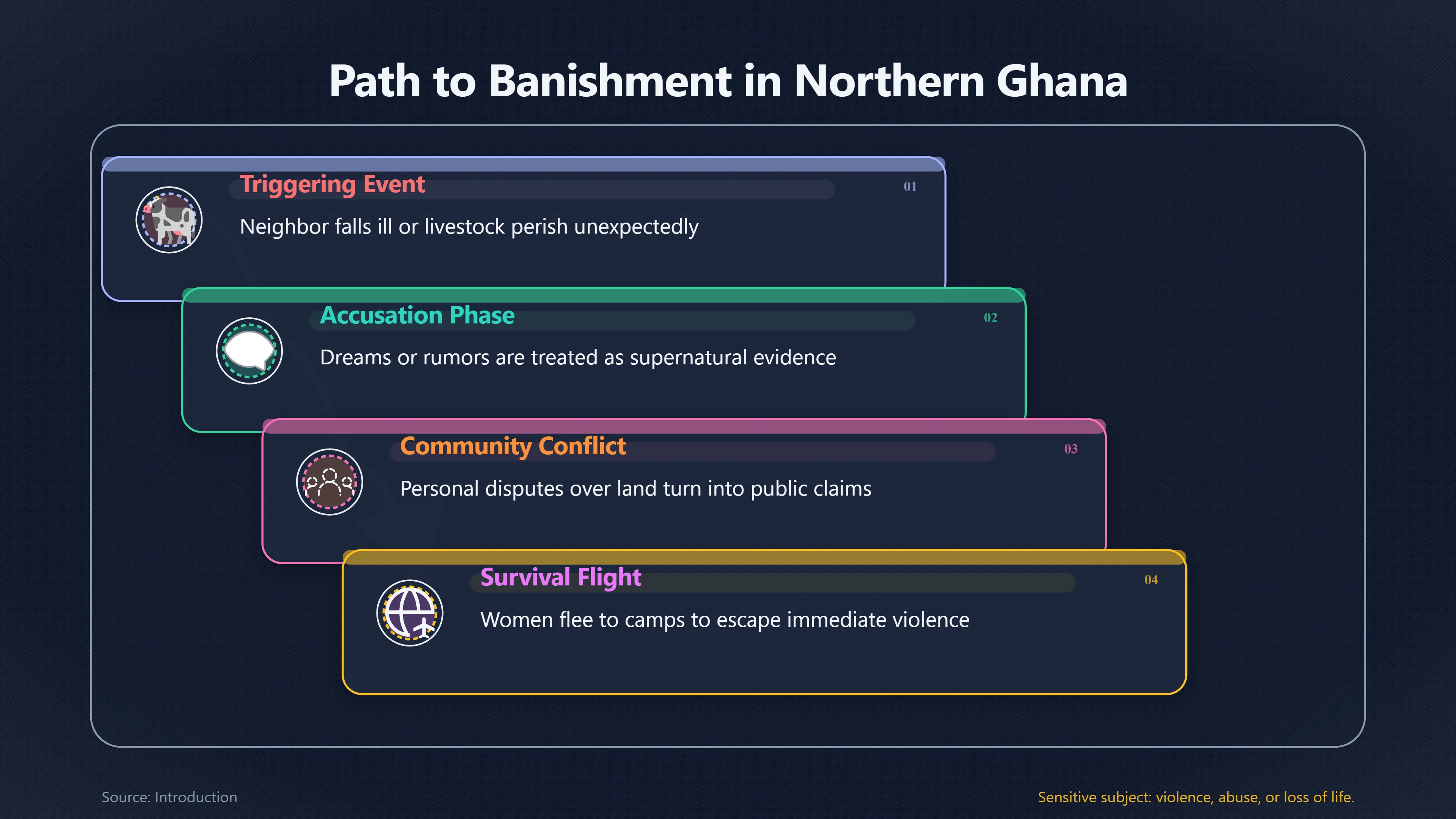
Most people arriving at the camps have not been convicted of any crime. Instead, they have become targets after a neighbour falls ill, a child dies, livestock perish, or family conflict demands an explanation. Dreams, rumours or consultations with spiritual specialists may be treated as evidence that a particular woman is responsible for invisible harm. The accusations frequently emerge within families rather than between strangers.[Amnesty International]amnesty.orgAmnesty InternationalGhana: Branded for life: Witchcraft accusations and the fight for dignity in the north of Ghana - Amnesty Internatio…
Research consistently shows that certain people face much greater risk than others. Those most commonly accused are:
- Older women, especially widows.
- Women living alone or without influential relatives.
- Women who are poor or dependent on others.
- Women with disabilities or mental health conditions.
- Women viewed as outspoken, unconventional or involved in inheritance disputes.
In many cases, the accusation reflects existing social tensions rather than any single supernatural belief. A widow who controls land or property may become vulnerable after her husband’s death. Family disagreements over inheritance, care responsibilities or household resources can become intertwined with claims of witchcraft, turning a personal dispute into a public accusation.[actionaid.org]ghana.actionaid.orgProtecting Women’s Rights: Why Ghana needs a law to proscribe witchcraft accusation | ActionAid GhanaDecember 12, 2022…
Once accused, women may face beatings, public humiliation or threats of lynching. Flight therefore becomes a survival strategy rather than a voluntary migration. The camps developed historically because they offered one of the few places where accused people could seek protection under the authority of local chiefs or shrine custodians when their own communities would no longer protect them.[amnesty.org]amnesty.orgInternational Victims of witchcraft accusations need protection and reparationAmnesty InternationalVictims of witchcraft accusations need protection and reparation…
Daily life in Gambaga and other settlements
The best-known settlement is Gambaga in the North East Region, but similar communities have existed at places including Kukuo, Gnani and Kpatinga. Although often described collectively as “witch camps”, they differ in size, history and local administration. They are generally informal settlements rather than institutions run by the Ghanaian state.[Amnesty International]amnesty.orgInternational Victims of witchcraft accusations need protection and reparationAmnesty InternationalVictims of witchcraft accusations need protection and reparation…
Life in these settlements illustrates why they are understood simultaneously as places of refuge and places of hardship.
On one hand, residents often describe finally feeling physically safe. After escaping threats in their home villages, they are less likely to face immediate mob violence. Some women build supportive relationships with other residents who have experienced similar persecution.
On the other hand, safety comes at a high price. Human rights investigations have documented inadequate housing, limited access to clean water, healthcare, food and income. Many women depend on subsistence farming, casual labour or charitable support. Separation from children, grandchildren and ancestral homes can become permanent, leaving residents socially isolated even when they are no longer in immediate danger.[Amnesty International]amnesty.orgAmnesty InternationalGhana: Branded for life: Witchcraft accusations and the fight for dignity in the north of Ghana - Amnesty Internatio…
The settlements also affect younger generations. Some children accompany accused grandmothers or mothers into exile, disrupting education and exposing them to the same stigma that forced their relatives to flee. Others remain behind with extended families, creating long-lasting family separation.[ActionAid UK]actionaid.org.ukAction Aid UKWe’re Action Aid. We’re people who areAction Aid UKWe’re Action Aid. We’re people who are
Refuge or prison?
Describing the camps simply as prisons misses an important reality: many residents are not physically detained and, in principle, can leave. Yet describing them simply as refuges is equally misleading because many women believe leaving would expose them to renewed violence.
This tension explains why scholars and human rights organisations increasingly avoid simplistic labels. The camps function as:
- Emergency refuges, because they provide immediate protection when local communities cannot.
- Places of social exile, because accusations often destroy family relationships and community membership.
- Sites of continuing discrimination, because residents remain identified primarily by the accusation that drove them there.
Amnesty International has argued that residents often have “no other choice” but to remain, making the camps both places of protection and symbols of state failure to guarantee equal rights and personal security.[Amnesty International]amnesty.orgAmnesty InternationalBranded for life but resilient: women accused of witchcraft in GhanaJuly 29, 2025…
Why closure and reintegration remain difficult
Calls to close the camps have existed for many years, but implementation has proved far more complicated than simply relocating residents.
The first challenge is safety. If women return to villages where accusations remain widely believed, they may again face assault or expulsion. Successful reintegration therefore requires extensive mediation with families, traditional authorities and local communities rather than simply transporting residents home.[ghana.actionaid.org]ghana.actionaid.orgOpen source on actionaid.org.
The second challenge is economic. Many residents have lost homes, farmland and livelihoods. Even if relatives agree to accept them, they may have no property or independent income to rebuild their lives.
The third challenge is social belief. Laws can prohibit violence or criminalise accusations, but legislation alone cannot eliminate deeply rooted explanations for illness, death or misfortune. Public education, local leadership and community dialogue remain essential if accusations are to become less common.[ghana.actionaid.org]ghana.actionaid.orgProtecting Women’s Rights: Why Ghana needs a law to proscribe witchcraft accusation | ActionAid GhanaDecember 12, 2022…
These practical difficulties explain why previous closure initiatives have achieved mixed results. Some settlements have been closed or reduced in size through negotiated reintegration, while others have continued because residents themselves judged the alternatives too dangerous.[ActionAid UK]actionaid.org.ukAction Aid UKWe’re Action Aid. We’re people who areAction Aid UKWe’re Action Aid. We’re people who are

Changing law and human rights responses
The killing of older women following witchcraft accusations, including high-profile cases in recent years, intensified pressure for legal reform. Ghana’s Parliament approved legislation intended to criminalise witchcraft accusations and related abuses, although campaigners have also emphasised that legal change must be accompanied by protection, compensation and community education if it is to be effective in practice.[actionaid.org]ghana.actionaid.orgProtecting Women’s Rights: Why Ghana needs a law to proscribe witchcraft accusation | ActionAid GhanaDecember 12, 2022…
Human rights organisations increasingly frame the camps not as a cultural curiosity but as evidence of intersecting forms of discrimination involving age, gender, poverty and social exclusion. Their recommendations typically include:
- Criminal penalties for violent witchcraft accusations.
- Better protection for people facing immediate threats.
- Reintegration programmes developed with local communities.
- Economic support for former residents.
- Public education aimed at reducing accusations before exile becomes necessary.
In 2025, Ghana’s Commission on Human Rights and Administrative Justice announced renewed efforts to close remaining camps while supporting residents through reintegration and financial assistance, reflecting a broader shift towards replacing long-term exile with community protection.[CHRAGJ]chraj.gov.ghMarch 11, 2025…
Why the camps remain culturally important
The continued existence of the camps illustrates that persecution is not sustained by belief alone. Witchcraft accusations become dangerous when they intersect with unequal power, insecure livelihoods, inheritance disputes, weak social protection and inadequate access to justice.
For that reason, the camps occupy a distinctive place in Ghana’s history of collective fear. They demonstrate how a shared explanation for misfortune can become a mechanism of exclusion, while also revealing the uncomfortable reality that informal refuge sometimes develops because formal systems of protection are absent. Their future therefore depends not only on closing physical settlements but on creating conditions in which accused people can return home without fearing violence, poverty or renewed persecution.[amnesty.org]amnesty.orgAmnesty InternationalGhana: Branded for life: Witchcraft accusations and the fight for dignity in the north of Ghana - Amnesty Internatio…
Amazon book picks
Further Reading
Books and field guides related to Are Ghana's Witch Camps Refuges or Prisons?. Use these as the next step if you want deeper reading beyond the article.

Purity and danger
First published 1966. Subjects: Purity, Ritual, Ritual Purity, Taboo, Pollution, Cultural Anthropology.

Witchcraft, Violence, and Democracy in South Africa
First published 2005. Subjects: Witchcraft, africa, Witchcraft, Political aspects.


The Penguin book of witches
First published 2014. Subjects: Witchcraft, History, Witchcraft, europe.
Endnotes
1.
Source: amnesty.org
Link:https://www.amnesty.org/en/documents/afr28/9220/2025/en/
Source snippet
Amnesty InternationalGhana: Branded for life: Witchcraft accusations and the fight for dignity in the north of Ghana - Amnesty Internatio...
2.
Source: ghana.actionaid.org
Link:https://ghana.actionaid.org/publications/2015/protecting-vulnerable-witchcraft-accusations-and-human-rights-abuses-ghana
3.
Source: amnesty.org
Title: International Victims of witchcraft accusations need protection and reparation
Link:https://www.amnesty.org/en/latest/news/2025/04/ghana-witchcraft-accusations/
Source snippet
Amnesty InternationalVictims of witchcraft accusations need protection and reparation...
4.
Source: ghana.actionaid.org
Link:https://ghana.actionaid.org/opinions/2022/protecting-womens-rights-why-ghana-needs-law-proscribe-witchcraft-accusation
Source snippet
Protecting Women’s Rights: Why Ghana needs a law to proscribe witchcraft accusation | ActionAid GhanaDecember 12, 2022...
Published: December 12, 2022
5.
Source: amnesty.org
Link:https://www.amnesty.org/en/latest/news/2025/07/ghana-witchcraft-accusations-2/
Source snippet
Amnesty InternationalBranded for life but resilient: women accused of witchcraft in GhanaJuly 29, 2025...
Published: July 29, 2025
6.
Source: ghana.actionaid.org
Link:https://ghana.actionaid.org/news/2025/lawmakers-join-actionaid-ghana-and-partners-advocacy-visits-witch-camps-step-toward
7.
Source: ghana.actionaid.org
Title: ghana and partners lead memorial lecture and march honouring [akua denteh]({{ ‘akua-denteh/’ | relative_url }})
Link:https://ghana.actionaid.org/news/2025/actionaid-ghana-and-partners-lead-memorial-lecture-and-march-honouring-akua-denteh
8.
Source: amnesty.org
Title: Ghana: Branded for Life
Link:https://www.amnesty.org/en/latest/research/2025/04/ghana-branded-for-life/
9.
Source: actionaid.org.uk
Title: Action Aid UKWe’re Action Aid. We’re people who are
Link:https://www.actionaid.org.uk/sites/default/files/publications/condemned_without_trial_women_and_witchcraft_in_ghana_report_september_2012.pdf
10.
Source: chraj.gov.gh
Link:https://chraj.gov.gh/2025/03/11/chraj-set-to-shut-down-witch-camps-by-dec-20/
Source snippet
March 11, 2025...
Published: March 11, 2025
Additional References
11.
Source: nature.com
Link:https://www.nature.com/articles/s41598-025-09183-9
Source snippet
ETHICAL APPROVAL AND CONSENT TO PARTICIPATE The authors’ obtained institutional ethics approval from the A...
12.
Source: tandfonline.com
Link:https://www.tandfonline.com/doi/abs/10.1080/09614524.2026.2616659
Source snippet
ry 9, 2026 — 61 Views 0 CrossRef citations to date 0 Altmetric Forthcoming in the Special Issue: Interrogating Localisation from Social J...
13.
Source: youtube.com
Link:https://www.youtube.com/watch?v=UzmXXWPIAXU
Source snippet
I Never Knew Witches Could do This Until I met Them...
14.
Source: youtube.com
Title: Witches of Gambaga (Trailer)
Link:https://www.youtube.com/watch?v=ARbon76B3f0
Source snippet
Ghana: Accused of witchcraft, hundreds of women banished to camps • FRANCE 24 English...
15.
Source: researchgate.net
Link:https://www.researchgate.net/publication/399532690_Reflections_on_CHRAJ%27s_Efforts_in_Past_Years_to_Promote_and_Protect_the_Rights_of_Persons_Banished_to_Witch_Camps_in_Ghana
16.
Source: pure.ug.edu.gh
Link:https://pure.ug.edu.gh/en/publications/an-exploratory-study-of-the-mental-health-and-emotional-challenge/
17.
Source: researchgate.net
Link:https://www.researchgate.net/publication/325185415_An_anthropological_study_of_witch_camps_and_human_rights_in_northern_Ghana
18.
Source: youtube.com
Title: Inside Ghana’s last ‘witch camps’ • FRANCE 24 English
Link:https://www.youtube.com/watch?v=didjLZkEoRI
Source snippet
Witches of Ghana | National Geographic...
19.
Source: amnesty.org.uk
Title: ghana hundreds accused witchcraft urgently need protection
Link:https://www.amnesty.org.uk/latest/ghana-hundreds-accused-witchcraft-urgently-need-protection/
20.
Source: graphic.com.gh
Title: Inmates in witch camps want reintegration — Survey report
Link:https://www.graphic.com.gh/component/content/article/inmates-in-witch-camps-want-reintegration-survey-report.html?catid=247
Topic Tree