Within Chad Panics
Does Chad Have a History of Mass Hysteria?
Chad's surviving record points to persecution and coercive belief rather than classic outbreaks of contagious unexplained illness.
On this page
- What the records do and do not show
- Panic, persecution and psychogenic illness
- How war and displacement shaped the archive
Page outline Jump by section
Introduction
The short answer is that Chad does not have a well-documented history of classic mass hysteria in the sense of school fainting epidemics, unexplained outbreaks of mass psychogenic illness or large apocalyptic movements. Instead, the surviving evidence points towards a different pattern: episodes in which fear, conflict and coercion produced persecution or political repression rather than contagious medically unexplained illness. This matters because it changes how Chad fits into the wider history of collective belief. The country’s record is not necessarily evidence that such events never occurred. Rather, it reflects the realities of a country whose modern history has been dominated by war, displacement, authoritarian rule and limited archival preservation, leaving historians with a fragmented picture of everyday social fears and rumours.[refworld.org]refworld.orgSeeking meaning: an anthropological and community-based approach to witchcraft accusations and their prevention in refugee situat…
Does Chad Have a History of Mass Hysteria?
Compared with many countries that have been extensively studied by psychologists and social historians, Chad offers remarkably few verified examples of mass psychogenic illness. Searches of the historical and medical literature produce isolated accounts of witchcraft accusations and politically motivated supernatural claims, but almost no well-documented outbreaks resembling famous school fainting epidemics, dance manias or contagious panic illnesses.
This absence should not be mistaken for proof that collective fear never occurred. Historians are careful to distinguish between missing evidence and evidence of absence. Much of Chad’s twentieth-century history was marked by civil war, regional conflict, refugee crises and weak state institutions. Researchers, humanitarian agencies and journalists understandably concentrated on documenting armed violence, famine, displacement and disease rather than recording rumours, local scares or psychologically mediated illness outbreaks.[countrystudies.us]countrystudies.usCountry Studies ChadCountry StudiesChad - TOMBALBAYE ERA, 1960-75…
What the Records Do and Do Not Show
The strongest surviving evidence falls into two broad categories.
First are episodes of witchcraft accusations during humanitarian emergencies, where fear spread through communities facing genuine illness and loss. These incidents involved scapegoating identifiable people rather than large groups developing unexplained symptoms.
Second are examples of state-sponsored coercive belief, particularly during President François Tombalbaye’s rule in the early 1970s. His government accused political opponents of “political sorcery” and imposed initiation rituals on thousands of civil servants and officials. These actions reflected authoritarian politics rather than spontaneous collective psychological contagion.[Country Studies]countrystudies.usCountry Studies ChadCountry StudiesChad - TOMBALBAYE ERA, 1960-75…
What the historical record does not contain are well-substantiated national episodes comparable with:
- widespread school fainting epidemics;
- contagious laughing or dancing outbreaks;
- medically unexplained illness spreading rapidly through schools or factories;
- large documented millenarian movements centred on imminent apocalypse.
That distinction is important because these phenomena involve different social mechanisms and should not be grouped together simply because they all concern unusual beliefs or behaviour.
Panic, Persecution and Psychogenic Illness
One reason Chad’s record appears thin is that its best-known cases belong to a different category from classic mass hysteria.
The 2007 events in Dosseye refugee camp illustrate this clearly. Eleven refugees died within a week, largely from conditions such as malaria, diarrhoea and malnutrition. Fear and uncertainty led some residents to accuse four women of causing the deaths through witchcraft. Assaults, arson and social exclusion followed, while some refugees stopped trusting clinics and safe water supplies in favour of traditional explanations. Humanitarian organisations responded with health education and community discussions aimed at reducing accusations without dismissing local beliefs outright.[unhcr.org]unhcr.orgWitchcraft allegations plague southern Chad's camps | UNHCR USOctober 25, 2007…
Although this episode involved rapidly spreading fear, researchers generally classify it as a witchcraft accusation crisis rather than an outbreak of mass psychogenic illness. The central process was the spread of blame and persecution, not the spread of medically unexplained physical symptoms.
This distinction is especially important in Chad, where belief in spiritual causes of illness may form part of ordinary cultural and religious life. A panic develops when suspicion becomes organised around specific alleged offenders and results in violence or exclusion, not simply because supernatural explanations exist.[Refworld]refworld.orgSeeking meaning: an anthropological and community-based approach to witchcraft accusations and their prevention in refugee situat…
How War and Displacement Shaped the Archive
Chad’s modern history helps explain why the documentary record is so limited.[data.mongabay.com]data.mongabay.comSource details in endnotes.
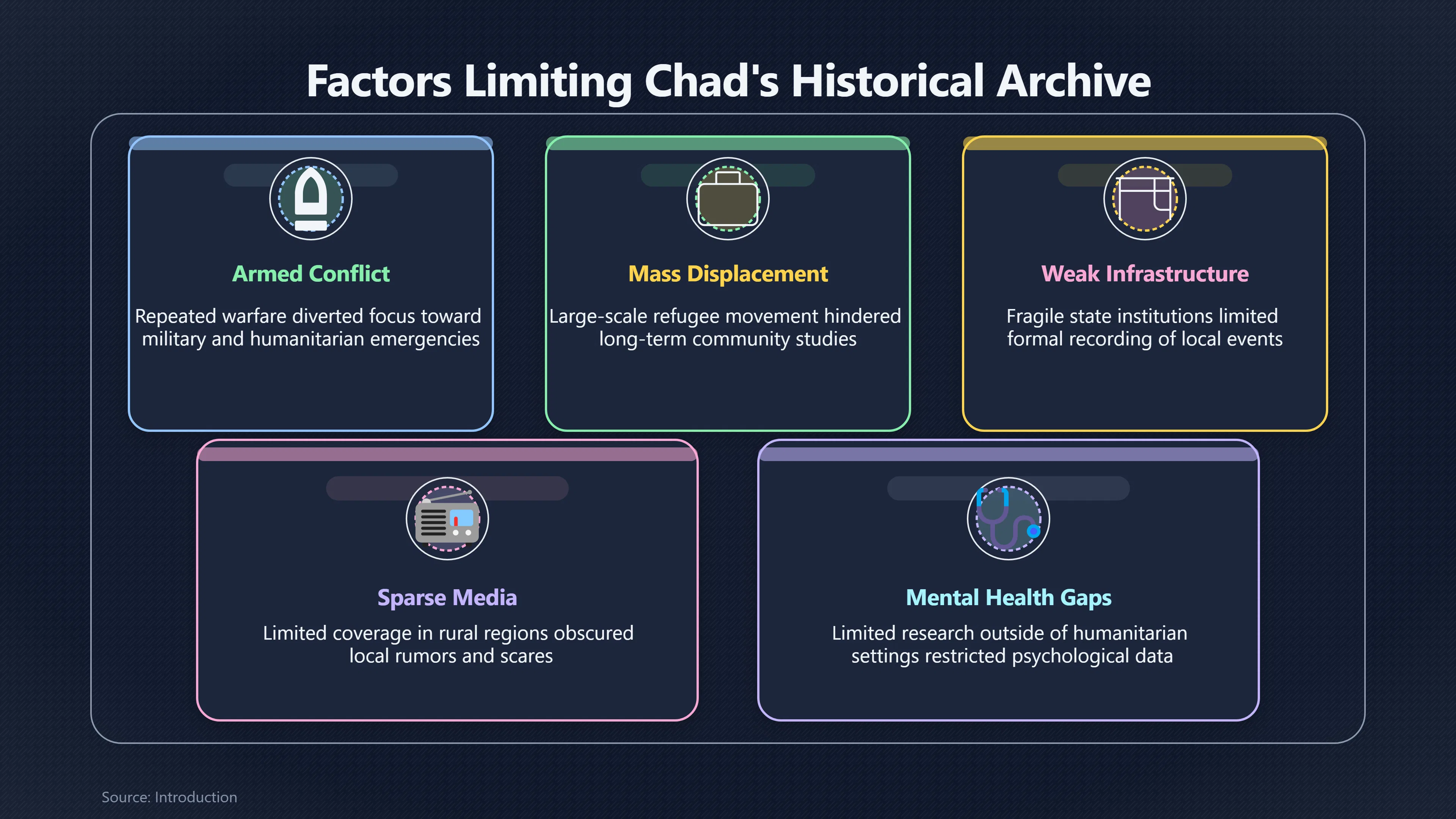
Several overlapping factors reduced opportunities for systematic observation:
- Repeated armed conflict, which diverted attention towards military and humanitarian emergencies.
- Large-scale displacement, making long-term community studies difficult.
- Weak archival infrastructure, with many local events never formally recorded.
- Limited mental health research, especially outside humanitarian settings.
- Sparse media coverage, particularly in rural regions where rumours or local scares might otherwise have been documented.
These conditions contrast with countries where schools, hospitals and public health agencies routinely investigated unusual illness clusters, creating detailed historical records that researchers can analyse decades later.[nih.gov]pmc.ncbi.nlm.nih.govPMCA working visit to Chad’s refugee camps for the people of Western DarfurPMCA working visit to Chad’s refugee camps for the people of Western Darfur
The refugee context also shaped what was documented. International agencies focused on preventing violence, improving sanitation and restoring confidence in medical care rather than classifying events through the lens of “mass hysteria”. As a result, surviving reports emphasise protection, public health and community mediation.[UNHCR]unhcr.orgWitchcraft allegations plague southern Chad's camps | UNHCR USOctober 25, 2007…
Why the Evidence Matters
The scarcity of documented cases tells historians something valuable in itself. It highlights the importance of asking what kinds of events were recorded, who had the ability to record them, and which experiences disappeared from the historical archive.
It also cautions against forcing Chad into categories developed from European or North American examples of collective behaviour. Applying labels such as “mass hysteria” too broadly risks obscuring important differences between:
- contagious medically unexplained illness;
- rumour-driven persecution;
- culturally rooted spiritual belief;
- political manipulation of supernatural claims;
- humanitarian crises in which fear follows genuine disease and mortality.
Recognising these distinctions produces a more accurate picture of Chad’s social history and avoids exaggerating evidence that simply is not there.
The Main Takeaway
The historical record does not support the idea that Chad experienced numerous classic outbreaks of mass hysteria. Instead, the available evidence points towards isolated but significant episodes in which fear combined with illness, displacement or political repression to produce witchcraft accusations or coercive state policies. The apparent absence of classic psychogenic epidemics is therefore best understood as a combination of genuinely different historical patterns and the limits imposed by conflict, fragile institutions and an incomplete documentary archive.[unhcr.org]unhcr.orgWitchcraft allegations plague southern Chad's camps | UNHCR USOctober 25, 2007…



Endnotes
1.
Source: refworld.org
Link:https://www.refworld.org/reference/strategy/unhcr/2012/en/87639
Source snippet
Seeking meaning: an anthropological and community-based approach to witchcraft accusations and their prevention in refugee situat...
2.
Source: unhcr.org
Link:https://www.unhcr.org/us/node/11884
Source snippet
Witchcraft allegations plague southern Chad's camps | UNHCR USOctober 25, 2007...
Published: October 25, 2007
3.
Source: refworld.org
Link:https://www.refworld.org/country%2C%2C%2CANNUALREPORT%2CTCD%2C%2C485f50c98a%2C0.html
Source snippet
World Refugee Survey 2008 - Chad | RefworldJune 19, 2008 — WORLD REFUGEE SURVEY 2008 - CHAD [Button: Hide Details ] * Document...
Published: June 19, 2008
4.
Source: countrystudies.us
Title: Country Studies Chad
Link:https://countrystudies.us/chad/10.htm
Source snippet
Country StudiesChad - TOMBALBAYE ERA, 1960-75...
5.
Source: pmc.ncbi.nlm.nih.gov
Title: PMCA working visit to Chad’s refugee camps for the people of Western Darfur
Link:https://pmc.ncbi.nlm.nih.gov/articles/PMC6735006/
6.
Source: data.mongabay.com
Link:https://data.mongabay.com/reference/country_studies/chad/HISTORY.html
Additional References
7.
Source: fmsh.fr
Title: lacces la terre dans le camp de refugies de dosseye tchad
Link:https://www.fmsh.fr/projet/lacces-la-terre-dans-le-camp-de-refugies-de-dosseye-tchad
Source snippet
L’accès à la terre dans le camp de réfugiés de Dosseye (Tchad) | FMSHJuly 28, 2023 — L’ACCÈS À LA TERRE DANS LE CAMP DE RÉFUGIÉS DE DOSSE...
Published: July 28, 2023
8.
Source: atjhub.csvr.org.za
Title: csvr.org.za Chad African Transitional Justice Hub
Link:https://atjhub.csvr.org.za/chadtj/
Source snippet
1 Background 2. 2 Commission of Inquiry into the Crimes and Misappropriations Committed by Ex-President Hissène Habré, His Accomplice...
9.
Source: thenewhumanitarian.org
Link:https://www.thenewhumanitarian.org/report/76772/central-african-republic-chad-car-refugees-not-ready-return-home
Source snippet
CAR refugees not ready to return homeFebruary 15, 2008 — * 15 February 2008 CAR REFUGEES NOT READY TO RETURN HOME GORÉ Around 6,000 refug...
Published: February 15, 2008
10.
Source: mongabay.com
Link:https://www.mongabay.com/reference/country_studies/chad/all.html
11.
Source: doczz.net
Link:https://doczz.net/doc/8471800/witchcraft-and-displacement
12.
Source: youtube.com
Title: Chad: Rehabilitating Child Soldiers
Link:https://www.youtube.com/watch?v=WtY2oMuk4qY
Source snippet
The Great Toyota War: How Chad Won a War with Pickup Trucks...
13.
Source: hrw.org
Title: Chad: The Victims of Hissène Habré Still Awaiting Justice: Historical Background
Link:https://www.hrw.org/reports/2005/chad0705/3.htm
14.
Source: youtube.com
Title: Chad’s Strange and Brutal Dictators: Tombalbaye, Habré and Déby
Link:https://www.youtube.com/watch?v=tCw9q5tmA6c
Source snippet
The Chadian Civil War...
15.
Source: youtube.com
Title: The Great Toyota War: How Chad Won a War with Pickup Trucks
Link:https://www.youtube.com/watch?v=NAAc2Nyz9Ks
16.
Source: youtube.com
Title: Inside Story
Link:https://www.youtube.com/watch?v=zWZ1Bca7y5c
Source snippet
Chad: Rehabilitating Child Soldiers...
Topic Tree