Within Britain in Belief
How Britain Turned Witchcraft Into a Crime
Britain's witch trials became deadly when courts, clergy and officials turned local suspicions into legally credible conspiracies.
On this page
- Why accusations became believable
- England, Scotland, Wales and Ireland compared
- How courts lost faith in witchcraft evidence
Page outline Jump by section
Introduction
British witch trials were not simply outbreaks of superstition or neighbourly suspicion. They became deadly when governments, courts and churches transformed local fears into legally recognised crimes. Between the sixteenth and early eighteenth centuries, accusations that might once have remained village rumours were increasingly interpreted as evidence of a pact with the Devil and prosecuted through formal judicial systems. The result was a machinery of persecution in which ordinary misfortunes, confessions extracted under pressure, testimony from children or neighbours, and assumptions about invisible supernatural harm could lead to execution.
The pattern was never uniform across Britain. Scotland experienced far more intensive witch-hunting than England, Wales saw relatively few prosecutions, and Ireland witnessed comparatively limited but significant episodes. Understanding these differences reveals that witch trials were driven not simply by popular belief, but by legal institutions, religious conflict, political authority and changing standards of evidence.
Why accusations became believable
Early modern Britons lived in a world where illness, crop failure, livestock deaths and sudden accidents often lacked convincing natural explanations. Most people accepted that harmful magic could exist, while Protestant and Catholic traditions alike warned that the Devil actively sought to corrupt society. Witchcraft therefore appeared plausible not because people rejected reason, but because it fit the intellectual and religious framework of the time.[The National Archives]nationalarchives.gov.ukThe National Archives Early Modern witch trialsThe National ArchivesEarly Modern witch trials - The National Archives…
Local accusations usually followed familiar patterns:
- A quarrel between neighbours was followed by unexplained illness or bad luck.
- Someone with a reputation for healing, fortune-telling or cursing became a suspect.
- Existing poverty, old age, social isolation or dependence on charity increased vulnerability.
- Stories spread through communities until several unrelated misfortunes were interpreted as connected.
By themselves, these suspicions did not guarantee prosecution. They became dangerous only when magistrates, ministers and judges interpreted them through demonological ideas that portrayed witches as members of an organised conspiracy against God and society rather than merely troublesome neighbours.[The National Archives]nationalarchives.gov.ukThe National Archives Early Modern witch trialsThe National ArchivesEarly Modern witch trials - The National Archives…
How law turned suspicion into persecution
The crucial step in Britain’s witch persecutions was legal recognition. Parliament and the Scottish legislature created offences that allowed courts to punish alleged supernatural crimes even though no physical evidence could demonstrate magical acts.
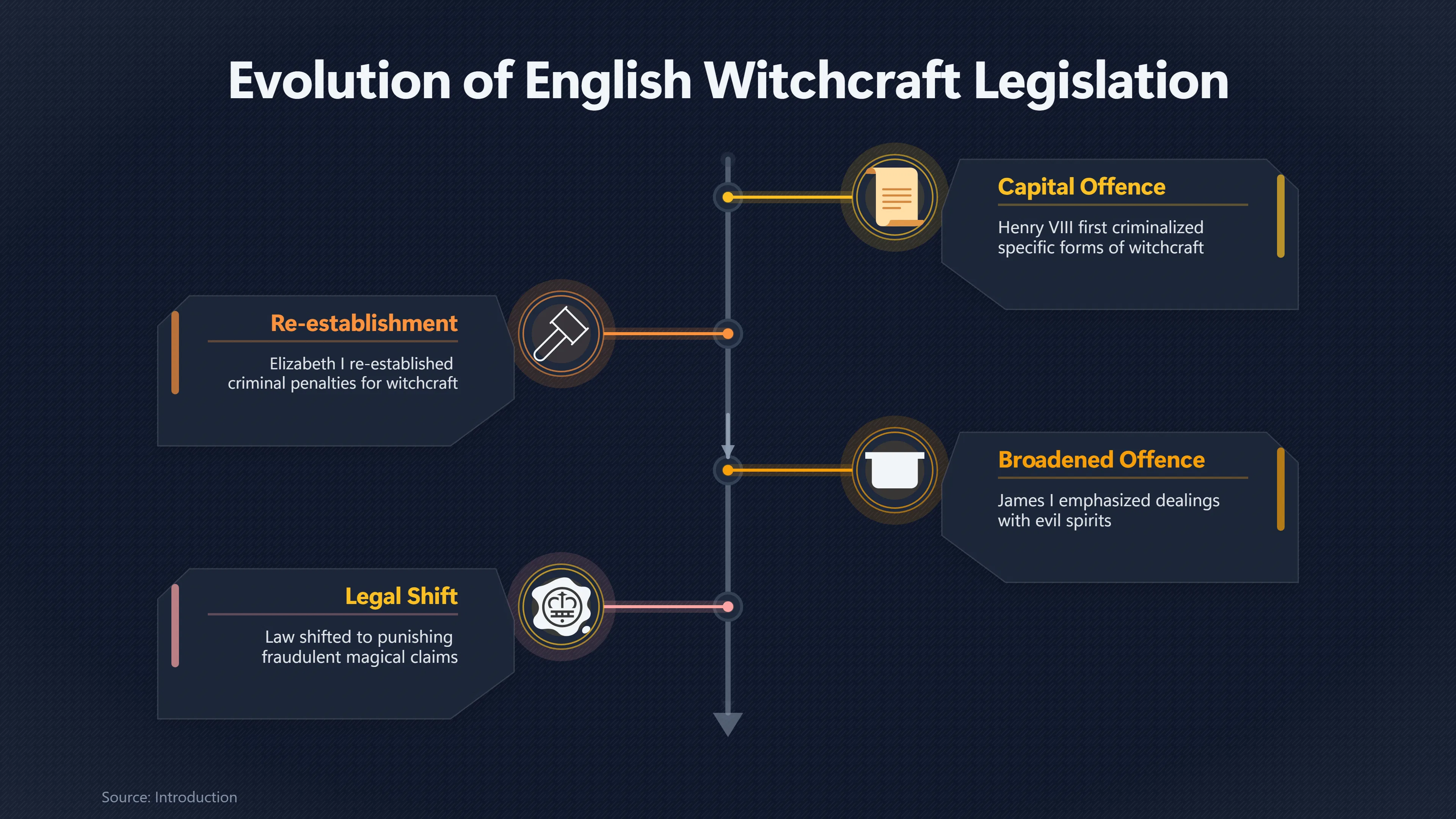
In England, legislation under Henry VIII first made certain forms of witchcraft a capital offence in 1542, although that Act was soon repealed. Elizabeth I’s Witchcraft Act of 1563 re-established criminal penalties, while James I’s 1604 Act broadened the offence by placing greater emphasis on dealings with evil spirits.[Historic England]historicengland.org.ukHistoric England Witchcraft and Witch Trials in England | Historic EnglandHistoric England Witchcraft and Witch Trials in England | Historic England
Once an accusation entered the legal system, several reinforcing mechanisms often appeared:
- Neighbour testimony supplied accounts of curses, arguments and unusual behaviour.
- Confessions, sometimes obtained after prolonged questioning, became powerful evidence.
- Naming accomplices encouraged chains of further accusations.
- Physical examinations searched for supposed “witch’s marks” that were interpreted as signs of a pact with the Devil.
- Religious interpretation framed individual cases as threats to the entire Christian community.
The process was self-reinforcing. Every confession seemed to confirm earlier accusations, while every new suspect appeared to validate belief in a hidden conspiracy.
North Berwick: when politics magnified panic
The North Berwick trials of 1590–1591 demonstrate how royal authority could transform local allegations into a national crisis.
After violent storms affected the voyage of James VI of Scotland and his bride Anne of Denmark, investigators concluded that witches had deliberately summoned the weather to murder the king. Agnes Sampson, John Fian and others were accused of attending meetings with the Devil and plotting against the monarchy. James personally questioned some suspects and later promoted his understanding of witchcraft through his treatise Daemonologie.[The National Archives]nationalarchives.gov.ukThe National Archives WitchcraftThe National ArchivesWitchcraft - The National Archives…
Modern historians regard these trials as illustrating the interaction of several forces:
- royal belief in witchcraft;
- political anxiety surrounding the monarchy;
- judicial acceptance of confessions obtained under severe pressure;
- the rapid spread of conspiracy narratives.
Rather than isolated village accusations, North Berwick became a state security issue. Alleged supernatural attacks were treated almost like treason.

Pendle: neighbourhood conflict enters the courtroom
The Pendle trials of 1612 remain England’s best-known witch prosecutions because unusually detailed records survive.
The defendants came largely from poor families around Pendle Hill in Lancashire. Long-standing feuds, dependence on begging, reputations for folk healing and accusations by children all combined to produce charges that twelve people had murdered ten victims through witchcraft. One accused died in prison, one was acquitted and ten were executed after conviction.[Historic England]historicengland.org.ukHistoric England Witchcraft and Witch Trials in England | Historic EnglandHistoric England Witchcraft and Witch Trials in England | Historic England
The surviving evidence shows how ordinary disputes became criminal cases:
- family rivalries merged with religious suspicion;
- children’s testimony carried considerable weight;
- coincidence was interpreted as proof of magical causation;
- previous rumours became evidence of criminal intent.
The Pendle records also reveal that defendants were not members of an organised occult religion. They were individuals whose lives became entangled in a legal process that accepted supernatural explanations as judicial fact.
Matthew Hopkins and the machinery of escalation
The most intense English outbreak occurred during the political instability of the Civil Wars in the 1640s.
Matthew Hopkins, who styled himself the “Witchfinder General”, travelled through East Anglia offering communities his services in identifying witches. His methods relied less on formal forensic evidence than on sustained interrogation, searching suspects’ bodies for supposed witch’s marks, prolonged sleep deprivation through “watching”, and encouraging accused people to identify additional suspects.[Historic England]historicengland.org.ukHistoric England Witchcraft and Witch Trials in England | Historic EnglandHistoric England Witchcraft and Witch Trials in England | Historic England
Although later legends exaggerated both Hopkins’ authority and the number of executions associated with him, historians agree that wartime disruption, weakened central oversight and heightened religious tensions allowed accusations to spread unusually quickly. His career demonstrates that persecution intensified when local fears were combined with professional witch-finding and institutional support.
England, Scotland, Wales and Ireland compared
Britain did not experience one unified pattern of witch-hunting.
RegionGeneral patternMain characteristicsScotlandHighest intensityFrequent national panics, strong church involvement, commissions for local trials, extensive use of confessions, larger prosecution waves.[witches.is.ed.ac.uk]witches.is.ed.ac.ukOpen source on ed.ac.uk. intensityMore localised prosecutions, jury trials, fewer mass panics, but severe regional outbreaks such as Pendle and Hopkins’ campaigns.[The National Archives]nationalarchives.gov.ukThe National Archives Early Modern witch trialsThe National ArchivesEarly Modern witch trials - The National Archives… few casesBelief in magic remained widespread, but comparatively limited judicial prosecution.[The National Archives]nationalarchives.gov.ukThe National Archives Early Modern witch trialsThe National ArchivesEarly Modern witch trials - The National Archives… major trialsWitchcraft prosecutions remained comparatively rare, partly because of differing legal and political circumstances.[The National Archives]nationalarchives.gov.ukThe National Archives Early Modern witch trialsThe National ArchivesEarly Modern witch trials - The National Archives…
These contrasts show that belief alone did not determine persecution. Legal institutions, religious organisation and political priorities shaped whether accusations ended in execution.

Why the courts gradually lost faith
The decline of British witch trials did not happen because belief in ghosts, magic or curses suddenly disappeared. Instead, confidence in particular kinds of legal evidence steadily weakened.
Several developments mattered:
- Higher courts increasingly questioned unreliable confessions.
- Child witnesses and spectacular supernatural claims attracted greater scepticism.
- Judges became more cautious about accepting accusations based entirely on rumour.
- Failed prosecutions demonstrated the dangers of multiplying allegations.
- Growing emphasis on observable evidence made invisible supernatural crimes harder to prove.
A revealing example came after the Lancashire accusations of 1634, when young witness Edmund Robinson admitted inventing stories after hearing neighbours discuss earlier Pendle cases. Central authorities investigated the proceedings rather than simply accepting the accusations, illustrating a growing willingness to re-examine supposed evidence.[The National Archives]nationalarchives.gov.ukThe National Archives Case of false evidenceThe National ArchivesCase of false evidence - The National ArchivesJuly 15, 1634…
The legal transformation culminated in the Witchcraft Act of 1736. Rather than treating witchcraft itself as a genuine supernatural crime, the new law punished fraudulent claims to magical powers. The state effectively abandoned the legal assumption that witches could exercise demonic powers, even though popular belief in magic continued for generations.[Historic England]historicengland.org.ukHistoric England Witchcraft and Witch Trials in England | Historic EnglandHistoric England Witchcraft and Witch Trials in England | Historic England
What the witch trials reveal about persecution
British witch trials illustrate how persecution becomes possible when institutions validate fears that cannot be objectively tested.
Neighbourhood quarrels, unexplained deaths and social tensions existed in many communities. What made some accusations lethal was the willingness of legal and religious authorities to convert suspicion into official truth. Courts accepted evidence that reinforced prevailing beliefs, while confessions, rumours and previous accusations were treated as mutually supporting proof rather than independent claims requiring verification.
For historians, the witch trials are therefore less a story about irrational crowds than about the interaction between belief, authority and legal procedure. They demonstrate how ordinary people can become victims when courts mistake culturally persuasive narratives for reliable evidence, and how reforms in judicial standards—rather than the disappearance of popular belief—ultimately dismantled the machinery of persecution.
Amazon book picks
Further Reading
Books and field guides related to How Britain Turned Witchcraft Into a Crime. Use these as the next step if you want deeper reading beyond the article.
The witch-hunt in early modern Europe
Explains legal, religious and social causes of witch trials.


WITCHES AND NEIGHBOURS: THE SOCIAL AND CULTURAL CONTEXT OF EU...
Shows how local accusations developed into prosecutions.
Endnotes
1.
Source: witches.is.ed.ac.uk
Link:https://witches.is.ed.ac.uk/trial-procedures/
2.
Source: parliament.uk
Link:https://www.parliament.uk/about/living-heritage/transformingsociety/private-lives/religion/overview/witchcraft/
3.
Source: witches.is.ed.ac.uk
Link:https://witches.is.ed.ac.uk/introduction/
4.
Source: nationalarchives.gov.uk
Title: The National Archives Early Modern witch trials
Link:https://www.nationalarchives.gov.uk/education/resources/early-modern-witch-trials/?show=all
Source snippet
The National ArchivesEarly Modern witch trials - The National Archives...
5.
Source: nationalarchives.gov.uk
Title: The National Archives Witchcraft
Link:https://www.nationalarchives.gov.uk/explore-the-collection/explore-by-time-period/early-modern/witchcraft/
Source snippet
The National ArchivesWitchcraft - The National Archives...
6.
Source: historicengland.org.uk
Title: Historic England Witchcraft and Witch Trials in England | Historic England
Link:https://historicengland.org.uk/whats-new/features/halloween/witchcraft-and-witch-trials-in-england
7.
Source: nrscotland.gov.uk
Title: National Records of Scotland Crime and Criminals
Link:https://www.nrscotland.gov.uk/learning-and-events/research-guides/crime-and-criminals/
Source snippet
National Records of ScotlandCrime and Criminals - National Records of Scotland (NRS)...
8.
Source: nationalarchives.gov.uk
Title: The National Archives Case of false evidence
Link:https://www.nationalarchives.gov.uk/education/resources/early-modern-witch-trials/case-of-false-evidence/
Source snippet
The National ArchivesCase of false evidence - The National ArchivesJuly 15, 1634...
Published: July 15, 1634
9.
Source: media.nationalarchives.gov.uk
Title: nationalarchives.gov.uk Trials: Ordeal and combat | The National Archives
Link:https://media.nationalarchives.gov.uk/index.php/trials-ordeal-and-combat/
Source snippet
nationalarchives.gov.ukTrials: Ordeal and combat | The National ArchivesApril 8, 2021 — TRIALS: ORDEAL AND COMBAT Thursday 8 April 2021 |...
Published: April 8, 2021
10.
Source: nationalarchives.gov.uk
Title: Scottish witches
Link:https://www.nationalarchives.gov.uk/education/resources/early-modern-witch-trials/scottish-witches/
11.
Source: nationalarchives.gov.uk
Title: Classroom resources Archives
Link:https://www.nationalarchives.gov.uk/category/education/classroom-resources/page/97/
Additional References
12.
Source: blog.historicenvironment.scot
Title: The Act resulted in a century and a half of wi
Link:https://blog.historicenvironment.scot/2022/06/the-witchcraft-act-and-its-impact-in-scotland/
Source snippet
Witchcraft Act in Scotland | Historic Environment ScotlandJune 10, 2022 — Written by: Guest Blog Fri 10 June 2022 THE WITCHCRAFT ACT AND...
Published: June 10, 2022
13.
Source: degruyterbrill.com
Title: Scottish Witchcraft Trials
Link:https://www.degruyterbrill.com/document/doi/10.1515/9781805435303/html?lang=en
Source snippet
March 25, 2025 — SCOTTISH WITCHCRAFT TRIALS * Edited by: Julian Goodare and Liv Helene Willumsen Language: English Published/Copyright: 2...
Published: March 25, 2025
14.
Source: youtube.com
Title: Ronald Hutton on the Rise and Fall of Matthew Hopkins, Witchfinder General
Link:https://www.youtube.com/watch?v=7tWNBXl1pVM
Source snippet
The King's Curse: Scotland's Notorious Witch Trials...
15.
Source: youtube.com
Title: King James and the Scottish Witches
Link:https://www.youtube.com/watch?v=5iR14telPN4
Source snippet
The Rise & Fall of The Most Brutal Witch Hunter | Witches: A Century of Murder | Channel 5...
16.
Source: youtube.com
Title: The King’s Curse: Scotland’s Notorious Witch Trials
Link:https://www.youtube.com/watch?v=qCBsLNF0Rg8
Source snippet
The Witch Trial That Shocked Britain | Full Documentary...
17.
Source: history.co.uk
Link:https://www.history.co.uk/articles/a-discovery-of-witches-british-witch-trials-in-the-17th-century
18.
Source: repository.mdx.ac.uk
Link:https://repository.mdx.ac.uk/item/83438
19.
Source: youtube.com
Link:https://www.youtube.com/watch?v=LoMbk8rX48o
20.
Source: wp.lancs.ac.uk
Title: lancs.ac.uk Case notes: S01E06 – The Pendle Witch Trials | en clair
Link:https://wp.lancs.ac.uk/enclair/2019/03/31/case-notes-s01e06-the-pendle-witch-trials/
21.
Source: youtube.com
Title: The Witch Trial That Shocked Britain | Full Documentary
Link:https://www.youtube.com/watch?v=fMpVVbTWt60
Source snippet
King James and the Scottish Witches...
Topic Tree