How Witch Fear Took Hold in Andorra
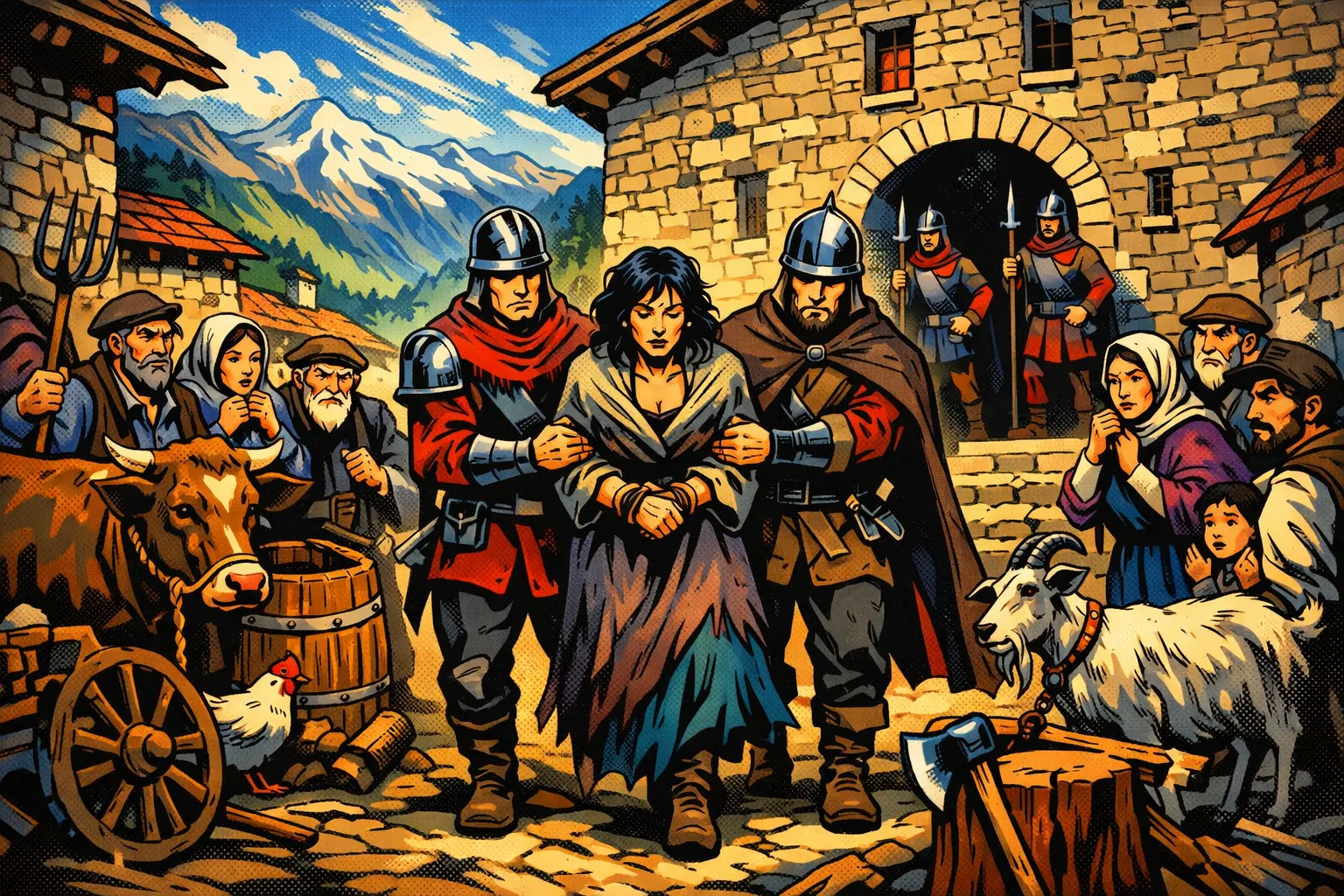
Andorra’s clearest documented episode of contagious fear is not a modern “cult panic” or outbreak of mass psychogenic illness, but a long series of witchcraft prosecutions between the fifteenth and seventeenth centuries. Surviving court records describe roughly 180 women who were denounced or investigated, with at least 15 known executions.
Page outline Jump by section
Introduction
The evidence also requires restraint. Andorra does not appear to have experienced one explosive, Salem-style panic in which accusations suddenly overwhelmed the whole country. Instead, witch beliefs repeatedly entered local disputes over illness, livestock, weather, reputation and neighbourly hostility. Later folklore has made Andorra seem like a timeless “land of witches”, but the historical record shows something more human and more troubling: ordinary suspicions became lethal when communities and courts treated supernatural harm as a real crime.
What happened in the Andorran witch trials?
The earliest identified Andorran proceedings date from 1471, when Margarida Anglada, also known by the names Gillema or Amilla, was accused and witnesses were questioned. Further cases appeared over the following two centuries, with the last known execution for witchcraft dated to 1661. The records survive within the exceptionally extensive archive of the Tribunal de Corts, whose documents cover Andorran judicial life from the Middle Ages into the twentieth century.[Govern d’Andorra]govern.ad2005 el soler ahir i avui de la bruixeria a andorraGovern d’AndorraEL SOLERSeptember 26, 2022 — Cal esperar gairebé dos segles perquè es datin els primers procediments judicials contra bru…
Recent research by historian Pau Castell, building on earlier work by Robert Pastor, has identified about 180 women who were marked out, denounced or prosecuted in connection with witchcraft. Fifteen are presently known to have been executed. The number may change as records are catalogued and compared, but it already demonstrates that persecution was not a marginal curiosity in a country with a very small population.[bondia.ad]bondia.adLes quinze dones que sabem que van ser executades per bruixes ho van ser per ordre del Tribunal de Corts, no de…Read more…
The geographical pattern was uneven. Canillo appears especially prominent: local research has identified around 30 women from the parish who were tried between the mid-fifteenth century and 1621, about six of whom were hanged. Such clustering matters because witch accusations did not spread evenly through abstract religious doctrine. They grew through face-to-face communities in which families knew one another’s quarrels, illnesses, debts and reputations.[Bondia]bondia.adsi ets bruixa de canillo serasSi ets bruixa, de Canillo seràsUna trentena de canillenques van ser jutjades per fetilleres entre el 1450 i el 1621: mitja dotzena…
The accused were usually women. This reflected the wider pattern across Catalonia and the Pyrenees, where women formed the overwhelming majority of those prosecuted. Gender did not operate alone, however. Vulnerability could also arise from poverty, widowhood, age, social isolation, an abrasive reputation or association with healing and household remedies. Witchcraft accusations often attached themselves to people who were already difficult to defend within village society.[ub.edu]revistes.ub.eduOpen source on ub.edu.
What did people believe witches were doing?
Early modern Andorrans did not treat witchcraft merely as eccentric religion. Accusers believed that certain people could cause practical, physical harm through supernatural means. Across the Pyrenean tradition, alleged witches were blamed for sickening children, killing livestock, damaging crops, raising storms and inflicting unexplained pain. Learned demonology could add claims about worshipping the devil or attending secret nocturnal gatherings, but many cases began with a much simpler sequence: a quarrel occurred, misfortune followed, and someone decided the two events were connected.[researchgate.net]researchgate.netResearch Gate(PDF) "Wine vat witches suffocate children". The mythicalResearch Gate(PDF) "Wine vat witches suffocate children". The mythical
This distinction is important. The belief did not necessarily begin as a fully developed story of an organised satanic conspiracy. A neighbour might first be suspected because an animal died after she issued a threat, because a child became ill after receiving food from her, or because repeated misfortunes seemed to follow her presence. Courts and interrogators could then fit these suspicions into a broader demonological framework.
The alleged crime therefore combined two levels of belief:
- Everyday harmful magic: illness, impotence, dead animals, failed harvests or violent weather attributed to a hostile neighbour.
- Religious conspiracy: the suggestion that accused witches had rejected Christianity, served the devil or gathered as an organised group.
The second level made the first more dangerous. A difficult neighbour was no longer simply suspected of a private act of malice; she could be imagined as part of a hidden collective threat to the entire Christian community.
How fear became a court case
Witch panics were rarely produced by belief alone. They depended on institutions willing to translate rumour into evidence. In Andorra, criminal justice was administered locally through officials responsible to the country’s co-lords. The Tribunal de Corts acted as the highest judicial body, hearing serious civil and criminal matters and preserving testimony, interrogations and sentences.[Govern d’Andorra]govern.adbutlleti 2015 06 pdfGovern d’AndorraSUMARI9 Jun 2015 — L'Arxiu del Tribunal de Corts (1347-1959), declarat bé moble d'interès cultural el. 26 de gener del 20…
This local structure helps explain why the Inquisition should not be made the central villain of the Andorran story. Pastor’s study of the records concludes that the 15 known executions were ordered by the Tribunal de Corts, not by inquisitors. This matches a broader pattern in Catalonia and neighbouring Pyrenean territories: secular and seigneurial courts were frequently harsher in witchcraft cases than the Spanish Inquisition, whose senior officials became increasingly doubtful about accusations based on rumour, coercion and impossible confessions.[bondia.ad]bondia.adLes quinze dones que sabem que van ser executades per bruixes ho van ser per ordre del Tribunal de Corts, no de…Read more…
The contrast is striking because the Inquisition is commonly imagined as the automatic driving force behind every Iberian witch hunt. After investigating the major Basque panic of the early seventeenth century, inquisitor Alonso de Salazar Frías reported that he had found no convincing proof that witchcraft had occurred. He attributed many confessions to dreams, suggestion, pressure from relatives and neighbours, and the circulation of stories by preachers and officials. These conclusions influenced stricter rules for handling later allegations.[repositorio.uam.es]repositorio.uam.esOpen source on uam.es.
Andorran local justice offered fewer safeguards against a community accusation becoming self-confirming. Once officials accepted the basic reality of witchcraft, repeated rumours could be treated as corroboration. Interrogation and torture could produce elaborate admissions, which in turn seemed to validate what neighbours already feared. A confession extracted under pressure might name other women, widening the circle of suspicion.
That mechanism resembles a social panic, although historians generally prefer the more precise term witch hunt. “Mass hysteria” can imply that an entire population suddenly became irrational or mentally ill. The records instead reveal an interaction between shared supernatural beliefs, local conflict, legal procedure and unequal power.
Why accusations spread
No single explanation accounts for every Andorran prosecution. The strongest interpretations combine social stress with a belief system that made misfortune appear intentional.
Close village relationships intensified suspicion. Andorran settlements were small, and survival depended on cooperation over pasture, livestock, food, inheritance and communal resources. The same closeness that supported mutual aid also preserved grudges. Insults, refusals of charity and family rivalries could be remembered when illness or economic loss followed.
Misfortune demanded an explanation. Early modern households lived with high levels of infant mortality, epidemic disease, animal sickness and harvest uncertainty. Without modern medical or meteorological knowledge, supernatural aggression offered a culturally credible explanation for an otherwise arbitrary disaster.
Reputation accumulated over time. Witchcraft accusations were often less like spontaneous inventions than files assembled informally over many years. Stories about threats, curses, healing practices and unusual behaviour could circulate until a new misfortune gave officials a reason to act.
Gender shaped who could safely be blamed. Women’s work placed them near childbirth, childcare, food preparation, animal care and informal medicine—the very areas in which unexplained death or illness was most emotionally charged. Patriarchal assumptions also made outspoken, independent or socially marginal women easier to portray as disorderly and dangerous. Research across Catalonia finds that about 90 per cent of those sentenced for witchcraft were women.[catalannews.com]catalannews.comthe first witches in europe were in the pyreneesthe first witches in europe were in the pyrenees
Stories travelled across the mountains. Andorra was politically distinctive but not culturally isolated. People, goods, clergy and rumours moved through the Pyrenees, connecting its valleys with Catalonia, the Alt Urgell, Pallars, Foix and southern France. Historians now regard the Pyrenean region as important to the early development of European witch persecution, rather than as a remote area that merely copied ideas from major cities.[ub.edu]web.ub.educongres bruixes ubcongres bruixes ub
Witch panic, heresy fear and political pressure
The most intense period of Andorran witch prosecution overlapped with wider religious and political tension. The Reformation and Counter-Reformation sharpened fears of heresy across Europe, while the French Wars of Religion placed Andorra near conflict involving Catholics and Protestants. Accusations that people were sheltering French Protestants or trading across suspect boundaries could turn religious identity into a question of political loyalty.[Govern d’Andorra]govern.add’Andorra Untitledd’Andorra Untitled
Andorra’s position between France and the Spanish territories made jurisdiction especially sensitive. Its co-princely system required a continuing balance between the bishop of Urgell and the French co-lord. Efforts by external religious authorities to investigate heresy could therefore be interpreted not only as spiritual protection but also as interference in Andorran rights.
The Tribunal de Corts should be understood within this effort to administer serious crime through recognised Andorran institutions. It did not exist solely to prosecute witches, and reducing it to a disguised witch court would be misleading. Its archive contains a much wider history of violence, theft, morality, property disputes and public order. Yet its witchcraft cases show how an institution designed to uphold justice could become an instrument of persecution when supernatural allegations were accepted as legally provable facts.[govern.ad]govern.adOpen source on govern.ad.
What the records can and cannot prove
Andorra’s court archive is unusually valuable because it preserves accusations in considerable detail. Researchers can reconstruct names, locations, testimony, legal procedures and, in some cases, sentences. The Andorran government has described this material as one of Europe’s richest yet comparatively understudied bodies of witch-trial documentation. Cataloguing and doctoral research have revealed substantially more material than earlier surveys suggested.[Govern d’Andorra]govern.adOpen source on govern.ad.
Court records are not transparent accounts of what truly happened, however. They tell historians what witnesses said, what interrogators asked and what defendants admitted under extreme pressure. They do not establish that anyone actually caused illness by magic, met the devil or travelled to nocturnal assemblies.
Confessions require particular caution. Torture, exhaustion, fear of execution and leading questions could encourage defendants to repeat narratives already supplied by their interrogators. When several people gave similar stories, officials could regard the agreement as proof, even though the similarity might result from shared questioning, local gossip or knowledge of earlier cases.
The surviving total is therefore best expressed carefully:
- About 180 women have so far been identified as denounced, implicated or prosecuted.
- At least 15 executions are documented.
- The precise number of accusations, completed trials and deaths may change as research continues.
- The records prove that authorities and communities acted upon witch beliefs; they do not prove the supernatural allegations themselves.[bondia.ad]bondia.adLes quinze dones que sabem que van ser executades per bruixes ho van ser per ordre del Tribunal de Corts, no de…Read more…
Folklore is not the same as persecution
Andorra has a rich landscape of witch legends. Engolasters Lake, mountain clearings and isolated rocks have been associated with stories of witches dancing, meeting or exercising dangerous powers. The place known as Roc de les Bruixes, the “Rock of the Witches”, carries a supernatural name, although its carvings are archaeological remains whose meanings pre-date early modern witch trials and cannot simply be treated as evidence of an ancient witch religion.[Perennial Pyrenees]perennialpyrenees.comweekly article 1 the witches of engolasters lakeweekly article 1 the witches of engolasters lake
Folklore and prosecution interacted, but they should not be collapsed into one category. A legend may preserve old fears, explain a striking landscape or offer entertainment. A court accusation could lead to imprisonment, torture and death. Later storytellers also reshaped events, merging genuine defendants with fairy tales, supposed gatherings and romantic images of magical women.
The popular description of Andorra as a “land of witches” is therefore both revealing and misleading. It reflects the quantity of surviving material and the persistence of mountain folklore. Yet it risks turning victims into picturesque characters and persecution into tourist atmosphere. The historical women were not members of a documented secret religion. They were people whom neighbours and courts classified as witches.[All PYRENEES]all-andorra.comAll PYRENEESAndorra, the land of the witchesAll PYRENEESAndorra, the land of the witches
Modern cultural projects increasingly try to preserve both parts of the inheritance without confusing them. Exhibitions, public lectures, archival programmes, performances and Andorra’s witchcraft study days have returned attention to the named women, the judicial documents and the social machinery of accusation.[bondia.ad]bondia.adla borrellona i quinze mesla borrellona i quinze mes
Were there later cults or mass-hysteria episodes?
Published evidence for a major Andorran satanic panic, UFO religion, apocalyptic sect, school fainting outbreak or mass psychogenic illness is extremely thin. That absence should not be filled with imported stories from France or Spain simply because Andorra lies between them. No comparably well-documented modern case currently occupies the place in Andorran history that the witch trials do.
Andorra has, of course, experienced religious change. Catholicism has a special historical and constitutional position, while immigration has brought Protestant, Muslim, Jewish and other communities. The constitution protects freedom of belief and prohibits religious discrimination, although minority communities have sometimes faced practical limits involving registration, worship space and burial arrangements. Such disagreements concern religious equality and public policy; they should not automatically be framed as “cult scares”.[ICNL]icnl.orgReligion and the Secular State in AndorraReligion and the Secular State in Andorra
This distinction matters because “cult” is often a hostile label rather than a neutral description. A small or unfamiliar religion is not necessarily coercive, dangerous or deceptive. Responsible analysis asks about demonstrable conduct—fraud, abuse, intimidation, confinement or exploitation—rather than treating unconventional belief as evidence of harm.
The thin modern record also reflects Andorra’s scale. Its small population and limited national press mean that local scares may leave fewer searchable traces than events in larger countries. Conversely, rumours from Spanish, Catalan and French media can circulate inside Andorra without becoming specifically Andorran episodes. National relevance therefore requires more than showing that residents could have encountered a story.
How Andorra remembers the accused
The modern rediscovery of Andorra’s witch trials has shifted attention from supernatural spectacle to historical responsibility. Robert Pastor’s work brought individual proceedings to a wider public, while Pau Castell’s research has expanded the known body of accused women through systematic examination of the Tribunal de Corts archive. The National Archive has supported cataloguing, digitisation, public lectures and exhibitions.[bondia.ad]bondia.adLes quinze dones que sabem que van ser executades per bruixes ho van ser per ordre del Tribunal de Corts, no de…Read more…
This work parallels a wider change across the Pyrenees and Catalonia. Earlier retellings often asked whether witches “really existed” or repeated dramatic confessions at face value. Current scholarship asks why particular women were accused, how testimony was constructed, why local courts imposed severe sentences and how gendered hostility became legitimate punishment.[ub.edu]revistes.ub.eduOpen source on ub.edu.
Commemoration can still create tensions. Presenting accused women as independent healers or rebels may restore dignity, but it can also replace one unsupported story with another. Some may have practised folk healing or divination; others may have done nothing that their communities considered magical. What united them was not a shared identity but the accusation imposed upon them.
The most defensible memorial approach is therefore to use their names where known, explain the charges without endorsing them, and recognise execution for an imaginary crime as institutional violence. Recent Andorran cultural events, including performances dedicated to women hanged for witchcraft, show that this history is moving from specialist archives into public memory.[Bondia]bondia.adtornen les bruixes de robert pastortornen les bruixes de robert pastor
Why the Andorran case matters
Andorra’s witch trials demonstrate how collective fear works without requiring an entire society to lose contact with reality at once. Most participants probably behaved according to assumptions that seemed ordinary in their own world. Neighbours believed harmful magic was possible. Officials believed confessions could reveal it. Courts believed execution could protect the community. Each step made the next accusation easier to accept.
The episode also corrects two common myths. First, witch persecution was not always imposed by a distant church on reluctant villagers. Local secular courts and community witnesses could be its most active agents. Second, mountain folklore does not prove that the accused belonged to an organised pre-Christian or satanic movement. The documented organisation was the machinery of accusation: rumour, testimony, interrogation and punishment.
For modern readers, Andorra’s experience is less a story about supernatural belief than about evidential failure. Coincidence became causation, reputation became proof, forced confession became confirmation, and social vulnerability was mistaken for dangerous power. That pattern connects the witch trials to later moral panics even where the feared object changes—from witches to supposed satanists, secret sects, contagious illnesses or hidden conspiracies.
The lasting lesson is not that early Andorrans were uniquely credulous. It is that familiar institutions can produce extraordinary injustice when a society agrees that an invisible enemy exists and lowers its standards of evidence accordingly.
Amazon book picks
Further Reading
Books and field guides related to How Witch Fear Took Hold in Andorra. Use these as the next step if you want deeper reading beyond the article.
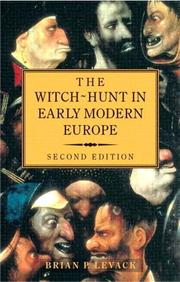
The witch-hunt in early modern Europe
Explains legal and social patterns behind witch persecutions.

Endnotes
1.
Source: bondia.ad
Link:https://www.bondia.ad/cultura/robert-pastor-historiador-les-quinze-dones-executades-per-bruixeria-les-va-condemnar-corts
Source snippet
Les quinze dones que sabem que van ser executades per bruixes ho van ser per ordre del Tribunal de Corts, no de...Read more...
2.
Source: govern.ad
Link:https://www.govern.ad/ca/w/s-amplia-el-fons-documental-sobre-la-cacera-de-bruixes-a-l-arxiu-nacional-amb-una-tesi-doctoral-de-l-historiador-pau-castell-1
3.
Source: govern.ad
Title: 2024 038 arxivand compressed pdf
Link:https://www.govern.ad/documents/d/guest/2024-038_arxivand_compressed-pdf?download=true
Source snippet
Govern d’Andorra2024 / 0038La cacera de bruixes a Andorra … arxius estrangers Col·laboracions Climent Miró, Tribunal de Corts (sobretot d...
4.
Source: govern.ad
Title: 2005 el soler ahir i avui de la bruixeria a andorra
Link:https://www.govern.ad/documents/d/guest/2005_el_soler_ahir_i_avui_de_la_bruixeria_a_andorra
Source snippet
Govern d’AndorraEL SOLERSeptember 26, 2022 — Cal esperar gairebé dos segles perquè es datin els primers procediments judicials contra bru...
Published: September 26, 2022
5.
Source: govern.ad
Title: butlleti 2015 06 pdf
Link:https://www.govern.ad/documents/d/guest/butlleti_2015_06-pdf?download=true
Source snippet
Govern d’AndorraSUMARI9 Jun 2015 — L'Arxiu del Tribunal de Corts (1347-1959), declarat bé moble d'interès cultural el. 26 de gener del 20...
6.
Source: govern.ad
Title: d’Andorra“La peça del mes”
Link:https://www.govern.ad/ca/tematiques/cultura-i-esports/arxiu-nacional/publicacions/la-peca-del-mes/2018
Source snippet
Govern d’Andorra“La peça del mes” - Govern d'AndorraEl Tribunal de Corts era l'òrgan suprem i bàsic de la justícia andorrana i tenia l'ob...
7.
Source: bondia.ad
Title: si ets bruixa de canillo seras
Link:https://www.bondia.ad/cultura/si-ets-bruixa-de-canillo-seras
Source snippet
Si ets bruixa, de Canillo seràsUna trentena de canillenques van ser jutjades per fetilleres entre el 1450 i el 1621: mitja dotzena...
8.
Source: researchgate.net
Title: Research Gate(PDF) “Wine vat witches suffocate children”. The mythical
Link:https://www.researchgate.net/publication/259713664_Wine_vat_witches_suffocate_children_The_mythical_complex_of_the_Iberian_witch
9.
Source: revistes.uab.cat
Title: 266 pdf ca
Link:https://revistes.uab.cat/manuscrits/article/download/v43-xam-mar/266-pdf-ca/2143
10.
Source: repositorio.uam.es
Link:https://repositorio.uam.es/server/api/core/bitstreams/224113d6-177b-498b-9884-02a522feaae6/content
11.
Source: revistes.uab.cat
Title: v43 xam mar
Link:https://revistes.uab.cat/manuscrits/article/view/v43-xam-mar
12.
Source: govern.ad
Title: d’Andorra Untitled
Link:https://www.govern.ad/documents/d/guest/ex-libris_20-2017-pdf
13.
Source: govern.ad
Link:https://www.govern.ad/ca/l/4523495
14.
Source: publicacions.iec.cat
Link:https://publicacions.iec.cat/repository/pdf/00000119/00000071.pdf
15.
Source: all-andorra.com
Title: All PYRENEESAndorra, the land of the witches
Link:https://all-andorra.com/andorra-the-land-of-the-witche/
16.
Source: bondia.ad
Title: tornen les bruixes de robert pastor
Link:https://www.bondia.ad/cultura/tornen-les-bruixes-de-robert-pastor
17.
Source: bondia.ad
Title: la borrellona i quinze mes
Link:https://www.bondia.ad/cultura/la-borrellona-i-quinze-mes
18.
Source: govern.ad
Title: arxivand 36 compressed pdf
Link:https://www.govern.ad/documents/d/guest/arxivand_36_compressed-pdf?download=true
19.
Source: icnl.org
Title: Religion and the Secular State in Andorra
Link:https://www.icnl.org/wp-content/uploads/Andorra2.pdf
20.
Source: researchgate.net
Title: 374170335 Hyperconvergence Religion Politics and UFOs
Link:https://www.researchgate.net/publication/374170335_Hyperconvergence_Religion_Politics_and_UFOs
21.
Source: researchgate.net
Link:https://www.researchgate.net/publication/313718111_Sects_Cults_and_New_Religions_An_Introduction
22.
Source: researchgate.net
Link:https://www.researchgate.net/publication/376738471_La_repressio_de_la_bruixeria_als_Pirineus_centrals_L%27Alt_Urgell
23.
Source: govern.ad
Link:https://www.govern.ad/documents/d/guest/2017_la_sala_de_mes_amunt_un_paracientific_del_segle_xvii_la_magia_natural_del_jesuita_hernando_castrillo
24.
Source: govern.ad
Link:https://www.govern.ad/documents/d/guest/parlardandorra?download=true
25.
Source: govern.ad
Title: ex libris2006
Link:https://www.govern.ad/documents/d/guest/ex-libris2006
26.
Source: bondia.ad
Title: sitemap 2023 04.xml
Link:https://www.bondia.ad/sitemaps/news/sitemap-2023-04.xml
27.
Source: folklore.ee
Link:https://www.folklore.ee/FOAFtale/ftn17.pdf
28.
Source: folklore.ee
Link:https://www.folklore.ee/FOAFtale/ftn38.htm
29.
Source: revistes.ub.edu
Link:https://revistes.ub.edu/index.php/IHE/article/download/28757/31723/0
30.
Source: catalannews.com
Title: the witch hunt in catalonia one of the earliest and deadliest in europe
Link:https://www.catalannews.com/society-science/item/the-witch-hunt-in-catalonia-one-of-the-earliest-and-deadliest-in-europe
31.
Source: patrimoni.gencat.cat
Link:https://patrimoni.gencat.cat/sites/default/files/hd-images-zip/descarregues/llibreBRUIXES_eng_final.pdf
32.
Source: dialnet.unirioja.es
Link:https://dialnet.unirioja.es/descarga/articulo/5746228.pdf
33.
Source: catalannews.com
Title: the first witches in europe were in the pyrenees
Link:https://www.catalannews.com/culture/item/the-first-witches-in-europe-were-in-the-pyrenees
34.
Source: web.ub.edu
Title: congres bruixes ub
Link:https://web.ub.edu/en/web/actualitat/w/congres-bruixes-ub
35.
Source: perennialpyrenees.com
Title: weekly article 1 the witches of engolasters lake
Link:https://perennialpyrenees.com/2017/04/24/weekly-article-1-the-witches-of-engolasters-lake/
36.
Source: revistes.ub.edu
Link:https://revistes.ub.edu/index.php/pedralbes/article/view/33926?articlesBySimilarityPage=66
37.
Source: revistes.ub.edu
Link:https://revistes.ub.edu/index.php/AFEL/article/viewFile/27371/28349
38.
Source: revistes.ub.edu
Link:https://revistes.ub.edu/index.php/IHE/article/download/3601/3858
39.
Source: state.gov
Link:https://www.state.gov/reports/2024-country-reports-on-human-rights-practices/andorra
40.
Source: state.gov
Link:https://www.state.gov/countries-areas-archive/andorra
41.
Source: 2021-2025.state.gov
Link:https://2021-2025.state.gov/countries-areas/andorra/
42.
Source: 2021-2025.state.gov
Link:https://2021-2025.state.gov/reports/2023-report-on-international-religious-freedom/spain/
43.
Source: sorapscourse.unive.it
Link:https://sorapscourse.unive.it/files/2019/05/Eng-proof-IO2Unit4_-New-Age-cults-and-New-Religious-Movements-reading.pdf
44.
Source: catalannews.com
Title: what to expect from the witchcraft exhibition in the pyrenees
Link:https://www.catalannews.com/culture/item/what-to-expect-from-the-witchcraft-exhibition-in-the-pyrenees
45.
Source: library.essex.ac.uk
Link:https://library.essex.ac.uk/history/witchcraft
46.
Source: hope.ac.uk
Link:https://www.hope.ac.uk/media/studywithus/schools/historyandpolitics/documents/Witchcraft.pdf
Additional References
47.
Source: youtube.com
Title: 7,000 Accused: Europe’s Largest Witch Trials
Link:https://www.youtube.com/watch?v=44PZ0Wk3ne0
Source snippet
Beyond Salem: The History and Legacy of the European Witch Trials...
48.
Source: academia.edu
Link:https://www.academia.edu/107388360/Hyperconvergence_Religion_Politics_and_UFOs
49.
Source: Wikipedia
Link:https://en.wikipedia.org/wiki/Andorra
50.
Source: david-zbiral.cz
Link:https://www.david-zbiral.cz/bgher.htm
51.
Source: lausanne.org
Link:https://lausanne.org/occasional-paper/lop-11
52.
Source: dafilmfestival.com
Link:https://dafilmfestival.com/en/director/david-arratibel/
53.
Source: academia.edu
Link:https://www.academia.edu/44340949/Feminine_magical_medicinal_practices_in_Catalan_trials_for_sorcery_and_witchcraft_changing_perceptions_between_Late_Middle_Ages_and_Early_Modern_Times
54.
Source: facebook.com
Link:https://www.facebook.com/groups/unsolvedstoriesandtruecrime/posts/529974169446042/
55.
Source: religionlink.com
Link:https://religionlink.com/reporting-on/reporting-on-new-religious-movements-nrms/
56.
Source: smithsonianmag.com
Link:https://www.smithsonianmag.com/history/spain-centuries-long-witch-hant-killed-700-women-180981018/
Topic Tree
Follow this branch
Related pages 192
- Antigua and Barbuda
- Argentina Belief Scares
- Azerbaijan Belief
- Bahrain Beliefs
- North Korea
- +187 more in sidebar