Within Qatar Panics
How Fake News Helped Ignite the Gulf Crisis
Fabricated state news, bot amplification and supernatural mockery turned existing regional tensions into a fast-moving information crisis.
On this page
- The fabricated statements that triggered outrage
- Bots, coordinated accounts and propaganda
- Why supernatural ridicule became politically useful
Page outline Jump by section
Introduction
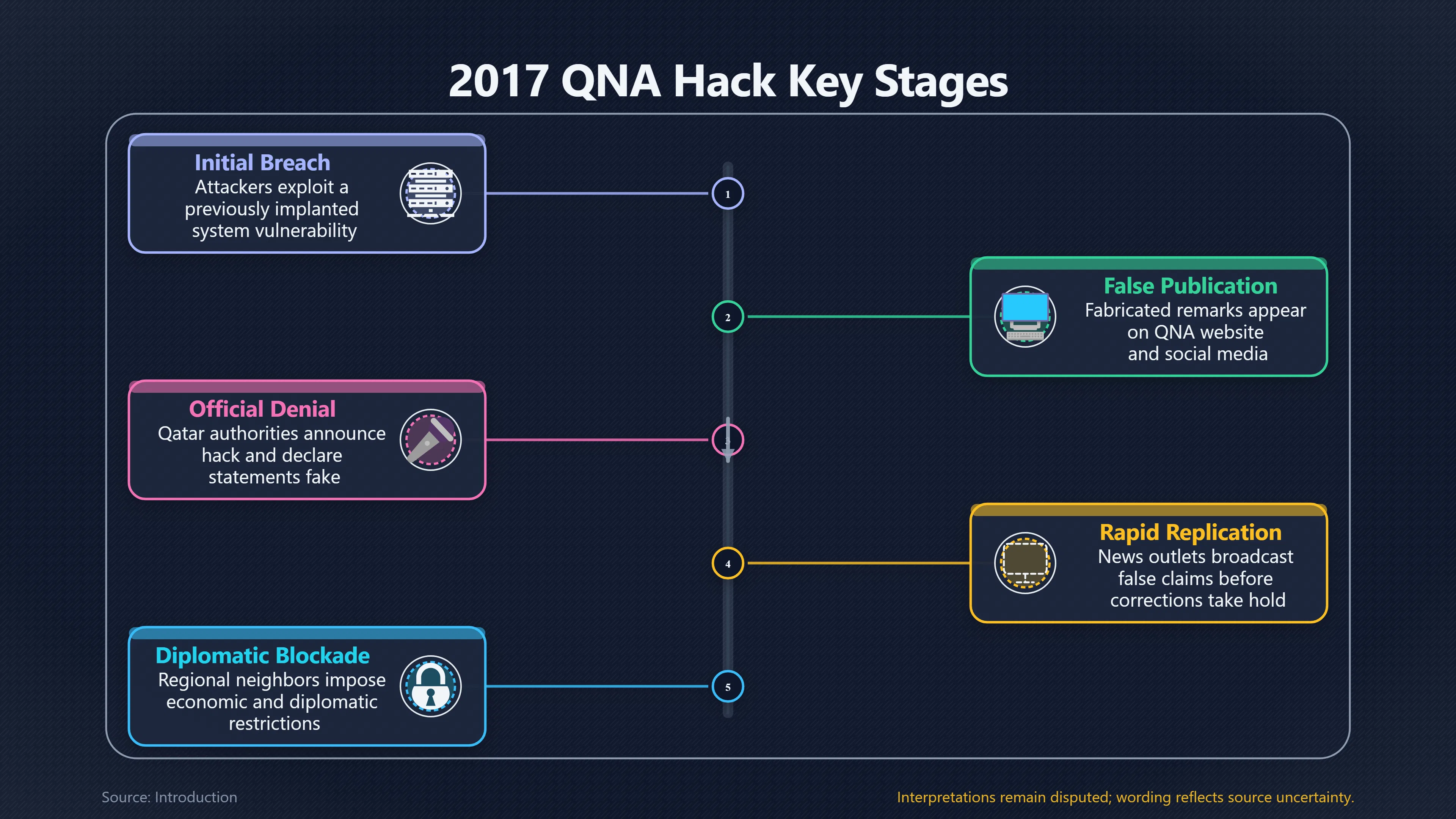
The 2017 Gulf crisis was not only a diplomatic confrontation but also a striking example of how fabricated information, coordinated online activity and emotionally charged narratives can rapidly intensify an international dispute. The immediate trigger was the publication of false statements attributed to Qatar’s emir on the website and social media accounts of the Qatar News Agency (QNA). Although Qatari officials announced within minutes that the material was fake and the result of a cyberattack, the statements spread rapidly across television, news websites and social media, helping to create a climate of outrage that preceded the diplomatic and economic blockade imposed by Saudi Arabia, the United Arab Emirates (UAE), Bahrain and Egypt on 5 June 2017.[gco.gov.qa]gco.gov.qaernment Communications OfficeGCO Statement Regarding Hacking of QNA and False Statement | Government Communications OfficeMay 24, 2017…
Within the history of collective fears and information panics in Qatar, this episode stands out because the central “belief” was not supernatural or medical but political. False information was presented as authentic, amplified before corrections could gain traction, and woven into wider narratives about loyalty, terrorism and regional identity. The result illustrates how modern disinformation can produce social consequences similar to older rumour panics, even when the claims themselves are quickly disputed.
The fabricated statements that triggered outrage
In the early hours of 24 May 2017, Qatar News Agency published what appeared to be remarks by Emir Sheikh Tamim bin Hamad Al Thani praising Iran, expressing sympathy for groups including Hamas and Hezbollah, and criticising neighbouring Gulf governments. The quotations immediately contradicted Qatar’s public diplomatic positions and were widely reported across the region.[gco.gov.qa]gco.gov.qaernment Communications OfficeGCO Statement Regarding Hacking of QNA and False Statement | Government Communications OfficeMay 24, 2017…
Qatari authorities responded almost immediately, announcing that QNA had been hacked and that the published remarks were fabricated. The Government Communications Office declared that the statements “had no basis whatsoever”, while the Ministry of Interior opened a criminal investigation supported by the FBI and the UK’s National Crime Agency. Investigators later reported that attackers had exploited a previously implanted vulnerability in the agency’s systems before releasing the false material.[Government Communications Office]gco.gov.qaernment Communications OfficeGCO Statement Regarding Hacking of QNA and False Statement | Government Communications OfficeMay 24, 2017…
Despite these denials, the fabricated quotations continued to circulate. In many cases, television broadcasters, newspapers and social media accounts repeated the original claims far more widely than the subsequent corrections. This imbalance is common in disinformation campaigns: emotionally provocative falsehoods often travel faster than later factual clarifications.
Why the false story spread so quickly
The effectiveness of the operation depended on more than the cyberattack itself. The false statements appeared during a period of already strained relations within the Gulf Cooperation Council, where disagreements over political Islam, relations with Iran and regional influence had been growing for years.
Because the fabricated remarks seemed to confirm existing suspicions held by Qatar’s rivals, many audiences found them immediately plausible. Psychologists describe this as confirmation bias: people are more likely to accept information that appears to reinforce beliefs they already hold. Disinformation campaigns frequently exploit this tendency by creating material that feels believable within an existing political narrative rather than inventing entirely new stories.
Timing also mattered. News organisations increasingly relied on rapid online publication and social media distribution. Once the fabricated remarks appeared, they could be copied and rebroadcast before careful verification had taken place, allowing the narrative to gain momentum while uncertainty remained.
Bots, coordinated accounts and propaganda
Researchers studying the online information environment surrounding the Gulf crisis found evidence that automated accounts and coordinated messaging amplified political narratives before and after the QNA hack.
Analysis published by researchers and journalists showed that networks of Twitter accounts repeatedly promoted similar themes, hashtags and talking points concerning Qatar. Some displayed behavioural patterns associated with automated or semi-automated “bot” accounts, including unusually high posting frequencies, synchronised activity and repeated dissemination of identical messages. The broader Oxford Internet Institute’s Computational Propaganda project has documented how such automated political communication is commonly deployed during periods of international crisis to magnify selected narratives.[oii.ox.ac.uk]oii.ox.ac.ukOI I | Computational PropagandaOI I | Computational Propaganda
According to investigations by Al Jazeera, many of the themes later attributed to the fabricated QNA statements had already been circulating among coordinated online accounts. Once the false quotations appeared, they appeared to validate these existing messages, allowing them to be repeated with far greater apparent credibility before television broadcasters amplified them further.[Al Jazeera]aljazeera.comOpen source on aljazeera.com.
This illustrates an important feature of modern disinformation campaigns. Rather than creating an entirely new belief from nothing, coordinated online activity often prepares audiences by repeatedly introducing narratives that can later be reinforced by a dramatic triggering event.
Why supernatural ridicule became politically useful
Although the crisis centred on geopolitics, some online propaganda adopted language that echoed much older forms of rumour and ridicule. Social media users produced memes, jokes and accusations suggesting that Qatar’s political influence resulted from sinister hidden forces, magical manipulation or supernatural intervention rather than ordinary diplomacy.
These claims were generally not intended as literal descriptions. Instead, they functioned as symbolic ridicule. Throughout the Middle East, references to sorcery, hidden powers or evil influence have long served as cultural shorthand for secretive or illegitimate behaviour. During the Gulf crisis, such imagery became another rhetorical device for portraying political opponents as unnatural, deceptive or morally corrupt.
From the perspective of collective belief, this matters because emotionally memorable ridicule often spreads more efficiently than factual argument. Humour, mockery and symbolic language encourage sharing even among people who do not literally believe the underlying claim. In this way, supernatural imagery became part of the broader information battle despite contributing little factual content.
Competing investigations and disputed responsibility
Responsibility for the original cyberattack became a subject of international dispute.
Qatar consistently maintained that the QNA website had been hacked as part of a coordinated operation intended to justify diplomatic action against the country. The Ministry of Interior reported technical evidence of a sophisticated intrusion, while the Government Communications Office argued that the fabricated statements formed one element of a broader smear campaign.[MOI Qatar - Ministry of interior Qatar]portal.moi.gov.qaMOI QatarMinistry of interior QatarNews Article…
Reporting by The Washington Post, citing anonymous US intelligence officials, stated that American intelligence agencies believed senior UAE officials had discussed plans connected with the hacking operation before it occurred. The UAE rejected these allegations. Because much of the intelligence evidence remains classified, historians and journalists generally distinguish between the established fact of the QNA compromise and the continuing dispute over ultimate responsibility.[The Washington Post]washingtonpost.comThe Washington PostUAE orchestrated hacking of Qatari government sites, sparking regional upheaval, according to U.S. intelligence offici…
The distinction is important. The existence of fabricated quotations is well documented. Attribution of responsibility remains politically contested, even though multiple official investigations accepted that the published statements were not genuine.
What this episode reveals about modern information panics
Unlike a traditional moral panic driven by spontaneous rumours, the Gulf crisis demonstrates how deliberate disinformation can create conditions in which collective emotional reactions spread with remarkable speed.
Several interacting mechanisms reinforced one another:
- A credible platform gave false information initial authority because it appeared on an official state news outlet.
- Rapid media replication ensured the claims reached audiences before verification.
- Coordinated online amplification increased visibility through repeated messaging and automated activity.
- Existing political tensions made audiences more willing to accept dramatic claims that matched prior expectations.
- Emotional framing encouraged outrage while reducing attention to later corrections.
These mechanisms resemble earlier episodes of collective fear in one crucial respect: once people believe that a threat has been confirmed by apparently trustworthy evidence, correction becomes much harder than the original spread.

Why the Gulf disinformation campaign remains significant
The 2017 QNA hack has become an important case study in cyber-enabled political disinformation because it demonstrates how a relatively small piece of fabricated content can contribute to major diplomatic consequences when combined with existing regional tensions and coordinated media amplification.
For Qatar, the episode represents one of the country’s clearest examples of an information-driven collective scare. The panic did not revolve around witchcraft, disease or supernatural danger, but around belief in false political statements presented as authentic. It also illustrates a broader shift in the history of mass belief: in highly connected digital societies, cyberattacks, automated social media networks and coordinated propaganda can spread fear and certainty as effectively as rumours passed by word of mouth, while making later correction far more difficult.
Amazon book picks
Further Reading
Books and field guides related to How Fake News Helped Ignite the Gulf Crisis. Use these as the next step if you want deeper reading beyond the article.
LikeWar: The Weaponization of Social Media
Strong fit for online propaganda and coordinated information operations.


Endnotes
1.
Source: portal.moi.gov.qa
Title: MOI Qatar
Link:https://portal.moi.gov.qa/wps/portal/MOIInternet/mediacenter/moinews/newsdetails/%21ut/p/z0/fcxBDoIwEEDR07iczBQowrJxgehOEsVuzBSKqUIRacTjywlcvuTno8YateePu3Nwo-d-9VWnt1JlyV6QOBZRtiVVSpVXp11MZ8IKD6j_J-vDPaZJK9TN6IP9BqyXZuidAbfy7W0A6zc0Mwyj83aZNyTjxsRdnoMQEUGSCAZjog5MJtqUmFspGV_P4vIDsEgVgw%21%21/
Source snippet
Ministry of interior QatarNews Article...
2.
Source: oii.ox.ac.uk
Title: OI I | Computational Propaganda
Link:https://www.oii.ox.ac.uk/research/projects/computational-propaganda/
3.
Source: ox.ac.uk
Title: Social media manipulation by political actors an industrial scale problem
Link:https://www.ox.ac.uk/news/2021-01-13-social-media-manipulation-political-actors-industrial-scale-problem-oxford-report
Source snippet
ford report | Oxford UniversityJanuary 13, 2021 — 13 January 2021 SOCIAL MEDIA MANIPULATION BY POLITICAL ACTORS AN INDUSTRIAL SCALE PRO...
Published: January 13, 2021
4.
Source: oii.ox.ac.uk
Link:https://www.oii.ox.ac.uk/social-media-manipulation-by-political-actors-now-an-industrial-scale-problem-prevalent-in-over-80-countries-annual-oxford-report/
Source snippet
Social media manipulation by political actors now an industrial scale problem prevalent in over 80 countries – annual Oxford reportJanu...
5.
Source: oii.ox.ac.uk
Link:https://www.oii.ox.ac.uk/use-of-social-media-to-manipulate-public-opinion-now-a-global-problem-says-new-report/
6.
Source: oii.ox.ac.uk
Link:https://www.oii.ox.ac.uk/oii_tag/disinformation/
7.
Source: oii.ox.ac.uk
Link:https://www.oii.ox.ac.uk/news-events/oii_tag/disinformation/?coverage=&page=158
8.
Source: gco.gov.qa
Link:https://www.gco.gov.qa/en/media-centre/press-releases/government-communications-office-statement-regarding-hacking-qatar-news-agency-false-statement/
Source snippet
ernment Communications OfficeGCO Statement Regarding Hacking of QNA and False Statement | Government Communications OfficeMay 24, 2017...
Published: May 24, 2017
9.
Source: washingtonpost.com
Link:https://www.washingtonpost.com/world/national-security/uae-hacked-qatari-government-sites-sparking-regional-upheaval-according-to-us-intelligence-officials/2017/07/16/00c46e54-698f-11e7-8eb5-cbccc2e7bfbf_story.html?tid=a_inl
Source snippet
The Washington PostUAE orchestrated hacking of Qatari government sites, sparking regional upheaval, according to U.S. intelligence offici...
10.
Source: aljazeera.com
Link:https://www.aljazeera.com/news/2018/6/4/twitter-bots-fake-news-and-propaganda-in-the-qatar-crisis
11.
Source: gco.gov.qa
Title: ernment Communications Office Qatar marks one year since QNA hack
Link:https://www.gco.gov.qa/en/media-centre/top-news/qatar-marks-one-year-since-qna-hack/
Source snippet
ernment Communications OfficeQatar marks one year since QNA hack...
12.
Source: aljazeera.com
Title: The fake Twitter accounts influencing the Gulf crisis | GCC News | Al Jazeera
Link:https://www.aljazeera.com/news/2019/7/21/the-fake-twitter-accounts-influencing-the-gulf-crisis
13.
Source: washingtonpost.com
Title: A plague of Twitter bots is roiling the Middle East
Link:https://www.washingtonpost.com/politics/a-plague-of-twitter-bots-is-roiling-the-middle-east/2018/06/05/b45d7aed-7763-4369-9743-eb24dc576b54_story.html
14.
Source: aljazeera.com
Title: Qatar state news agency’s hacking linked to Riyadh | News | Al Jazeera
Link:https://www.aljazeera.com/news/2018/6/4/qatar-state-news-agencys-hacking-linked-to-riyadh
15.
Source: aljazeera.com
Title: Qatar says cyberattack ‘originated from the UAE’ | GCC News | Al Jazeera
Link:https://www.aljazeera.com/news/2017/7/20/qatar-says-cyberattack-originated-from-the-uae
16.
Source: gco.gov.qa
Link:https://www.gco.gov.qa/en/media-centre/press-releases/statement-gco-director-response-nbc-news/
17.
Source: gco.gov.qa
Link:https://www.gco.gov.qa/en/media-centre/press-releases/unfortunate-shameful-act-cyber-terrorism-attributed-fellow-gcc-member-qatar-official/
18.
Source: mofa.gov.qa
Title: Ministry of the Interior Statement on Piracy Crime on Qatar News Agency Website
Link:https://mofa.gov.qa/en/qatar/latest-articles/latest-news/details/2017/06/07/ministry-of-the-interior-statement-on-piracy-crime-on-qatar-news-agency-website
19.
Source: washingtonpost.com
Title: Hacking, bots and information wars in the Qatar spat
Link:https://www.washingtonpost.com/news/monkey-cage/wp/2017/06/07/hacking-bots-and-information-wars-in-the-qatar-spat/
20.
Source: aljazeera.com
Title: Qatar to ‘prosecute perpetrators’ of QNA hacking | News | Al Jazeera
Link:https://www.aljazeera.com/news/2017/5/24/qatar-to-prosecute-perpetrators-of-qna-hacking
Additional References
21.
Source: reutersinstitute.politics.ox.ac.uk
Title: Four experts discuss how AI is reshaping war
Link:https://reutersinstitute.politics.ox.ac.uk/news/trolling-memes-and-deepfakes-how-ai-thickening-fog-war
Source snippet
ox.ac.ukTrolling, memes and deepfakes: How AI is thickening the fog of war | Reuters Institute for the Study of JournalismMay 4, 2026 — *...
Published: May 4, 2026
22.
Source: youtube.com
Title: David Hearst discusses latest cyberattack targets Qatar’s official media
Link:https://www.youtube.com/watch?v=rBDck82H6Q8
Source snippet
Gargash: Qatar hacking story completely untrue - BBC News...
23.
Source: youtube.com
Title: Qatar says cyberattack ‘originated from the UAE’
Link:https://www.youtube.com/watch?v=KK_9R5X1qhQ
Source snippet
David Hearst discusses latest cyberattack targets Qatar's official media...
24.
Source: youtube.com
Title: Gargash: Qatar hacking story completely untrue
Link:https://www.youtube.com/watch?v=liSxT0Glwco
Source snippet
Qatar cyberattack puts fake news in focus...
25.
Source: theguardian.com
Link:https://www.theguardian.com/world/2017/jul/17/uae-denies-arranging-hack-of-qatar-news-agency
26.
Source: ijoc.org
Link:https://ijoc.org/index.php/ijoc/article/view/8994
27.
Source: independent.co.uk
Link:https://www.independent.co.uk/voices/qatar-uae-saudi-arabia-fake-news-middle-easy-worst-in-world-a7846571.html
28.
Source: yahoo.com
Link:https://www.yahoo.com/news/uae-arranged-hacking-qatar-govt-sites-sparking-diplomatic-001016271.html
29.
Source: youtube.com
Title: Fake news and the Gulf crisis | Inside Story
Link:https://www.youtube.com/watch?v=-zCGdPbD4_4
Source snippet
Qatar says cyberattack 'originated from the UAE'...
30.
Source: business-standard.com
Title: UA E hacked Qatar govt sites to post false quotes linked to the emir: Report
Link:https://www.business-standard.com/article/international/uae-hacked-qatar-govt-sites-to-post-false-quotes-linked-to-the-emir-report-117071700286_1.html
Topic Tree