Within Congo
Was Kitawala a Church or a Rebellion?
Colonial officials treated diverse Kitawala communities as one secret rebellion, turning suspicion and repression into apparent proof of conspiracy.
On this page
- How Watch Tower teachings changed in Congo
- Why chiefs and colonial officials saw subversion
- How repression created secrecy and suspicion
Page outline Jump by section
Introduction
Kitawala is often described as a single anti-colonial sect, but historians increasingly argue that this picture reflects colonial fears more than Congolese religious reality. In the Belgian Congo, officials, missionaries and police frequently treated a wide variety of locally organised Kitawala communities as parts of one hidden conspiracy directed against the colonial state. That assumption shaped decades of surveillance, arrests and repression. Ironically, the resulting secrecy often seemed to confirm official suspicions, creating a cycle in which repression itself became evidence of an imagined underground network. Modern research shows that Kitawala was better understood as a loose family of religious and healing movements that shared some influences from the Watch Tower tradition but developed different beliefs, leaders and priorities across the Congo.[ohio.edu]ohioopen.library.ohio.eduUnruly Ideas: A History of Kitawala in Congo" by Nicole EggersUnruly Ideas: A History of Kitawala in Congo" by Nicole Eggers

Was Kitawala a Church or a Rebellion?
The simplest answer is that it was neither in any consistent sense.
Kitawala emerged from ideas associated with the African Watch Tower movement that spread through Central Africa during the 1920s. Yet by the time those teachings reached different parts of the Belgian Congo they had already been reshaped by African evangelists and local communities. Different congregations interpreted biblical prophecy, healing, authority and social justice in their own ways. Many had little contact with one another and did not recognise a single leader or governing institution.[Taylor & Francis Online]tandfonline.comTaylor & Francis OnlineFull article: Authority that is customary: Kitawala, customary chiefs, and the plurality of power in Congolese his…
Colonial authorities rarely accepted this diversity. Belgian officials generally preferred to classify Kitawala as one coordinated movement with common aims, common leadership and hidden methods of communication. Because some Kitawala followers rejected forced labour, refused to salute colonial symbols, criticised government-appointed chiefs or questioned taxation, administrators increasingly interpreted all Kitawala activity as evidence of political conspiracy rather than religious dissent.[Taylor & Francis Online]tandfonline.comTaylor & Francis OnlineFull article: Authority that is customary: Kitawala, customary chiefs, and the plurality of power in Congolese his…
Modern historians argue that this flattened a much more complicated reality. While some Kitawala groups became involved in resistance or local uprisings, others concentrated on healing, moral discipline, protection against witchcraft accusations, or creating communities independent of colonial control. Their concerns often centred on the proper use of power within villages as much as opposition to European rule.[ohio.edu]ohioopen.library.ohio.eduUnruly Ideas: A History of Kitawala in Congo" by Nicole EggersUnruly Ideas: A History of Kitawala in Congo" by Nicole Eggers
How Watch Tower teachings changed in Congo
Kitawala did not simply reproduce the teachings of the American Watch Tower movement.
As ideas travelled through Nyasaland, Northern Rhodesia, Katanga and other parts of Central Africa, they were translated into local political and spiritual languages. Biblical stories about God’s kingdom, the end of earthly empires and divine justice acquired new meanings in societies experiencing forced labour, racial hierarchy and colonial violence.[Cambridge University Press & Assessment]cambridge.orgCambridge University Press & AssessmentFREED SLAVES, MISSIONARIES, AND RESPECTABILITY: THE EXPANSION OF THE CHRISTIAN FRONTIER FROM ANGOL…
Congolese preachers adapted these ideas rather than merely copying them. Local prophets introduced teachings about healing, moral purity, the dangers of corrupt authority and protection from spiritual harm. Oral traditions collected by modern researchers show that many Kitawala communities viewed power itself—not merely colonial government—as something requiring moral restraint and divine judgement.[ohioopen.library.ohio.edu]ohioopen.library.ohio.eduUnruly Ideas: A History of Kitawala in Congo" by Nicole EggersUnruly Ideas: A History of Kitawala in Congo" by Nicole Eggers
This flexibility helps explain why historians now speak of “Kitawala movements” rather than one unified church. Beliefs differed across regions, changed over time and responded to local social conditions.[ohioopen.library.ohio.edu]ohioopen.library.ohio.eduUnruly Ideas: A History of Kitawala in Congo" by Nicole EggersUnruly Ideas: A History of Kitawala in Congo" by Nicole Eggers
Why chiefs and colonial officials saw subversion
From a colonial perspective, several Kitawala practices appeared deeply threatening even when they were not explicitly revolutionary.
Officials became suspicious because some followers:
- questioned the legitimacy of government-appointed chiefs;
- refused certain colonial obligations or labour demands;
- held meetings outside missionary supervision;
- relied on independent prophets instead of recognised churches;
- interpreted biblical prophecy as announcing the eventual end of unjust earthly rule.[Taylor & Francis Online]tandfonline.comTaylor & Francis OnlineFull article: Authority that is customary: Kitawala, customary chiefs, and the plurality of power in Congolese his…
These behaviours challenged the foundations of Belgian indirect rule. Colonial administration depended heavily on recognised chiefs, missionary churches and tightly regulated labour systems. Any religious movement operating outside those institutions could therefore appear politically dangerous.
Missionaries also contributed to official anxiety. Since Kitawala drew on Christian language while rejecting missionary authority, many church leaders portrayed it as heresy or deception. Their reports reinforced government fears that apparently separate congregations formed one disciplined underground organisation.[AfricaBib]africabib.orgOpen source on africabib.org.
How repression created secrecy and suspicion
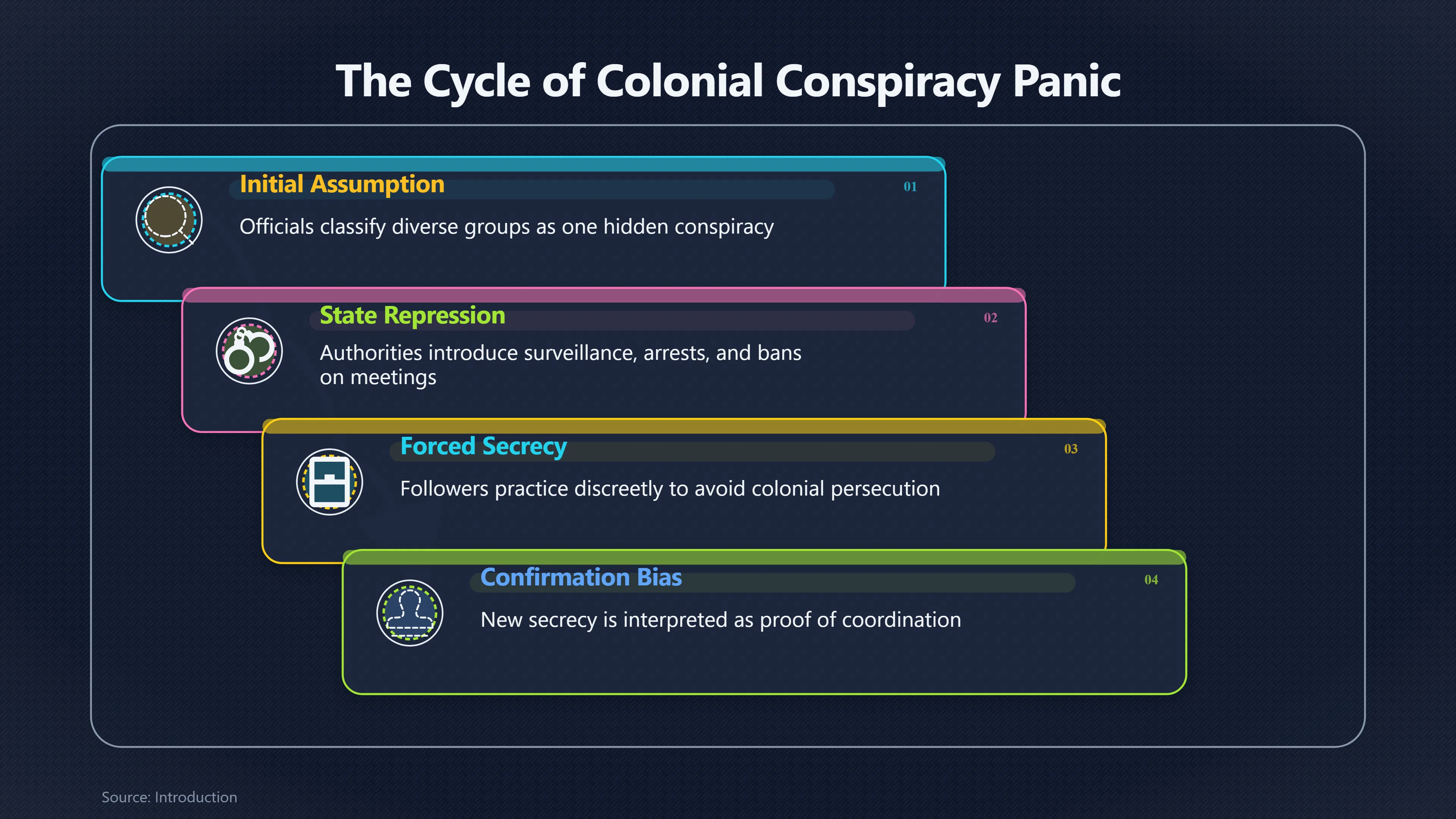
One of the most striking features of the Kitawala story is the self-reinforcing cycle between repression and official belief.
Once Belgian authorities concluded that Kitawala represented a hidden conspiracy, they introduced surveillance, arrests, bans and deportations. Public meetings became dangerous. Followers increasingly practised discreetly, trusted only close associates and avoided open discussion with outsiders.[Cambridge University Press & Assessment]cambridge.orgUniversity Press & Assessment Nicole EggersUnruly Ideas: A History of Kitawala in Congo. Athens, OH: Ohio University Press, 2023. New African Histories series. 291 pp. $34.95. Pape…
To colonial officials, this new secrecy appeared to confirm the original accusation. Hidden meetings were interpreted as proof of secret organisation rather than as understandable responses to persecution.
This created a classic conspiracy panic:
- officials assumed a central organisation existed;
- evidence proving such coordination remained limited or ambiguous;
- repression encouraged greater secrecy;
- the resulting secrecy was treated as further evidence of conspiracy.
Historians now argue that colonial archives often recorded administrative assumptions rather than objective descriptions of Kitawala itself. Reading those records therefore requires distinguishing between what officials believed and what later evidence suggests actually happened.[ohio.edu]ohioopen.library.ohio.eduUnruly Ideas: A History of Kitawala in Congo" by Nicole EggersUnruly Ideas: A History of Kitawala in Congo" by Nicole Eggers
Rebellions complicated the picture
The colonial authorities were not inventing every security concern from nothing.
Certain Kitawala-associated groups did participate in violent resistance at particular times, including the 1941 disturbances around Manono and later regional uprisings. These events convinced many officials that every Kitawala community represented part of the same revolutionary movement.[Cambridge University Press & Assessment]cambridge.orgCambridge University Press & AssessmentFREED SLAVES, MISSIONARIES, AND RESPECTABILITY: THE EXPANSION OF THE CHRISTIAN FRONTIER FROM ANGOL…
Modern scholarship takes a more cautious view. Individual rebellions certainly occurred, but participation varied greatly between regions. The existence of some armed resistance does not demonstrate that every congregation belonged to a centrally directed insurgency. Instead, similar religious language could inspire very different responses depending on local grievances, labour conditions, disputes over chiefs or experiences of colonial violence.[ohio.edu]ohioopen.library.ohio.eduUnruly Ideas: A History of Kitawala in Congo" by Nicole EggersUnruly Ideas: A History of Kitawala in Congo" by Nicole Eggers
Why historians interpret the panic differently today
Recent research has shifted attention away from asking whether Kitawala was “really” religious or political.
Instead, historians examine how colonial governments classified unfamiliar African religious movements. Nicole Eggers’ work, based on extensive oral testimony alongside colonial archives, argues that Kitawala cannot be reduced to anti-colonial rebellion alone. Questions of healing, morality, spiritual authority, family life and legitimate leadership were central to many communities. Colonial administrators often overlooked these concerns because they interpreted nearly every independent religious gathering through the lens of security and rebellion.[ohio.edu]ohioopen.library.ohio.eduUnruly Ideas: A History of Kitawala in Congo" by Nicole EggersUnruly Ideas: A History of Kitawala in Congo" by Nicole Eggers
This reinterpretation also highlights how colonial records themselves helped construct the image of Kitawala. Reports describing a vast secret organisation influenced later writers, creating a lasting impression of a single conspiratorial movement even though evidence increasingly points towards a far more diverse religious landscape.[Cambridge University Press & Assessment]cambridge.orgUniversity Press & Assessment Nicole EggersUnruly Ideas: A History of Kitawala in Congo. Athens, OH: Ohio University Press, 2023. New African Histories series. 291 pp. $34.95. Pape…
Why the episode still matters
The history of Kitawala illustrates how governments can mistake decentralised religious diversity for coordinated conspiracy.
The Belgian colonial state encountered numerous independent congregations linked by overlapping ideas rather than unified command. Because officials expected hidden political organisation, they interpreted diversity as disguise and secrecy as proof. The resulting campaign of repression strengthened the very appearance of clandestine organisation that authorities feared.
For historians of Congo, Kitawala therefore stands as an important example of a colonial conspiracy panic: not because all official concerns were imaginary, but because a wide range of distinct religious communities became compressed into the image of a single secret rebellion. Understanding that distinction helps explain both the persistence of Kitawala and the enduring caution among scholars about accepting colonial descriptions of African religious movements at face value.[ohio.edu]ohioopen.library.ohio.eduUnruly Ideas: A History of Kitawala in Congo" by Nicole EggersUnruly Ideas: A History of Kitawala in Congo" by Nicole Eggers
Amazon book picks
Further Reading
Books and field guides related to Was Kitawala a Church or a Rebellion?. Use these as the next step if you want deeper reading beyond the article.
African religions and philosophy
Useful framework for understanding religious movements.

Endnotes
1.
Source: ohioopen.library.ohio.edu
Title: “Unruly Ideas: A History of Kitawala in Congo” by Nicole Eggers
Link:https://ohioopen.library.ohio.edu/oupress/25/
2.
Source: cambridge.org
Link:https://www.cambridge.org/core/journals/journal-of-african-history/article/freed-slaves-missionaries-and-respectability-the-expansion-of-the-christian-frontier-from-angola-to-belgian-congo/EAD031979C400AFB36D8A4FF8E6268B2
Source snippet
Cambridge University Press & AssessmentFREED SLAVES, MISSIONARIES, AND RESPECTABILITY: THE EXPANSION OF THE CHRISTIAN FRONTIER FROM ANGOL...
3.
Source: cambridge.org
Title: University Press & Assessment Nicole Eggers
Link:https://www.cambridge.org/core/journals/african-studies-review/article/nicole-eggers-unruly-ideas-a-history-of-kitawala-in-congo-athens-oh-ohio-university-press-2023-new-african-histories-series-291-pp-3495-paper-isbn-9780821426081/D15AD0603311D0208FB8BE8631C85164
Source snippet
Unruly Ideas: A History of Kitawala in Congo. Athens, OH: Ohio University Press, 2023. New African Histories series. 291 pp. $34.95. Pape...
4.
Source: africabib.org
Link:https://www.africabib.org/rec.php?RID=189917369
5.
Source: africabib.org
Link:https://www.africabib.org/rec.php?RID=192757776
6.
Source: tandfonline.com
Link:https://www.tandfonline.com/doi/full/10.1080/17531055.2019.1708544
Source snippet
Taylor & Francis OnlineFull article: Authority that is customary: Kitawala, customary chiefs, and the plurality of power in Congolese his...
Additional References
7.
Source: researchgate.net
Link:https://www.researchgate.net/publication/338394863_Authority_that_is_customary_Kitawala_customary_chiefs_and_the_plurality_of_power_in_Congolese_history
Source snippet
January 4, 2020 — AUTHORITY THAT IS CUSTOMARY: KITAWALA, CUSTOMARY CHIEFS, AND THE PLURALITY OF POWER IN CONGOLESE HISTORY * January 2020...
Published: January 4, 2020
8.
Source: ideas.repec.org
Title: v14y2020i1p24 42
Link:https://ideas.repec.org/a/taf/rjeaxx/v14y2020i1p24-42.html
Source snippet
that is customary: Kitawala, customary chiefs, and the plurality of power in Congolese historyJanuary 1, 2020 — AUTHORITY THAT IS CUSTOMA...
Published: January 1, 2020
9.
Source: ensie.nl
Link:https://www.ensie.nl/winkler/kitawala
Source snippet
de Bruyne, G.B.J. Hiltermann en H.R. Hoetink (1947) Gepubliceerd op 28-01-2023 KITAWALA betekenis & definitie racistische en tegen de vre...
10.
Source: youtube.com
Title: Horror in the Congo: The Nightmare Begins | Part 1
Link:https://www.youtube.com/watch?v=uqGVHgV7Eg0
Source snippet
King Leopold II: The Horrors Of The Congo Free State...
11.
Source: socialscienceinaction.org
Link:https://www.socialscienceinaction.org/resources/authority-that-is-customary-kitawala-customary-chiefs-and-the-plurality-of-power-in-congolese-history/
12.
Source: persee.fr
Link:https://www.persee.fr/doc/assr_0003-9659_1971_num_31_1_2037_t1
13.
Source: socialscienceinaction.org
Link:https://www.socialscienceinaction.org/fr/ressources/autorite-coutumiere-des-chefs-coutumiers-kitawala-et-pluralite-du-pouvoir-dans-lhistoire-congolaise/
14.
Source: youtube.com
Title: All Murders Are Evil but Some Are Diabolical
Link:https://www.youtube.com/watch?v=zomExx9SQz8
Source snippet
Horror in the Congo: The Nightmare Begins | Part 1...
15.
Source: youtube.com
Link:https://www.youtube.com/watch?v=5_BweSNZ7Vc
Source snippet
All Murders Are Evil but Some Are Diabolical...
16.
Source: youtube.com
Title: King Leopold II: The Horrors Of The Congo Free State
Link:https://www.youtube.com/watch?v=EAokwWHJKr0
Source snippet
The Horrors of the Belgian Congo...
Topic Tree