Within Antigua and Barbuda
Was Antigua's 1736 Conspiracy Real or Enlarged?
The 1736 trials may have exposed a real resistance network, but coercion and planter panic probably enlarged the official story.
On this page
- What the colonial authorities claimed
- Why the testimony remains contested
- Resistance, panic and exemplary punishment
Page outline Jump by section
Introduction
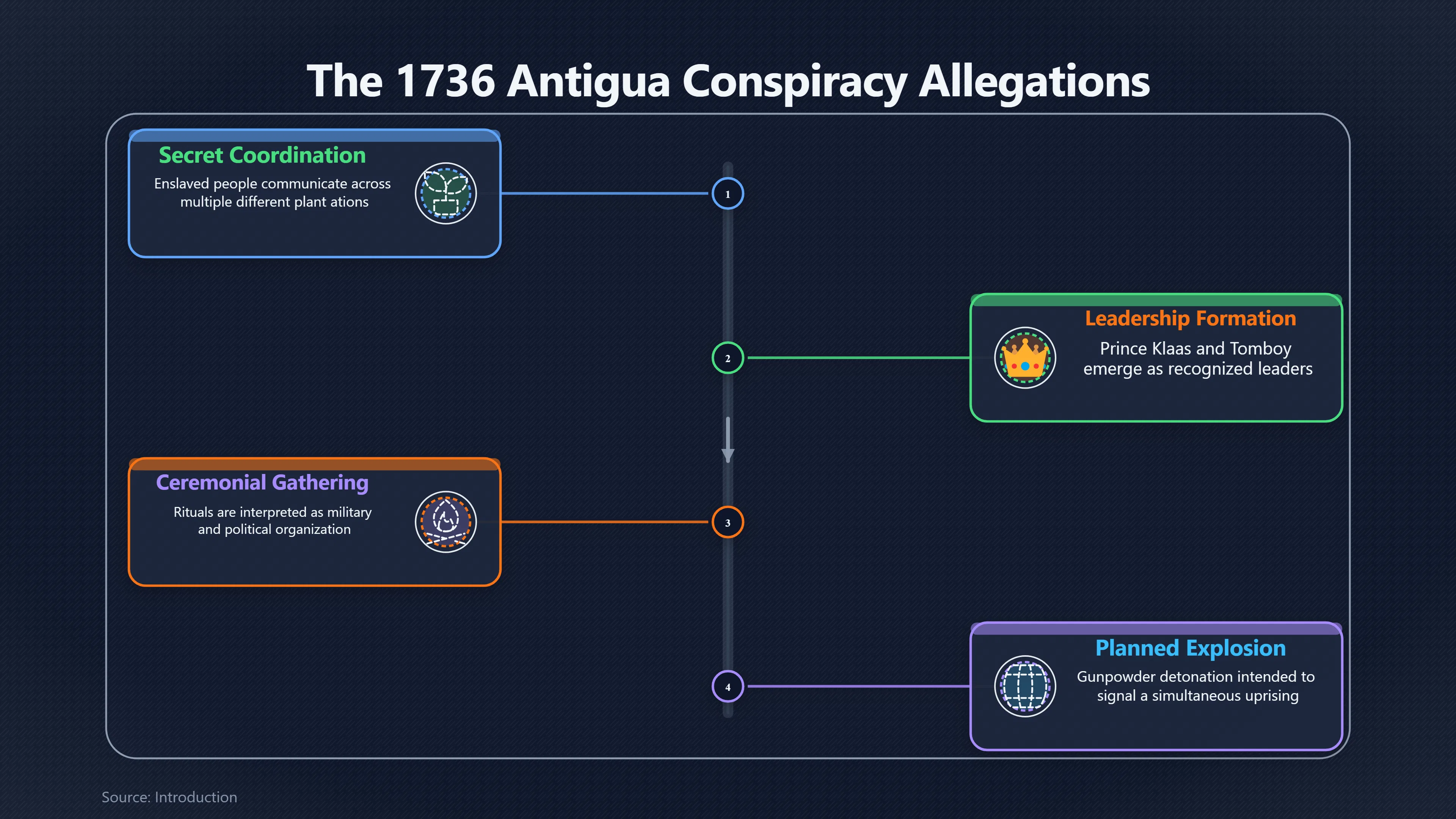
The alleged slave conspiracy uncovered in Antigua in 1736 remains one of the most debated episodes in Caribbean colonial history because it appears to combine two realities at once: organised resistance by enslaved people and an official investigation shaped by fear, coercion and the interests of a slaveholding regime. Colonial authorities claimed they had uncovered a vast plot led by Court, better known today as Prince Klaas, to destroy the island’s white ruling class and establish an African-led government. The resulting trials led to the execution of at least 88 enslaved people and severe punishments for many others. Yet historians continue to dispute how much of the official narrative reflected an actual revolutionary network and how much was enlarged by coerced testimony, rumour and planter panic.[Smithsonian Magazine]smithsonianmag.comantiguas disputed slave conspiracy of 1736 117569Smithsonian MagazineAntigua’s Disputed Slave Conspiracy of 1736January 2, 2013…
Rather than asking whether the conspiracy was entirely real or entirely invented, most modern scholarship examines how evidence was produced inside a colonial legal system that denied enslaved defendants meaningful rights. That approach makes the 1736 case important not only as an episode of resistance but also as an example of how fear, violence and unequal power can shape the historical record.
What the colonial authorities claimed
According to the official investigation, Prince Klaas and numerous associates had organised a carefully coordinated uprising involving enslaved people across multiple plantations. The central allegation was that a barrel of gunpowder would be detonated during a large public celebration in St John’s, killing many leading colonists. The explosion would signal plantation workers across the island to rise simultaneously, kill surviving whites and establish a new African kingdom under Klaas’s leadership.[Smithsonian Magazine]smithsonianmag.comantiguas disputed slave conspiracy of 1736 117569Smithsonian MagazineAntigua’s Disputed Slave Conspiracy of 1736January 2, 2013…
Officials argued that the conspiracy had several features suggesting long-term planning:
- communication between enslaved communities on different plantations;
- recognised leaders, including Prince Klaas and close associates such as Tomboy;
- ceremonial gatherings interpreted as political and military organisation;
- the expectation that enslaved people across Antigua would join once violence began.
The government regarded the alleged conspiracy as an existential threat because enslaved Africans greatly outnumbered the white population. In that setting, colonial officials considered the possibility of coordinated rebellion entirely plausible, especially after earlier slave resistance elsewhere in the Caribbean.[Smithsonian Magazine]smithsonianmag.comantiguas disputed slave conspiracy of 1736 117569Smithsonian MagazineAntigua’s Disputed Slave Conspiracy of 1736January 2, 2013…
Why the testimony remains contested
The strongest evidence for the conspiracy came from confessions and witness statements gathered after arrests began. This is also the principal reason historians remain cautious.
The investigation unfolded within a legal system designed to protect slaveholders rather than defendants. Enslaved people could be imprisoned indefinitely, subjected to harsh interrogation and, in some cases, threatened with torture or execution. Under such conditions, confession could become a survival strategy rather than reliable evidence. Modern historians therefore distinguish between the existence of testimony and the reliability of that testimony.[Smithsonian Magazine]smithsonianmag.comantiguas disputed slave conspiracy of 1736 117569Smithsonian MagazineAntigua’s Disputed Slave Conspiracy of 1736January 2, 2013…
Several specific problems complicate the evidence.
Confessions spread through the prison population. Prisoners had opportunities to hear accusations against others and learn what investigators expected. Later confessions often repeated earlier details, making it difficult to know whether witnesses were independently confirming events or repeating information already circulating in custody. Historian Jason Sharples argues that knowledge moved through conversations among prisoners as well as through questioning by officials.[Smithsonian Magazine]smithsonianmag.comantiguas disputed slave conspiracy of 1736 117569Smithsonian MagazineAntigua’s Disputed Slave Conspiracy of 1736January 2, 2013…
Informers had incentives to accuse others. Some enslaved witnesses avoided execution by providing names of additional suspects. This created obvious pressure to expand the investigation. One informer later appeared in another alleged conspiracy in New York, reportedly explaining that accusing others was often the safest course once arrested. That episode has reinforced scholarly concern about the reliability of informer testimony.[Smithsonian Magazine]smithsonianmag.comantiguas disputed slave conspiracy of 1736 117569Smithsonian MagazineAntigua’s Disputed Slave Conspiracy of 1736January 2, 2013…
Little physical evidence survived. Despite extensive searches, authorities never recovered the barrel of gunpowder central to the official narrative, nor did they uncover substantial hidden weapon stores matching the scale of the alleged island-wide uprising. The prosecution therefore depended overwhelmingly on oral testimony rather than material evidence.[Smithsonian Magazine]smithsonianmag.comantiguas disputed slave conspiracy of 1736 117569Smithsonian MagazineAntigua’s Disputed Slave Conspiracy of 1736January 2, 2013…
Did African rituals prove a conspiracy?
One of the most disputed aspects concerns ceremonies involving Prince Klaas shortly before the alleged uprising.
Colonial observers described a gathering in which Klaas was ceremonially recognised as a king among fellow Africans. Many white witnesses interpreted the event as a declaration of war and evidence that rebellion was imminent. Later writers often repeated this interpretation.[Smithsonian Magazine]smithsonianmag.comantiguas disputed slave conspiracy of 1736 117569Smithsonian MagazineAntigua’s Disputed Slave Conspiracy of 1736January 2, 2013…
Modern historians have offered more cautious readings.
David Barry Gaspar argues that African political traditions helped organise collective resistance and that ceremonies could reinforce loyalty among participants preparing for revolt. In this interpretation, African cultural practices formed part of a genuine resistance movement rather than being merely symbolic.[Scholars@Duke]scholars.duke.eduScholars@DukeScholars@Duke publication: The Antigua Slave Conspiracy of 1736: A Case Study of the Origins of Collective Resistance…
Other scholars, including Kwasi Konadu, argue that colonial observers frequently misunderstood West African political and religious traditions. A public ceremony recognising leadership did not necessarily constitute a declaration of war. Europeans unfamiliar with Akan customs may have interpreted ordinary cultural practices through the lens of their own fears about rebellion.[Smithsonian Magazine]smithsonianmag.comantiguas disputed slave conspiracy of 1736 117569Smithsonian MagazineAntigua’s Disputed Slave Conspiracy of 1736January 2, 2013…
This debate illustrates a wider problem: colonial records often describe African religious practices through hostile or confused observers, making it difficult to reconstruct what participants themselves believed.
Resistance, panic and exemplary punishment
The punishments imposed after the trials were exceptionally severe. Prince Klaas and several others were executed by breaking on the wheel, others were burned alive, while additional prisoners were gibbeted or otherwise publicly executed. These methods were intended not simply to punish individuals but to terrorise the wider enslaved population into obedience.[Smithsonian Magazine]smithsonianmag.comantiguas disputed slave conspiracy of 1736 117569Smithsonian MagazineAntigua’s Disputed Slave Conspiracy of 1736January 2, 2013…
The severity of these sentences also shaped the investigation itself. Colonial governments wanted to demonstrate absolute control after even the suggestion of organised resistance. Public executions served as political theatre, warning enslaved communities that any challenge to plantation rule would meet overwhelming violence.
At the same time, slaveholders lived with genuine anxiety. Antigua’s economy depended upon an enslaved majority whose labour sustained the sugar plantations. Successful revolts elsewhere in the Caribbean showed that rebellion was possible. Fear therefore had a rational foundation even if particular allegations became exaggerated during investigation.[Smithsonian Magazine]smithsonianmag.comantiguas disputed slave conspiracy of 1736 117569Smithsonian MagazineAntigua’s Disputed Slave Conspiracy of 1736January 2, 2013…
How historians assess the evidence today
The debate has shifted away from simple acceptance or rejection of the colonial narrative.
One influential interpretation, associated with David Barry Gaspar, argues that the evidence points to a substantial conspiracy rooted in extensive social networks among Antigua’s enslaved population. From this perspective, the investigation uncovered a genuine revolutionary movement, even if some details recorded by officials were distorted or incomplete.[Scholars@Duke]scholars.duke.eduScholars@DukeScholars@Duke publication: The Antigua Slave Conspiracy of 1736: A Case Study of the Origins of Collective Resistance…
Other historians place greater emphasis on the limitations of the surviving evidence. They note that nearly every detailed account comes from colonial officials, magistrates or informers operating within an unequal legal system. These scholars argue that investigators probably expanded a smaller resistance network into a much larger conspiracy through coercive questioning, repeated accusations and assumptions about African political organisation.[Smithsonian Magazine]smithsonianmag.comantiguas disputed slave conspiracy of 1736 117569Smithsonian MagazineAntigua’s Disputed Slave Conspiracy of 1736January 2, 2013…
Despite these disagreements, there is broad agreement on several points:
- organised resistance to slavery unquestionably existed in Antigua;
- enslaved people had compelling reasons to plan rebellion;
- the surviving evidence was created under conditions that undermine complete confidence in every confession;
- the official narrative cannot simply be accepted at face value, but neither can it be dismissed as pure invention.[Smithsonian Magazine]smithsonianmag.comantiguas disputed slave conspiracy of 1736 117569Smithsonian MagazineAntigua’s Disputed Slave Conspiracy of 1736January 2, 2013…

Why the case remains important
The 1736 conspiracy occupies a distinctive place in Antigua and Barbuda’s historical memory because it sits at the intersection of resistance and colonial fear. Prince Klaas is honoured today as a national hero, reflecting modern recognition of anti-slavery resistance rather than acceptance of every detail recorded by eighteenth-century officials.[gis.gov.ag]gis.gov.agAntigua and Barbdua Government Information ServiceAntigua and Barbdua Government Information Service
For historians of collective belief and social panic, the episode demonstrates how genuine political threats and exaggerated official narratives can become inseparable. A slave society built upon violence produced both authentic resistance and chronic fear among those who ruled it. The investigation was therefore shaped simultaneously by real possibilities of revolt and by the psychological pressures of a colonial elite convinced that catastrophe might arrive at any moment.
The enduring question is not simply whether there was a conspiracy, but how a society founded on coercion produced evidence about rebellion. The surviving records preserve both the determination of enslaved people to seek freedom and the ways in which panic, unequal justice and exemplary punishment could transform a criminal investigation into a narrative whose precise scale remains impossible to reconstruct with certainty.[Smithsonian Magazine]smithsonianmag.comantiguas disputed slave conspiracy of 1736 117569Smithsonian MagazineAntigua’s Disputed Slave Conspiracy of 1736January 2, 2013…
Amazon book picks
Further Reading
Books and field guides related to Was Antigua's 1736 Conspiracy Real or Enlarged?. Use these as the next step if you want deeper reading beyond the article.


Testing the Chains: Resistance to Slavery in the British West...
Directly relevant to interpreting the Antigua conspiracy.
Interesting Narrative of the Life of Olaudah Equiano
Provides firsthand context for slavery in the Atlantic world.
Endnotes
1.
Source: scholars.duke.edu
Link:https://scholars.duke.edu/publication/1010457
Source snippet
Scholars@DukeScholars@Duke publication: The Antigua Slave Conspiracy of 1736: A Case Study of the Origins of Collective Resistance...
2.
Source: gis.gov.ag
Title: Antigua and Barbdua Government Information Service
Link:https://gis.gov.ag/?page_id=98
3.
Source: scholars.duke.edu
Title: journal articles
Link:https://scholars.duke.edu/person/dgaspar/scholarly-works/journal-articles
Source snippet
Gaspar | Scholars@Duke profile: Scholarly WorksBARRY GASPAR Professor of History History dgaspar@duke.edu Dept of History, Box 90719, Dur...
4.
Source: smithsonianmag.com
Title: antiguas disputed slave conspiracy of 1736 117569
Link:https://www.smithsonianmag.com/history/antiguas-disputed-slave-conspiracy-of-1736-117569/
Source snippet
Smithsonian MagazineAntigua’s Disputed Slave Conspiracy of 1736January 2, 2013...
Published: January 2, 2013
Additional References
5.
Source: nationalhumanitiescenter.org
Link:https://nationalhumanitiescenter.org/fellows-book/bondmen-and-rebels-a-study-of-master-slave-relations-in-antigua-with-implications-for-colonial-british-america/
Source snippet
nterWork of the Fellows: Monographs BONDMEN AND REBELS: A STUDY OF MASTER-SLAVE RELATIONS IN ANTIGUA, WITH IMPLICATIONS FOR COLONIAL BRIT...
6.
Source: dukeupress.edu
Link:https://www.dukeupress.edu/bondmen-and-rebels
Source snippet
Bondmen and Rebels: A Study of Master-Slave Relations in AntiguaHome / Books / Bondmen and Rebels BONDMEN AND REBELS A STUDY OF MASTER-SL...
7.
Source: jstor.org
Link:https://www.jstor.org/stable/j.ctv120qs9h
Source snippet
tions in Antigua Bondmen and Rebels: A Study of Master-Slave Relations in Antigua David Barry Gaspar Copyright Date: 1985 Published...
8.
Source: mikedashhistory.com
Link:https://mikedashhistory.com/2012/12/28/the-crucifixion-of-prince-klaas-antiguas-disputed-slave-rebellion-of-1736/
Source snippet
The crucifixion of Prince Klaas: Antigua’s disputed slave rebellion of 1736 | A Blast From The PastDecember 28, 2012 — Seasoned slaves en...
Published: December 28, 2012
9.
Source: degruyterbrill.com
Title: Bondmen and Rebels
Link:https://www.degruyterbrill.com/document/doi/10.1515/9780822381778/html
Source snippet
Your documents are now available to view. Gaspar, David Barry. Bondmen and Rebels: A Study of Master-Slave Relations in Antigua, New York...
10.
Source: youtube.com
Title: History of Antigua and Barbuda: The Islands Britain Feared Would Rise
Link:https://www.youtube.com/watch?v=cWRXd8zOEOI
Source snippet
THE MAN WHO WHO PLANNED TO MAKE ANTIGUA AN AFRICAN STATE...
11.
Source: youtube.com
Title: Moira Stuart: Tracking Slave Owners in Antigua | Who Do You Think You Are
Link:https://www.youtube.com/watch?v=baAMcqGAnnQ
Source snippet
Roots: A History Revealed - Forms of Rebellion...
12.
Source: bibliovault.org
Link:https://www.bibliovault.org/BV.book.epl?ISBN=9780822313366
Source snippet
Bondmen and Rebels: A Study of Master-Slave Relations in Antigua (9780822313366): David Barry Gaspar - BiblioVault(9780822313366) (978082...
13.
Source: bibliovault.org
Link:https://www.bibliovault.org/BV.book.epl?ISBN=9780822381778
Source snippet
Bondmen and Rebels: A Study of Master-Slave Relations in Antigua (9780822381778): David Barry Gaspar - BiblioVaultBUY FROM PUBLISHER Avai...
14.
Source: youtube.com
Title: Prince Klass & Kingdom of Antigua & Barbuda
Link:https://www.youtube.com/watch?v=dGPDLq4eQTw
Source snippet
Moira Stuart: Tracking Slave Owners in Antigua | Who Do You Think You Are...
Topic Tree