Within Saint Lucia
How Did Obeah Become So Feared?
Obeah became a catch-all accusation that blurred healing, protection, fraud and feared spiritual harm under colonial rule.
On this page
- What the disputed word obeah meant
- How colonial churches and officials framed the threat
- Rumour, stigma and the limits of the evidence
Page outline Jump by section
Introduction
In Saint Lucia, as elsewhere in the British Caribbean, the fear surrounding obeah was not simply a reaction to a single religious practice. Rather, it was the result of a long colonial process that transformed a loose and disputed collection of African-derived healing, protective and spiritual traditions into a legal and moral category associated with crime, conspiracy and hidden danger. That transformation mattered because it gave colonial governments a powerful justification for policing forms of authority that existed outside the plantation, the church and the state.
Modern historians argue that “obeah” became feared less because of any consistent set of rituals than because colonial officials, missionaries and courts repeatedly portrayed it as the opposite of legitimate religion. The label eventually blurred together healing, spiritual protection, deception, poisoning, fraud and alleged supernatural harm, making it difficult to distinguish between genuine criminal acts, popular rumour and ordinary religious practice. This legacy shaped attitudes in Saint Lucia for generations and explains why accusations of obeah often reveal as much about colonial power and social anxiety as about the practices themselves.[Edinburgh Research]research.ed.ac.ukinburgh ResearchObeah acts: Producing and policing the boundaries of religion in the Caribbean - University of Edinburgh Research Explorer…
What the disputed word obeah meant
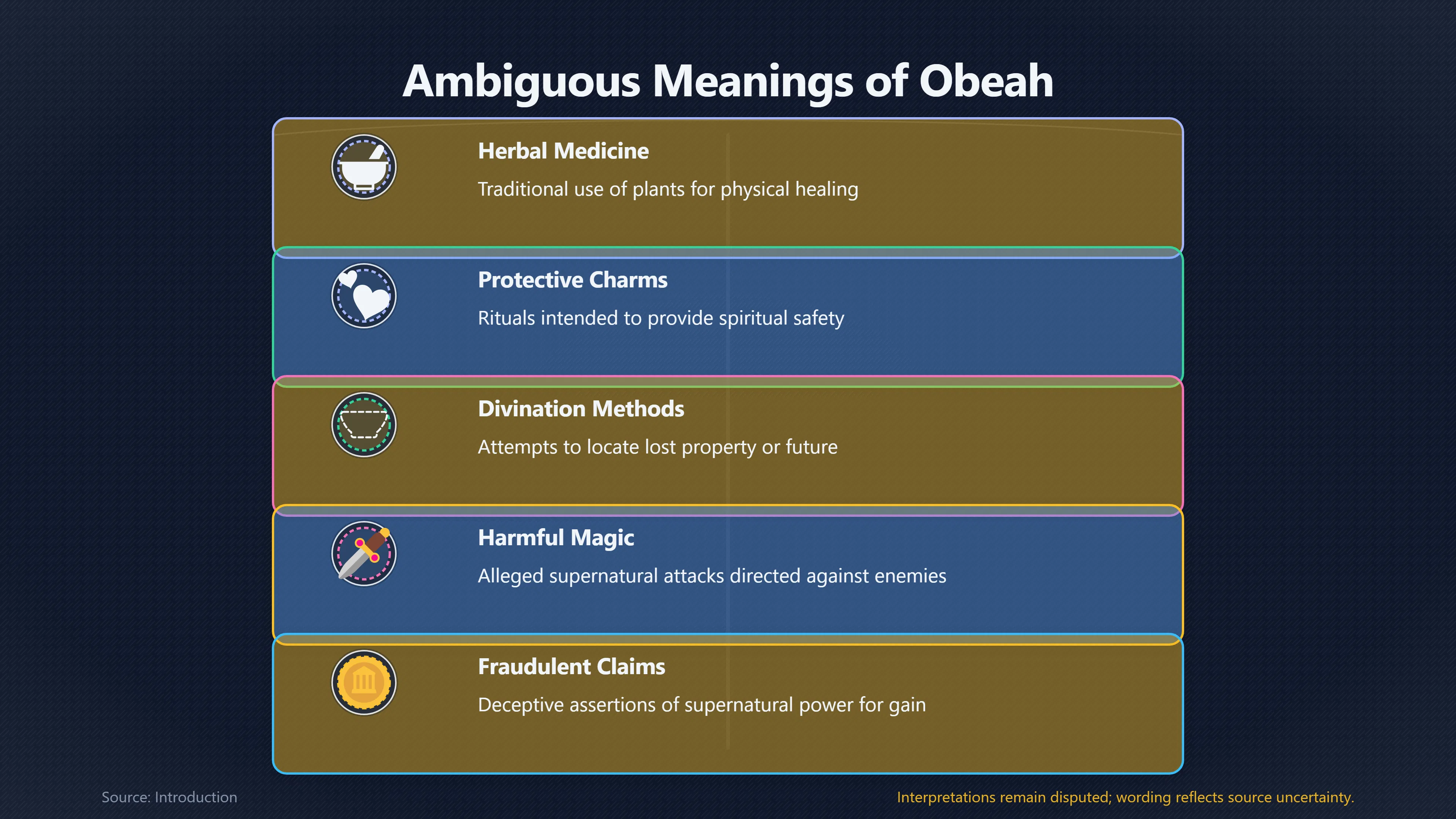
One reason obeah became such a potent colonial threat is that nobody ever agreed precisely what it was. Unlike an organised church with recognised doctrines, clergy or sacred texts, obeah referred to a wide range of practices that varied between islands and even between neighbouring communities.
Depending on who was speaking, the term might refer to:
- Herbal medicine and healing.
- Protective charms and rituals.
- Spiritual counselling.
- Divination or attempts to locate lost property.
- Rituals intended to bring luck or protection.
- Alleged harmful magic directed against enemies.
- Fraudulent claims of supernatural power.
Colonial officials rarely separated these activities. Instead, they increasingly treated them as parts of a single dangerous phenomenon. This ambiguity proved politically useful because authorities could prosecute individuals without first establishing exactly what constituted obeah. The accusation itself often became sufficient to imply deception or public danger.[Edinburgh Research]research.ed.ac.ukinburgh ResearchObeah acts: Producing and policing the boundaries of religion in the Caribbean - University of Edinburgh Research Explorer…
Historians Jerome Handler and Kenneth Bilby have also shown that some of the earliest recorded uses of the word did not automatically imply evil. Before the late eighteenth century, its meanings could be relatively neutral or even positive in some contexts. The strongly negative association developed alongside colonial legislation rather than preceding it.[History Workshop]historyworkshop.org.ukHistory Workshop The Racist History of Jamaica's Obeah Laws | History WorkshopHistory WorkshopThe Racist History of Jamaica's Obeah Laws | History WorkshopJuly 4, 2019…
How colonial churches and officials framed the threat
For colonial governments, the greatest concern was not simply belief in supernatural power but the social influence exercised by respected healers and ritual specialists.
Enslaved Africans frequently relied upon knowledgeable practitioners for medicine, emotional support, conflict resolution and spiritual protection. Such figures could command trust independently of plantation owners, magistrates or missionaries. In societies built upon slavery, that independent authority appeared deeply threatening.
Christian missionaries viewed many African-derived rituals through familiar European ideas about witchcraft, diabolical influence and superstition. Practices that participants regarded as healing or protective could therefore be interpreted by missionaries as evidence of spiritual corruption. Colonial courts reinforced this interpretation by embedding it in legislation and legal language.[Edinburgh Research]research.ed.ac.ukinburgh ResearchObeah acts: Producing and policing the boundaries of religion in the Caribbean - University of Edinburgh Research Explorer…
The result was a powerful alliance between religious and governmental authority. Churches framed obeah as sinful, while governments increasingly treated it as criminal. Together they established a public narrative in which African-derived spiritual knowledge appeared incompatible with civilisation, Christianity and social order.
Why colonial governments saw political danger
The political dimension is essential to understanding why obeah acquired such an alarming reputation throughout the British Caribbean, including territories such as Saint Lucia.
After major slave rebellions—most famously Jamaica’s uprising of 1760—colonial authorities increasingly associated ritual specialists with organised resistance. Officials believed that some practitioners administered oaths, inspired courage or promised supernatural protection against European weapons. Whether every such claim was accurate mattered less than the fact that colonial governments believed these networks could strengthen collective resistance.[History Workshop]historyworkshop.org.ukHistory Workshop The Racist History of Jamaica's Obeah Laws | History WorkshopHistory WorkshopThe Racist History of Jamaica's Obeah Laws | History WorkshopJuly 4, 2019…
Consequently, anti-obeah laws became tools for controlling more than alleged magic. They also enabled authorities to:
- Monitor gatherings outside official supervision.
- Restrict respected African community leaders.
- Suppress alternative systems of justice and healing.
- Break networks of trust among enslaved communities.
- Reinforce Christian missionary influence.
Seen in this light, criminalising obeah formed part of a broader strategy for maintaining colonial control rather than simply protecting the public from supposed supernatural harm.[Edinburgh Research]research.ed.ac.ukinburgh ResearchObeah acts: Producing and policing the boundaries of religion in the Caribbean - University of Edinburgh Research Explorer…
Saint Lucia within the wider Caribbean pattern
Saint Lucia’s colonial history differed from that of some neighbouring islands because sovereignty shifted repeatedly between Britain and France before permanent British control in the nineteenth century. Nevertheless, by the Victorian period the island increasingly reflected wider British Caribbean attitudes towards obeah.
The island did not produce a single famous “obeah panic” comparable to some Jamaican episodes. Instead, suspicion became embedded in everyday administration, policing and public morality. Colonial authorities generally adopted the broader British understanding that African-derived ritual specialists represented potential fraudsters, manipulators or dangerous practitioners of hidden powers.
This broader regional framework helps explain why Saint Lucia inherited legal restrictions and enduring social suspicion even though documented prosecutions on the island were relatively limited compared with larger colonies. The fear travelled through imperial law, missionary activity and shared colonial assumptions rather than through one defining local crisis.[Edinburgh Research]research.ed.ac.ukinburgh ResearchThe Cultural Politics of Obeah: Religion, Colonialism and Modernity in the Caribbean World - University of Edinburgh Re…
Rumour, stigma and the limits of the evidence
One of the most important conclusions reached by modern historians is that surviving colonial records tell us far more about colonial fears than about everyday spiritual practice.
Court records overwhelmingly preserve the voices of magistrates, police officers and missionaries rather than those accused of practising obeah. Newspapers often repeated rumours about secret rituals, curses or hidden objects without independent verification. Accusations could arise from neighbourhood disputes, family conflict, business rivalry or unexplained illness.
This creates important limits on the historical evidence.
First, historians cannot assume every accusation reflected actual ritual practice. Second, accusations themselves had social power regardless of their truth. Being labelled an obeah practitioner could damage reputations, isolate individuals or attract criminal investigation.
As a result, scholars increasingly distinguish between three different phenomena:
- Spiritual practice, which participants often understood as healing or protection.
- Colonial representation, which portrayed obeah as criminal superstition.
- Popular rumour, in which fear of hidden spiritual attack circulated independently of demonstrable evidence.
Recognising these distinctions avoids treating colonial accusations as objective descriptions of African-Caribbean religion.[Edinburgh Research]research.ed.ac.ukinburgh ResearchObeah acts: Producing and policing the boundaries of religion in the Caribbean - University of Edinburgh Research Explorer…
Why the colonial image proved so durable
The colonial construction of obeah proved remarkably resilient because it entered law, education, journalism and popular Christianity simultaneously.
Even after many Caribbean territories repealed or relaxed anti-obeah legislation, the older association between obeah, evil and criminality often survived in everyday language. The word continued to function as a catch-all label for practices that many people neither understood nor wished to recognise as legitimate religion.
Diana Paton argues that colonial governments effectively separated those aspects of Afro-Caribbean spirituality that could be recognised as “religion” from those labelled “magic”, “witchcraft” or “superstition”. This distinction made it much harder for practitioners to claim the protections normally extended to recognised faiths.[Edinburgh Research]research.ed.ac.ukinburgh ResearchObeah acts: Producing and policing the boundaries of religion in the Caribbean - University of Edinburgh Research Explorer…
For Saint Lucia, this history helps explain why public discussion of obeah still often combines uncertainty, curiosity and suspicion. Modern researchers generally caution against accepting inherited colonial definitions at face value. Instead, they encourage examining who used the label, whose interests it served, and whether it described genuine criminal behaviour, contested religious practice, interpersonal conflict or simply fear of the unseen.
Amazon book picks
Further Reading
Books and field guides related to How Did Obeah Become So Feared?. Use these as the next step if you want deeper reading beyond the article.

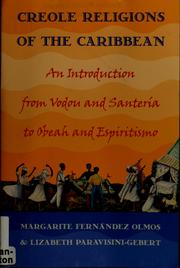
Creole religions of the Caribbean
Explains the place of obeah among related traditions.
The fear of French negroes
Examines colonial fears surrounding Afro-Caribbean communities.
Endnotes
1.
Source: research.ed.ac.uk
Link:https://www.research.ed.ac.uk/en/publications/obeah-acts-producing-and-policing-the-boundaries-of-religion-in-t/
Source snippet
inburgh ResearchObeah acts: Producing and policing the boundaries of religion in the Caribbean - University of Edinburgh Research Explorer...
2.
Source: research.ed.ac.uk
Link:https://www.research.ed.ac.uk/en/publications/the-cultural-politics-of-obeah-religion-colonialism-and-modernity/
Source snippet
inburgh ResearchThe Cultural Politics of Obeah: Religion, Colonialism and Modernity in the Caribbean World - University of Edinburgh Re...
3.
Source: historyworkshop.org.uk
Title: History Workshop The Racist History of Jamaica’s Obeah Laws | History Workshop
Link:https://www.historyworkshop.org.uk/empire-decolonisation/the-racist-history-of-jamaicas-obeah-laws/
Source snippet
History WorkshopThe Racist History of Jamaica's Obeah Laws | History WorkshopJuly 4, 2019...
Published: July 4, 2019
4.
Source: obeahhistories.org
Title: Legislation | Obeah Histories
Link:https://obeahhistories.org/law/
Source snippet
September 18, 2012 — LEGISLATION This section presents extracts and transcripts of several Acts and Ordinances passed by different local...
Published: September 18, 2012
5.
Source: research.ed.ac.uk
Title: ed.ac.uk Witchcraft, poison, law and Atlantic slavery
Link:https://www.research.ed.ac.uk/en/publications/witchcraft-poison-law-and-atlantic-slavery/
Additional References
6.
Source: cambridge.org
Title: University Press & Assessment The Cultural Politics of Obeah
Link:https://www.cambridge.org/core/books/cultural-politics-of-obeah/18560C16399F297C310529C686CD039A
Source snippet
The Cultural Politics of ObeahAugust 5, 2015 — * Diana Paton, University of Newcastle upon Tyne * Diana Paton, University of Newcastle up...
Published: August 5, 2015
7.
Source: cambridge.org
Title: The post-colonial politics of obeah (Chapter 8)
Link:https://www.cambridge.org/core/books/cultural-politics-of-obeah/postcolonial-politics-of-obeah/4A9FB8FC8E027EF50AB659189A86399E
Source snippet
The Cultural Politics of ObeahAugust 5, 2015 — 8 - THE POST-COLONIAL POLITICS OF OBEAH Published online by Cambridge University Press: 05...
Published: August 5, 2015
8.
Source: cambridge.org
Link:https://www.cambridge.org/core/books/cultural-politics-of-obeah/obeah-in-the-courts-18901939/DC36F64021BD8B2FFDFED90CD9CF9CEF
Source snippet
Obeah in the courts, 1890–1939 (Chapter 5) - The Cultural Politics of ObeahAugust 5, 2015 — 5 - OBEAH IN THE COURTS, 1890–1939 Published...
Published: August 5, 2015
9.
Source: academic.oup.com
Link:https://academic.oup.com/ahr/article-abstract/121/5/1714/2750881
Source snippet
The Cultural Politics of Obeah: Religion, Colonialism, and Modernity in the Caribbean World. | The American Historical Review | Oxford Ac...
10.
Source: researchgate.net
Link:https://www.researchgate.net/publication/236747892_Obeah_Acts_Producing_and_Policing_the_Boundaries_of_Religion_in_the_Caribbean
11.
Source: youtube.com
Title: The Roots of Obeah in the Caribbean
Link:https://www.youtube.com/watch?v=7rib_cplUXo
Source snippet
Guard Ring & Obeah: Beliefs That Still Shape Jamaica Today...
12.
Source: youtube.com
Title: Early Caribbean Digital Archive
Link:https://www.youtube.com/watch?v=a9TgKJgcUcA
Source snippet
The Guardian...
13.
Source: youtube.com
Title: Guard Ring & Obeah: Beliefs That Still Shape Jamaica Today
Link:https://www.youtube.com/watch?v=tkyJ0o_-b9Q
14.
Source: youtube.com
Title: Famous Obeah Cases in Jamaica
Link:https://www.youtube.com/watch?v=70DFUDwOkvQ
Source snippet
The Roots of Obeah in the Caribbean...
15.
Source: youtube.com
Link:https://www.youtube.com/watch?v=yRdQTdxdfGI
Source snippet
Early Caribbean Digital Archive - Northeastern University...
Topic Tree