Within Zambia's Hidden Fears
Why Watch Tower Frightened Colonial Zambia
Watch Tower preaching joined biblical prophecy to anger over taxes, labour and colonial authority without forming one unified conspiracy.
On this page
- How Watch Tower ideas reached Northern Rhodesia
- Why prophecy appealed amid colonial disruption
- How officials turned a loose movement into a security threat
Page outline Jump by section
Introduction
The Watch Tower movement became one of the earliest religious currents to alarm the colonial authorities in what is now Zambia, then Northern Rhodesia. Although inspired by the writings of Charles Taze Russell, it was never a single, centrally directed organisation across Central Africa. Instead, local preachers adapted biblical prophecies to African experiences of taxation, forced labour, migrant work, racial discrimination and colonial rule. To many followers, the promise that God’s Kingdom would soon replace earthly governments offered both spiritual hope and a way of making sense of rapid social change. To many officials, however, the same message appeared dangerously close to political rebellion. Historians now argue that colonial governments often exaggerated the movement’s unity and revolutionary intent, turning a loose network of millenarian believers into a perceived security threat.[ox.ac.uk]ora.ox.ac.ukford University Research ArchiveThe Watch Tower movement in south central Africa, 1908-1945 - ORA - Oxford University Research Archive…

How Watch Tower ideas reached Northern Rhodesia
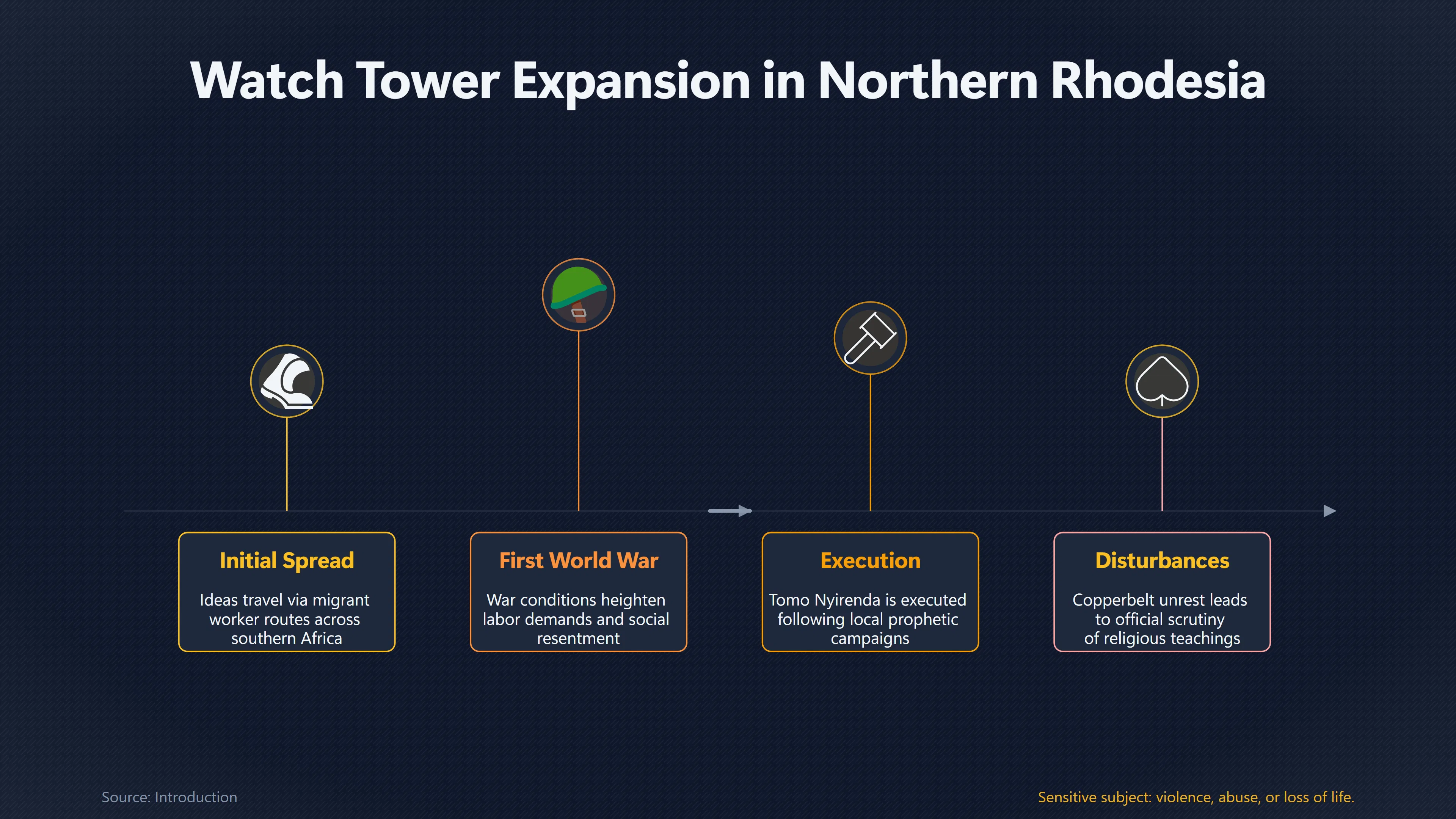
Watch Tower teaching did not arrive in Northern Rhodesia through an organised missionary campaign alone. Instead, it spread along the same routes that carried thousands of African workers across southern and central Africa.
Labour migrants travelling between Nyasaland (now Malawi), Southern Rhodesia (Zimbabwe), Northern Rhodesia and the mines of the Congo exchanged religious ideas as readily as news about wages and employers. Preachers associated with Elliott Kamwana’s revival in Nyasaland played an especially important role in transmitting Watch Tower beliefs into Northern Rhodesia during and after the First World War. As the movement spread, its organisation became increasingly local rather than directed from overseas.[Oxford University Research Archive]ora.ox.ac.ukford University Research ArchiveThe Watch Tower movement in south central Africa, 1908-1945 - ORA - Oxford University Research Archive…
This distinction is important because colonial reports frequently treated every independent preacher using Watch Tower language as part of one coordinated organisation. Modern scholarship paints a different picture. Different congregations often operated independently, adapted teachings to local conditions and interpreted biblical prophecy through their own experiences. The label “Watch Tower” therefore described a broad religious current more than a disciplined movement with unified leadership.[Africabib]africabib.orgAfrica Bib | The Watch Tower Movement in ZambiaAfricaBib | The Watch Tower Movement in ZambiaApril 1, 1989…
Why prophecy appealed amid colonial disruption
Watch Tower preaching gained influence because it addressed everyday hardships rather than abstract theology alone.
Colonial Northern Rhodesia was undergoing profound change. Hut taxes forced many men into migrant labour. Expanding mines and plantations disrupted older social structures, while racial inequalities limited African opportunities despite growing economic importance. Families were often separated for long periods as workers travelled between distant employment centres.
Against this background, millenarian teaching—that the present world order was temporary and would soon be replaced by God’s just kingdom—offered reassurance that injustice would not last forever. The expectation of divine intervention also provided a moral language through which Africans could criticise colonial authority without necessarily organising conventional political movements.[ox.ac.uk]ora.ox.ac.ukford University Research ArchiveThe Watch Tower movement in south central Africa, 1908-1945 - ORA - Oxford University Research Archive…
Rather than promising detailed political programmes, many Watch Tower preachers emphasised that earthly governments, racial hierarchies and oppressive labour systems belonged to a temporary age nearing its end. That message resonated particularly among migrant workers whose lives had been transformed by colonial capitalism and labour migration.[Oxford University Research Archive]ora.ox.ac.ukford University Research ArchiveThe Watch Tower movement in south central Africa, 1908-1945 - ORA - Oxford University Research Archive…

How officials turned a loose movement into a security threat
Colonial administrators interpreted these religious ideas through the lens of security rather than theology.
Several developments heightened official anxiety. The First World War increased demands for African labour and military carriers, creating widespread hardship and resentment. At the same time, memories of the 1915 Chilembwe uprising in neighbouring Nyasaland encouraged officials to suspect that independent African religious leaders might inspire wider resistance. As Watch Tower ideas spread during the later war years, administrators increasingly linked them with anti-government sentiment.[journals.gold.ac.uk]journals.gold.ac.ukWar, Mobilisation and Colonial Crisis in Northern Rhodesia, 1914-1916 | British Journal for Military History…
This fear shaped colonial policy. African teachers and preachers came under closer surveillance, suspected leaders were arrested, and regulations governing African mission education became more restrictive. Officials increasingly described Watch Tower adherents as “subversive” even where evidence for coordinated political conspiracy remained limited.[Cambridge University Press & Assessment]cambridge.orgCambridge University Press & AssessmentThe Spectre of a Second Chilembwe: Government, Missions, and Social Control in Wartime Northern Rh…
The pattern continued into the 1930s. Following the 1935 Copperbelt disturbances, a colonial commission argued that Watch Tower teaching had helped prepare the ground for unrest because it encouraged distrust of government and established churches. Debate in the British Parliament repeated these concerns, portraying the movement as hostile to all governments and churches. Yet even at the time, some parliamentarians questioned whether rival missionary organisations and colonial fears had exaggerated the danger.[parliament.uk]hansard.parliament.ukHansard Northern Rhodesia (Watch Tower MovementNorthern Rhodesia (Watch Tower Movement) - Hansard - UK Parliament…
Why historians reject the idea of a single conspiracy
Modern historians generally distinguish between genuine tensions created by Watch Tower teaching and colonial claims that the movement formed a coordinated revolutionary organisation.
The movement certainly challenged colonial authority in important ways. Some followers rejected government institutions, questioned the legitimacy of colonial rule, or withdrew from mission-controlled churches. Such beliefs could undermine official authority even without organised political planning.
However, the evidence does not support the idea of a single conspiracy directing believers across Central Africa. Instead, researchers describe a flexible network of locally adapted congregations whose beliefs evolved according to local social and economic conditions. Some groups remained primarily religious, while others became entangled with local political disputes or conflicts over traditional authority.[ox.ac.uk]ora.ox.ac.ukford University Research ArchiveThe Watch Tower movement in south central Africa, 1908-1945 - ORA - Oxford University Research Archive…
The career of Tomo Nyirenda illustrates both the diversity and the complexity of the movement. After encountering Watch Tower teaching on the Copperbelt, he developed his own prophetic leadership, claiming special spiritual authority and conducting campaigns against alleged witches. His movement eventually became associated with killings, leading colonial authorities to pursue, try and execute him in 1926. Historians treat Nyirenda as an example of one locally evolving movement rather than a representative leader of all Watch Tower believers.[African Christian Biography]dacb.orgAfrican Christian Biography Nyirenda, TomoAfrican Christian BiographyNyirenda, Tomo - Dictionary of African Christian Biography…

Why the colonial alarm mattered
The colonial response to Watch Tower established patterns that influenced later interpretations of independent African religious movements in Zambia.
Officials increasingly viewed autonomous religious organisations through the language of public order and security rather than simply religious difference. This tendency shaped later responses to other movements, including those that emerged during the late colonial period.
The episode also demonstrates how colonial governments often struggled to distinguish between religious dissent, social protest and political rebellion. A movement whose central message concerned God’s coming kingdom became interpreted through administrative fears about labour unrest, anti-colonial resistance and declining governmental authority.
For historians, Watch Tower therefore represents more than an unusual religious movement. It shows how millenarian belief could become a language for expressing grievances about inequality and colonial disruption, while revealing how governments sometimes transformed diverse local movements into a single imagined threat. That interaction between genuine religious conviction and official alarm remains one of the defining episodes in the history of collective belief and colonial governance in Zambia.[ox.ac.uk]ora.ox.ac.ukford University Research ArchiveThe Watch Tower movement in south central Africa, 1908-1945 - ORA - Oxford University Research Archive…
Amazon book picks
Further Reading
Books and field guides related to Why Watch Tower Frightened Colonial Zambia. Use these as the next step if you want deeper reading beyond the article.
African religions and philosophy
Provides essential background on African religious worldviews shaping reception of millenarian movements.
Christianity in Africa
Explains how Christianity adapted to African social and colonial realities.
The scramble for Africa,
First published 1990. Subjects: History, Colonies, Colonization, Colonización, Kolonisatie.
The scramble for Africa,
Supplies accessible colonial background for understanding official fears in Northern Rhodesia.
Endnotes
1.
Source: cambridge.org
Link:https://www.cambridge.org/core/services/aop-cambridge-core/content/view/A7B1DBD3ADB8A53A17A03F8E3FEA7970/S0022278X00019376a.pdf/sectarian-allegiance-and-political-authority-the-watch-tower-society-in-zambia-190735.pdf
Source snippet
Cambridge University Press & AssessmentSectarian Allegiance & Political Authority: the Watch Tower Society in Zambia, 1907–35 | The Journ...
2.
Source: hansard.parliament.uk
Title: Hansard Northern Rhodesia (Watch Tower Movement)
Link:https://hansard.parliament.uk/commons/1935-12-05/debates/639b5f19-2b1a-41c7-9e26-c0ccad060cbb/NorthernRhodesia%28WatchTowerMovement%29
Source snippet
Northern Rhodesia (Watch Tower Movement) - Hansard - UK Parliament...
3.
Source: africabib.org
Title: Africa Bib | Witnesses and Watchtower in the Rhodesia’s and Nyasaland
Link:https://www.africabib.org/rec.php?RID=189172428
Source snippet
AfricaBib | Witnesses and Watchtower in the Rhodesia's and Nyasaland...
4.
Source: africabib.org
Title: Africa Bib | The Watch Tower Movement in Zambia
Link:https://www.africabib.org/rec.php?DB=p&RID=084557826
Source snippet
AfricaBib | The Watch Tower Movement in ZambiaApril 1, 1989...
Published: April 1, 1989
5.
Source: journals.gold.ac.uk
Link:https://journals.gold.ac.uk/index.php/bjmh/article/view/660
Source snippet
War, Mobilisation and Colonial Crisis in Northern Rhodesia, 1914-1916 | British Journal for Military History...
6.
Source: cambridge.org
Link:https://www.cambridge.org/core/journals/journal-of-african-history/article/abs/spectre-of-a-second-chilembwe-government-missions-and-social-control-in-wartime-northern-rhodesia-191418/881DF914890F9C970E89E5B7D34FDA4A
Source snippet
Cambridge University Press & AssessmentThe Spectre of a Second Chilembwe: Government, Missions, and Social Control in Wartime Northern Rh...
7.
Source: cambridge.org
Link:https://www.cambridge.org/core/journals/journal-of-african-history/article/abs/witnesses-and-watchtower-in-the-rhodesias-and-nyasaland/4D20063E1736329747A77E96A6608E4A
8.
Source: cambridge.org
Link:https://www.cambridge.org/core/journals/journal-of-modern-african-studies/article/abs/sectarian-allegiance-political-authority-the-watch-tower-society-in-zambia-190735/A7B1DBD3ADB8A53A17A03F8E3FEA7970
9.
Source: africabib.org
Link:https://www.africabib.org/rec.php?RID=080528120
10.
Source: africabib.org
Link:https://www.africabib.org/rec.php?RID=189171588
11.
Source: africabib.org
Link:https://africabib.org/rec.php?RID=192827472
12.
Source: ora.ox.ac.uk
Link:https://ora.ox.ac.uk/objects/uuid%3Aa54ec9cf-31da-4172-96c8-d167162f9c8f
Source snippet
ford University Research ArchiveThe Watch Tower movement in south central Africa, 1908-1945 - ORA - Oxford University Research Archive...
13.
Source: tandfonline.com
Link:https://www.tandfonline.com/doi/abs/10.1080/03086534.2021.1985218
Source snippet
Taylor & Francis OnlineFull article: Speaking as a Colonial State: Mass Broadcasting and the Language of Development in Northern Rhodesia...
14.
Source: Wikipedia
Title: Northern Rhodesia
Link:https://en.wikipedia.org/wiki/Northern_Rhodesia
15.
Source: dacb.org
Title: African Christian Biography Nyirenda, Tomo
Link:https://dacb.org/stories/zambia/nyirenda-tomo/
Source snippet
African Christian BiographyNyirenda, Tomo - Dictionary of African Christian Biography...
Additional References
16.
Source: youtube.com
Title: The UNTOLD Story of Zambia’s Struggle for Independence
Link:https://www.youtube.com/watch?v=WD6xfPfkD5A
Source snippet
Zambia's Path to Independence: From Colonial Rule to Sovereignty...
17.
Source: researchgate.net
Link:https://www.researchgate.net/publication/378109806_African_Reactions_to_the_First_World_War_The_Case_of_the_Mtenga-Tenga_of_Northern_Rhodesia_Zambia
18.
Source: researchgate.net
Link:https://www.researchgate.net/publication/263565282_Gay_Rights_the_Devil_and_the_End_Times_Public_Religion_and_the_Enchantment_of_the_Homosexuality_Debate_in_Zambia
19.
Source: britishempire.co.uk
Link:https://www.britishempire.co.uk/maproom/northernrhodesia.htm
20.
Source: youtube.com
Title: Early Independent Churches in Africa
Link:https://www.youtube.com/watch?v=cwZP1c0nUn0
Source snippet
Jehovah's Witnesses Their History and Beliefs...
21.
Source: youtube.com
Title: Zambia’s Path to Independence: From Colonial Rule to Sovereignty
Link:https://www.youtube.com/watch?v=B2Mu3x8ZSrE
Source snippet
Alice Lenshina E04: A Deadly Rivalry...
22.
Source: etheses.whiterose.ac.uk
Title: White Rose e Theses Online ORGANISED LABOUR AND THE STATE
Link:https://etheses.whiterose.ac.uk/31099/1/852362.pdf
23.
Source: youtube.com
Title: Alice Lenshina E04: A Deadly Rivalry
Link:https://www.youtube.com/watch?v=thP7_DnJgfs
Source snippet
Early Independent Churches in Africa...
24.
Source: youtube.com
Title: Jehovah’s Witnesses Their History and Beliefs
Link:https://www.youtube.com/watch?v=FvUUwm1EWGE
25.
Source: zambianhistory.com
Title: historical zambia
Link:https://www.zambianhistory.com/historical-zambia
Topic Tree