Within Ethiopia
Why Did Illness Spread Through Ethiopian Schools?
Ethiopian school outbreaks show how real symptoms can spread through fear, close contact and expectations without a shared physical cause.
On this page
- The outbreaks in Bati, Haraza and Addis Ababa
- How investigators ruled out infection and poisoning
- Why fear, rumours and school pressures amplified symptoms
Page outline Jump by section
Introduction
Several well-documented illness outbreaks in Ethiopian schools have become important case studies of mass psychogenic illness (also called mass sociogenic illness). In these episodes, pupils developed genuine symptoms such as fainting, breathlessness, weakness, headaches, nausea, abnormal movements or temporary loss of speech, yet investigators found no infectious disease, poison or environmental hazard capable of explaining how the illnesses spread. Instead, the evidence points to symptoms spreading through close social contact, anxiety, rumours and shared expectations. These incidents matter because they show how real physical suffering can emerge from psychological and social processes without implying that those affected were pretending or imagining their illness. They also reveal the challenges facing schools, health services and communities when fear spreads faster than medical evidence.[PMC]pmc.ncbi.nlm.nih.govJuly 23, 2020…
The outbreaks in Bati, Haraza and Addis Ababa
Although reports exist from several parts of Ethiopia over recent decades, including Gondar and Kombolcha, three investigations illustrate the pattern particularly clearly.
Bati High School, Amhara Region (2010)
One of the best-known Ethiopian investigations examined an outbreak at a girls’ high school in Bati in April 2010. Forty-four students became ill over approximately three weeks. Most experienced combinations of breathlessness, crying, anxiety, fear and temporary weakness or inability to move their limbs.
Field investigators interviewed students, teachers, administrators and health officials while examining whether an infectious disease, environmental toxin or deliberate poisoning could explain the event. The overall pattern did not match a recognised infectious outbreak. Cases clustered within the school’s social networks, symptoms varied considerably between individuals, and many pupils recovered rapidly.
Researchers concluded that the episode was most consistent with mass psychogenic illness. The study also highlighted the importance of community concern and circulating rumours, which amplified anxiety as more pupils became ill.[PMC]pmc.ncbi.nlm.nih.govJuly 23, 2020…
Haraza Elementary School, Tigray (2019–2020)
An outbreak beginning in December 2019 at Haraza Elementary School in the Erop district was investigated in greater detail using interviews with pupils, health workers and community members.
Twelve affected pupils formed the core study group. Most were adolescent girls, with an average age of around fourteen years. Reported symptoms included:
- temporary inability to speak
- shouting or crying
- headaches
- dizziness
- sleepiness
- episodes of unconsciousness
- breathlessness
- abnormal body movements
- occasional coughing or laughter.
Clinical assessment identified migraine, fainting (syncope) and psychological symptoms but no convincing organic disease linking all cases. Six additional affected pupils had already been taken elsewhere for religious healing before researchers could examine them.
The investigation also explored local interpretations. Many community members attributed the illness to evil spirits or the evil eye, while others linked it to recent political changes or supernatural forces. Researchers argued that these competing explanations helped sustain uncertainty and rumours after the outbreak began.[PMC]pmc.ncbi.nlm.nih.govJuly 23, 2020…
Addis Ababa school-feeding incident (2019)
One of Ethiopia’s largest documented school episodes occurred in November 2019 shortly after the introduction of a municipal school-feeding programme in Addis Ababa.
More than one hundred pupils from two schools were brought to Tikur Anbessa Specialized Hospital after concerns spread that the school breakfast—bread and marmalade—had caused poisoning. Most patients were girls aged roughly 10–15 years.
The investigation quickly revealed inconsistencies with a food-poisoning outbreak. Only about half of the affected pupils had actually eaten the breakfast blamed for the illness. Most complained of nausea and vomiting, yet physical examinations were largely normal, laboratory tests found no infectious cause, and toxicological testing did not identify a harmful contaminant in the food.
Most students recovered rapidly with reassurance and minimal treatment. Researchers concluded that the event closely matched mass psychogenic illness rather than food contamination, although the fear of poisoning had clearly acted as a trigger for the spread of symptoms.[PMC]pmc.ncbi.nlm.nih.govOpen source on nih.gov.
How investigators ruled out infection and poisoning
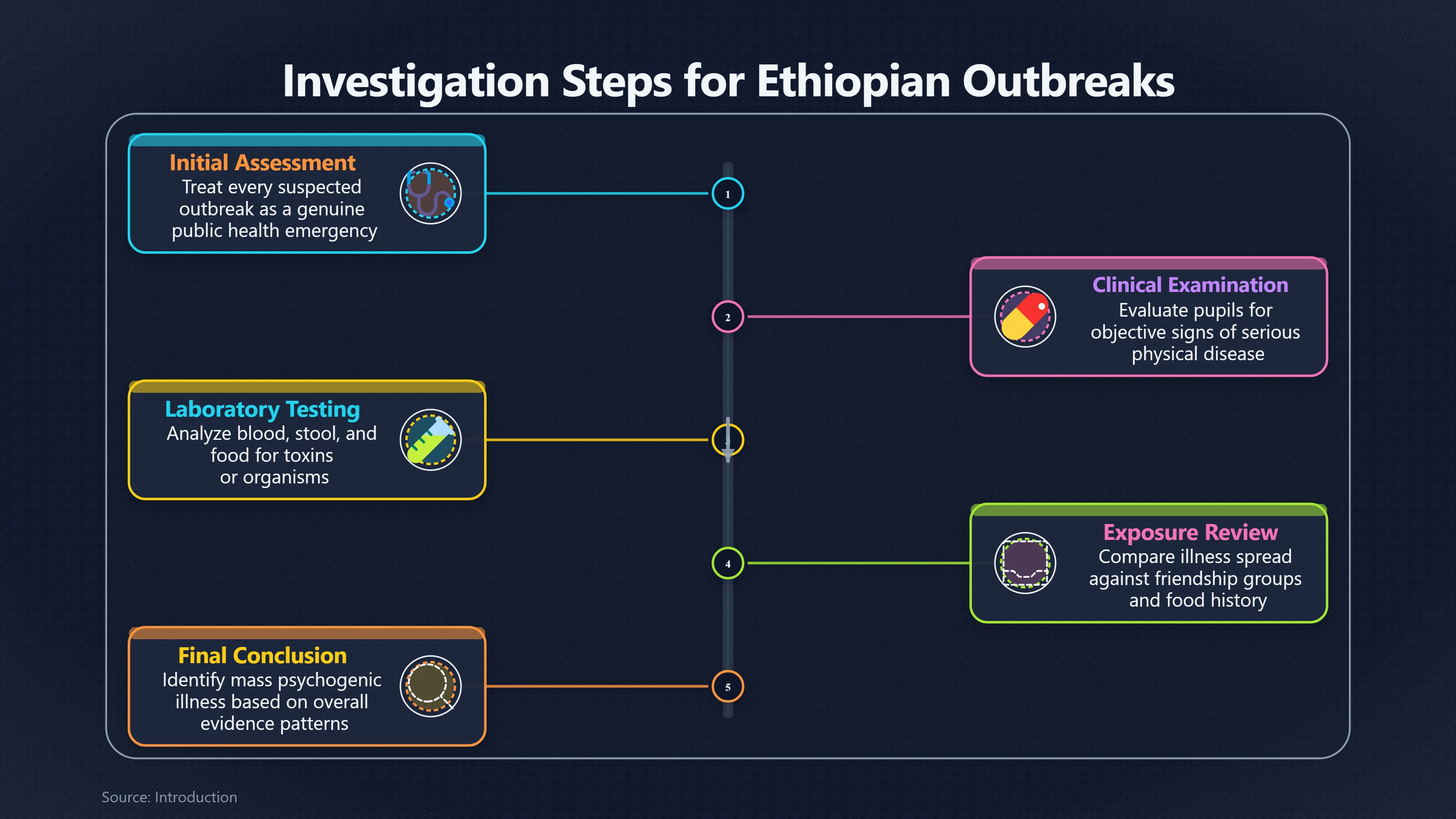
One common misunderstanding is that these outbreaks were diagnosed as psychogenic simply because doctors “could not find anything”. In reality, investigators actively tested alternative explanations before reaching that conclusion.
Across the Ethiopian investigations, they looked for several kinds of evidence:
- Clinical examination: Most pupils had symptoms but few objective signs of serious disease.
- Laboratory testing: Blood, stool and, where relevant, food samples failed to identify infectious organisms or toxins.
- Timing of cases: Illness spread through friendship groups or classrooms rather than following patterns expected for infectious disease.
- Exposure history: In Addis Ababa, many affected pupils had never eaten the food blamed for the outbreak.
- Recovery pattern: Symptoms often improved quickly after pupils were separated, reassured or temporarily removed from the school environment.
Mass psychogenic illness therefore becomes a diagnosis supported by the overall pattern of evidence rather than merely the absence of laboratory findings. Investigators also stress that every suspected outbreak should first be treated as a genuine public health emergency until dangerous causes have been excluded.[PMC]pmc.ncbi.nlm.nih.govJuly 23, 2020…
Why fear, rumours and school pressures amplified symptoms
The Ethiopian studies are consistent with international research showing that mass psychogenic illness most often develops in closely connected groups under stress.
Several interacting factors appear repeatedly.
Close observation of others. Seeing classmates faint or struggle to breathe can increase vigilance to normal bodily sensations. Minor symptoms such as dizziness or nausea may then become more intense through anxiety.
Rumours and uncertainty. In Haraza, uncertainty about the cause encouraged explanations involving supernatural forces, while in Addis Ababa rumours of contaminated school meals spread rapidly before laboratory testing was complete. Researchers argued that exaggerated reporting and conflicting information prolonged community concern.[PMC]pmc.ncbi.nlm.nih.govJuly 23, 2020…
School-related stress. Although individual stressors differed, schools are environments where examinations, discipline, peer relationships and family expectations may already create psychological pressure. Such pressures do not cause symptoms on their own but may increase vulnerability when a frightening event occurs.
Strong social cohesion. Most outbreaks occurred within tightly connected groups of pupils who spent much of the day together. The spread of symptoms followed social interaction rather than environmental exposure.
The Ethiopian investigators caution against simplistic explanations that portray adolescent girls as naturally more susceptible. While girls made up most documented cases, researchers instead emphasise social circumstances, communication patterns and the way distress is expressed within particular communities.[PMC]pmc.ncbi.nlm.nih.govJuly 23, 2020…
What these outbreaks reveal about Ethiopian society
The outbreaks also illuminate broader questions about health communication.
In Haraza, many residents initially preferred explanations involving evil spirits or the evil eye over medical interpretations. Researchers did not dismiss these beliefs as irrational; instead, they showed how existing cultural frameworks shaped people’s understanding of unfamiliar symptoms. The gap between biomedical explanations and local belief systems contributed to confusion and delayed reassurance.[PMC]pmc.ncbi.nlm.nih.govJuly 23, 2020…
The Addis Ababa episode demonstrated how public confidence can be affected by new government programmes. Because the illnesses appeared soon after the introduction of school breakfasts, many families naturally suspected the food. Even after testing failed to support poisoning, some parents remained unconvinced, illustrating how difficult it can be to rebuild trust once rumours become established.[PMC]pmc.ncbi.nlm.nih.govOpen source on nih.gov.
Lessons for schools and public health
The Ethiopian investigations recommend a careful balance between medical caution and clear communication.
Health authorities should investigate every outbreak thoroughly to exclude infectious disease or toxic exposure before considering psychogenic explanations. Once dangerous causes have been ruled out, rapid and consistent communication becomes essential.
Researchers recommend:
- prompt clinical assessment and appropriate laboratory investigation
- coordinated communication between health authorities, schools and local leaders
- avoiding contradictory or speculative public statements
- limiting the spread of unsupported rumours through media and social networks
- involving behavioural health specialists where appropriate
- educating communities about mass psychogenic illness before future outbreaks occur.
The Haraza investigators specifically argued that training public health workers and journalists about mass psychogenic illness could reduce unnecessary panic and prevent future episodes from escalating.[PMC]pmc.ncbi.nlm.nih.govJuly 23, 2020…
Why these cases remain important
Ethiopia’s documented school outbreaks are significant because they demonstrate that mass psychogenic illness is neither a historical curiosity nor evidence of deliberate deception. The symptoms experienced by pupils were real, often frightening and disruptive, even though investigators found no shared physical disease.
Taken together, the outbreaks in Bati, Haraza and Addis Ababa show how genuine illness can spread through fear, expectation and social interaction, particularly in schools where young people spend long periods together. They also underline a practical lesson for public health: careful investigation must go hand in hand with clear communication. Without trustworthy explanations, rumours can become almost as disruptive as the symptoms themselves.[PMC]pmc.ncbi.nlm.nih.govJuly 23, 2020…
Amazon book picks
Further Reading
Books and field guides related to Why Did Illness Spread Through Ethiopian Schools?. Use these as the next step if you want deeper reading beyond the article.


The Spirit Catches You and You Fall Down
Useful for understanding communication during health crises.

Endnotes
1.
Source: pmc.ncbi.nlm.nih.gov
Link:https://pmc.ncbi.nlm.nih.gov/articles/PMC7396040/
Source snippet
July 23, 2020...
Published: July 23, 2020
2.
Source: pmc.ncbi.nlm.nih.gov
Link:https://pmc.ncbi.nlm.nih.gov/articles/PMC9214752/
3.
Source: pubmed.ncbi.nlm.nih.gov
Link:https://pubmed.ncbi.nlm.nih.gov/32775400/
Source snippet
Mass Psychogenic Illness in Haraza Elementary School, Erop District, Tigray, Northern Ethiopia: Investigation to the Nature of an E...
4.
Source: pubmed.ncbi.nlm.nih.gov
Link:https://pubmed.ncbi.nlm.nih.gov/35813689/
Source snippet
Mass Hysteria among Beneficiary Students of the School-Feeding Program in Addis Ababa, Ethiopia - PubMed...
5.
Source: pubmed.ncbi.nlm.nih.gov
Title: * ^{6} Department of Psychiatry and Psychotherapy, LMU University Hospi
Link:https://pubmed.ncbi.nlm.nih.gov/42130002/
Source snippet
barriers: mental health literacy and stigma in Addis Ababa's schools - a qualitative study in Ethiopia - PubMedMay 12, 2026 — * ^{5} Depa...
Published: May 12, 2026
6.
Source: pubmed.ncbi.nlm.nih.gov
Link:https://pubmed.ncbi.nlm.nih.gov/40537604/
Source snippet
2026 Mar;61(3):405-422. doi: 10.1007/s00127-025-02949-6. Epub 2025 Jun 19. FACTORS RELATED TO THE OCCURRENCE OF MASS PSYCHOGENIC ILLNESS...
7.
Source: pmc.ncbi.nlm.nih.gov
Link:https://pmc.ncbi.nlm.nih.gov/articles/PMC5992694/
8.
Source: ouci.dntb.gov.ua
Link:https://ouci.dntb.gov.ua/en/works/7A5yzAo2/
Additional References
9.
Source: researchgate.net
Title: The objective was to determine the cause of illness, guide interven
Link:https://www.researchgate.net/publication/360411819_Mass_Hysteria_among_Beneficiary_Students_of_the_School-Feeding_Program_in_Addis_Ababa_Ethiopia
Source snippet
(PDF) Mass Hysteria among Beneficiary Students of the School-Feeding Program in Addis Ababa, EthiopiaMay 1, 2022 — Mass psychogenic illne...
Published: May 1, 2022
10.
Source: youtube.com
Title: The Town That Caught Tourettes | Thursday, 9pm | Channel 4
Link:https://www.youtube.com/watch?v=yRwFilSEGQ0
Source snippet
The Razor-Thin Line Between Contagion and Connection | Dan Taberski | TED...
11.
Source: youtube.com
Title: Mass hysteria causing students to simulate tiger-like behaviour
Link:https://www.youtube.com/watch?v=sYHfIBleqGc
Source snippet
The Unbelievable Laughter Epidemic – The Tanganyika Mystery...
12.
Source: dergipark.org.tr
Link:https://dergipark.org.tr/en/pub/clinexphealthsci/article/1654943
Source snippet
The Societal Impacts of Mass Psychogenic Illness: A Systematic Review - Clinical and Experimental Health SciencesDecember 26, 2025 — Chro...
Published: December 26, 2025
13.
Source: researchgate.net
Link:https://www.researchgate.net/publication/340194539_Mass_Psychogenic_Illness_in_Haraza_Elementary_School_Tigray_Northern_Ethiopia_Investigation_to_the_nature_of_an_Episode
14.
Source: researchgate.net
Link:https://www.researchgate.net/publication/268694182_Outbreak_of_Mass_Psychogenic_Illness_at_a_High_School_Amhara_Region_Ethiopia_April_2010
Published: April 2010
15.
Source: nejm.org
Link:https://www.nejm.org/doi/abs/10.1056/NEJM200001133420206
16.
Source: mendeley.com
Link:https://www.mendeley.com/catalogue/dfceb3d0-8fac-3559-8889-e0c1a881c658/
17.
Source: scienceopen.com
Link:https://www.scienceopen.com/document?vid=74a5e4fb-b3bc-45e4-8c31-a5a62c2f57b9
18.
Source: youtube.com
Title: Teens suffer from mystery illness
Link:https://www.youtube.com/watch?v=M-Sg0EM8fFM
Source snippet
Mass hysteria causing students to simulate tiger-like behaviour...
Topic Tree