Within Moldova Belief Panics
Why Did Inochentism Spread So Far?
Inochentism turned vernacular preaching, miracle claims and end-times hope into Moldova's most enduring millenarian movement.
On this page
- The monk, the miracles and the end times
- Why Bessarabian peasants joined the movement
- From Balta psychosis to lasting religious identity
Page outline Jump by section
Introduction
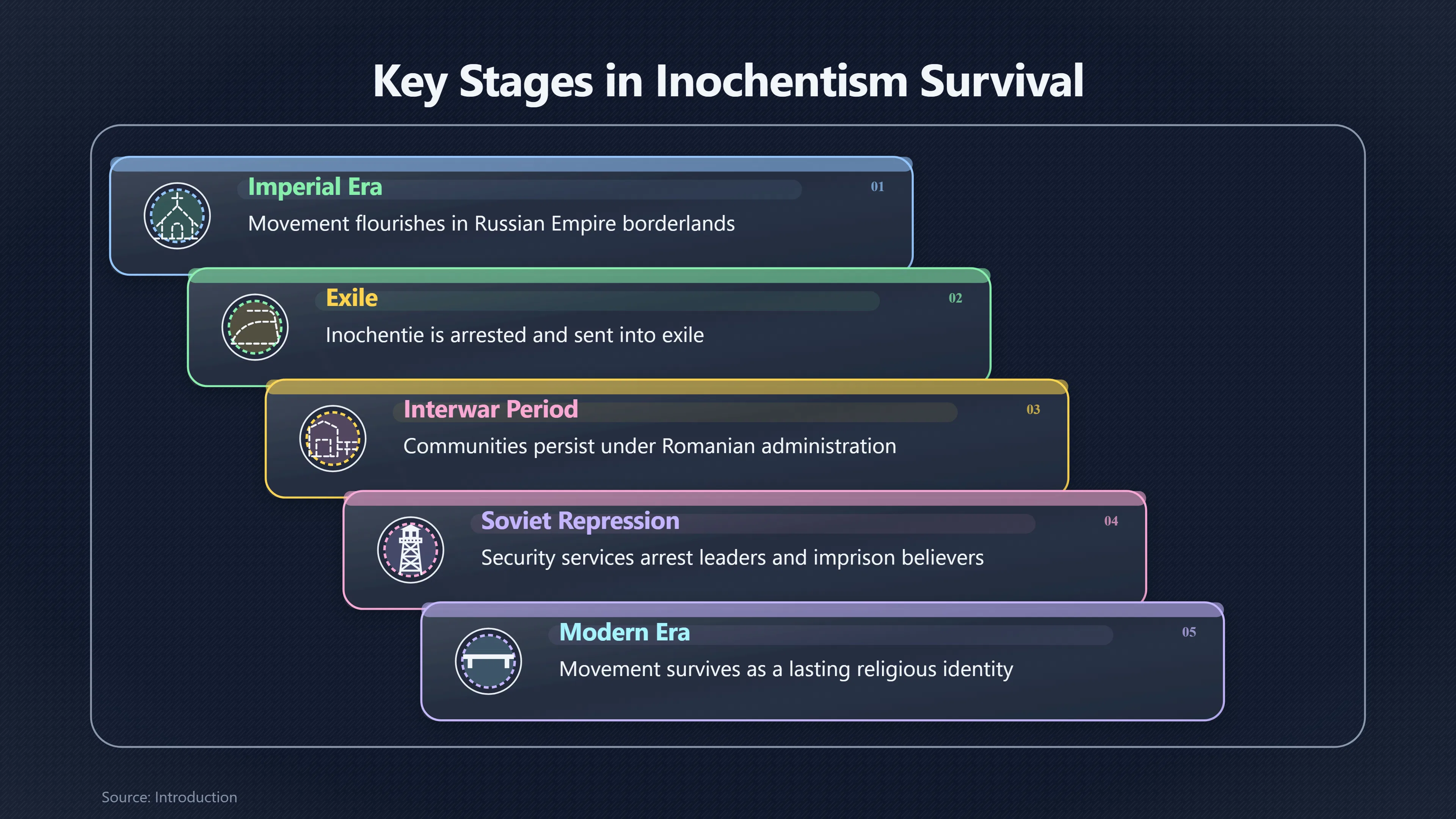
Inochentism was the most influential millenarian movement to emerge from what is now Moldova. Beginning in the final years of the Russian Empire, it combined charismatic preaching, miracle claims and an urgent expectation that history itself was approaching a decisive turning point. Rather than being a short-lived religious craze, it became a durable movement that survived exile, political upheaval, Romanian rule, Soviet persecution and the independence of modern Moldova. Its story helps explain why apocalyptic hope could spread so widely among Bessarabian peasants and why officials increasingly interpreted the movement as a threat to public order rather than simply a religious revival.[dacoromania.net]dacoromania.netOpen source on dacoromania.net.

Why Did Inochentism Spread So Far?
Inochentism did not arise in a social vacuum. It flourished in Bessarabia, a largely rural frontier province where many Romanian-speaking Orthodox Christians felt politically and culturally marginalised within the Russian Empire. State institutions increasingly promoted Russian language and administration, while church leadership was often appointed from outside the local population. Into this environment stepped the monk Ioan Levizor, later known as Inochenție, whose sermons were delivered in the language ordinary villagers spoke and understood.[dacoromania.net]dacoromania.netOpen source on dacoromania.net.
For many followers, the attraction was not only theological. Inochenție presented an intensely personal religious message that promised healing, divine justice and the nearness of God’s kingdom. He offered a spiritual world in which poor peasants occupied the centre rather than the margins of history. Historians increasingly interpret this as a movement of religious and cultural self-assertion as much as one of apocalyptic expectation. Instead of viewing it solely as irrational enthusiasm, recent scholarship places it within the wider experience of imperial borderlands where language, identity and religion became closely intertwined.[dacoromania.net]dacoromania.netOpen source on dacoromania.net.
The Monk, the Miracles and the End Times
According to movement tradition, Levizor experienced visions of the Virgin Mary before entering monastic life. After moving to the newly established monastery at Balta, he gained a reputation as an unusually compelling preacher and miracle worker. Pilgrims travelled from across Bessarabia and neighbouring provinces seeking healing, spiritual guidance and preparation for the approaching end of the age.[dacoromania.net]dacoromania.netOpen source on dacoromania.net.
His preaching centred on several interconnected ideas:
- the world stood on the threshold of dramatic divine intervention;
- miraculous gifts showed that the Holy Spirit was acting in the present;
- suffering possessed spiritual value and could help prepare humanity for God’s kingdom;
- ordinary believers had a direct role in the unfolding sacred drama.
As devotion intensified, some followers attributed extraordinary status to Inochenție himself. Critics claimed that he was treated as the embodiment of the Holy Spirit, while supporters understood him as God’s uniquely chosen servant. Distinguishing precisely which beliefs belonged to the founder and which developed among enthusiastic followers is difficult because much surviving evidence comes from hostile church or government investigators. Modern historians therefore treat the most dramatic accusations cautiously rather than accepting them uncritically.[dacoromania.net]dacoromania.netOpen source on dacoromania.net.
The movement also created sacred geography. Around Balta, believers established what became known as the “Garden of Paradise”, while later communities developed underground religious centres described as a “New Jerusalem”. These places symbolised the conviction that the biblical end times were unfolding in their own generation.[dacoromania.net]dacoromania.netOpen source on dacoromania.net.
Why Bessarabian Peasants Joined the Movement
The movement’s rapid expansion reflected several reinforcing social mechanisms rather than a single cause.
Religious accessibility. Sermons in Romanian reached people who often encountered official church life through Russian-speaking institutions. This made Inochenție’s message emotionally immediate and culturally familiar.[dacoromania.net]dacoromania.netOpen source on dacoromania.net.
Miracle culture. Pilgrimage, healing stories and reports of supernatural experiences encouraged further attendance. Every claimed cure or vision strengthened the expectation that extraordinary times had arrived.[Wikipedia]WikipediaOpen source on wikipedia.org.
Apocalyptic hope. Hardship acquired meaning within an end-times narrative. Poverty, injustice and political uncertainty no longer appeared permanent but became signs that divine transformation was close.[OUP Academic]academic.oup.comOUP AcademicEschatology and Peasant Visions in Moldovan Folk Religion | The Oxford Handbook of Slavic and East European Folklore | Oxford…
Collective participation. Large pilgrimages allowed believers to witness the faith of thousands of others. Contemporary reports estimated that more than 80,000 pilgrims visited Balta during the movement’s peak in 1910, reinforcing the impression that history itself was visibly changing.[dacoromania.net]dacoromania.netOpen source on dacoromania.net.
These factors produced a powerful feedback loop. Pilgrimages generated miracle stories; miracle stories attracted more pilgrims; growing crowds seemed to confirm the movement’s divine significance.

From Balta “Psychosis” to Lasting Religious Identity
Imperial authorities viewed these developments very differently. Church leaders worried about unapproved doctrines, while civil authorities feared large unsupervised gatherings and the social consequences of apocalyptic expectation.
Investigators increasingly described the movement in medical language. Contemporary psychiatrists referred to the excitement surrounding Balta as the “Balta psychosis”. Their explanations reflected the assumptions of the early twentieth century rather than modern psychological research. Some attributed the phenomenon to poor education, malnutrition and emotional suggestion, while others dismissed it as manipulation by charismatic leaders. Few attempted to understand the movement through its linguistic, cultural or political setting.[dacoromania.net]dacoromania.netOpen source on dacoromania.net.
The official response hardened after Inochenție’s arrest and exile in 1912. Instead of disappearing, the movement became even more explicitly apocalyptic. Some followers sold property, embraced celibacy or joined communal settlements while awaiting the imminent transformation of the world. The leader’s absence reinforced rather than extinguished expectations that a decisive divine intervention was near.[dacoromania.net]dacoromania.netOpen source on dacoromania.net.
Modern historians generally avoid treating the phrase “Balta psychosis” as a clinical diagnosis. Instead, they see it as an example of how governments and church authorities used the language of psychiatry to explain away forms of popular religion they regarded as socially disruptive.[dacoromania.net]dacoromania.netOpen source on dacoromania.net.
Survival Through Repression
Unlike many millenarian movements, Inochentism did not collapse after its founder’s death in 1917.
Communities continued under Romanian administration between the world wars, although they often faced suspicion from both church and state. After the Soviet Union reoccupied Moldova, repression became far more systematic. Security services arrested leaders, imprisoned believers and portrayed the movement as an antisocial sect in propaganda campaigns. Soviet publications frequently exaggerated or distorted its teachings, adding sensational allegations that are poorly supported by historical evidence.[dacoromania.net]dacoromania.netOpen source on dacoromania.net.
Despite repeated campaigns, the movement survived underground. Official memoranda from the late 1940s reported Inochentite groups in numerous villages, particularly around Bălți, Soroca, Orhei and Chișinău. Even after arrests, labour camps and monastery closures, believers maintained local communities that persisted into the late Soviet period.[dacoromania.net]dacoromania.netOpen source on dacoromania.net.
This endurance distinguishes Inochentism from many episodes of religious excitement. Rather than remaining a brief outbreak of collective expectation, it evolved into a continuing religious identity passed across generations.

Why It Still Matters
Inochentism occupies a distinctive place in Moldova’s history because it illustrates how apocalyptic belief can emerge from ordinary social conditions rather than extraordinary irrationality.
The movement brought together vernacular religion, ethnic identity, charismatic leadership and expectations of the end times in ways that resonated deeply with rural communities experiencing rapid political and cultural change. It also demonstrates how states often respond to unconventional religious movements by framing them as medical, criminal or political problems rather than engaging with the beliefs that attract followers.
For historians of religion, Inochentism is therefore more than an unusual episode of miracle claims or prophetic preaching. It provides a window into how collective hope spreads, how authorities classify unfamiliar belief, and how an apocalyptic movement can become a lasting component of Moldova’s religious landscape long after the dramatic expectations that first inspired it have faded.[OUP Academic]academic.oup.comOUP AcademicEschatology and Peasant Visions in Moldovan Folk Religion | The Oxford Handbook of Slavic and East European Folklore | Oxford…
Amazon book picks
Further Reading
Books and field guides related to Why Did Inochentism Spread So Far?. Use these as the next step if you want deeper reading beyond the article.
When Prophecy Fails
Explains why apocalyptic groups often persist despite disappointment.

The pursuit of the millennium
The closest widely available book for understanding Inochentism's apocalyptic appeal.
Endnotes
1.
Source: dacoromania.net
Link:https://dacoromania.net/article/apocalypticism_russian_borderlands_inochentie_levizor_and_his_moldovan_followers
2.
Source: academic.oup.com
Link:https://academic.oup.com/edited-volume/43182/chapter-abstract/425658474
Source snippet
OUP AcademicEschatology and Peasant Visions in Moldovan Folk Religion | The Oxford Handbook of Slavic and East European Folklore | Oxford...
3.
Source: Wikipedia
Link:https://en.wikipedia.org/wiki/Inochentism
4.
Source: dacoromania.net
Link:https://dacoromania.net/articles/bessarabia
5.
Source: academic.oup.com
Link:https://academic.oup.com/book/24827
Additional References
6.
Source: tandfonline.com
Link:https://www.tandfonline.com/doi/abs/10.1080/09637499808431829
Source snippet
Taylor & Francis OnlineApocalypticism in the Russian borderlands: Inochentie Levizor and his Moldovan followers∗: Religion, State and So...
7.
Source: elib.fi
Link:https://elib.fi/m/articles/view/The-Innocent-Movement-and-the-Moldavian-question-in-Bessarabia-at-the-beginning-of-the-XX-century
Source snippet
December 15, 2024 — The Innocent Movement and the "Moldavian question" in Bessarabia at the beginning of the XX century Article text · Co...
Published: December 15, 2024
8.
Source: elibrary.pl
Link:https://elibrary.pl/m/articles/view/The-Innocent-Movement-and-the-Moldavian-question-in-Bessarabia-at-the-beginning-of-the-XX-century
Source snippet
According to some sources, his real surname is Turcan. See: Popovschi, Istoria Bisericii din Basarabia, p. 441. page 88 In 1909, Levizor...
9.
Source: researchgate.net
Title: (PDF) `The Inochentism: Faith, Ritual Practices, and Sacred Spaces
Link:https://www.researchgate.net/publication/401927549_The_Inochentism_Faith_Ritual_Practices_and_Sacred_Spaces_New_Data_and_Approaches_in_Hiperboreea_7_2_2020_pp
Source snippet
New Data and Approaches`, in Hiperboreea, 7 (2), 2020, pp. 203 – 231.November 17, 2020 — Article PDF Available `THE INOCHENTISM: FAITH, R...
Published: November 17, 2020
10.
Source: schweitzer-online.de
Link:https://www.schweitzer-online.de/ebook/Kapalo/Inochentism-Orthodox-Christianity/9781317116264/A41641334/
Source snippet
Kapalo | 1. Auflage | 2019June 5, 2019 — WEITERE DETAILS Reihe Routledge New Religions Auflage 1. Auflage Sprache Englisch Verlagsort Lon...
Published: June 5, 2019
11.
Source: readingreligion.org
Title: Inochentism and Orthodox Christianity
Link:https://readingreligion.org/9781472432186/inochentism-and-orthodox-christianity/
Source snippet
Reading ReligionApril 1, 2022 — Its followers continued to think of themselves as Orthodox, yet had a complicated relationship to the Ort...
Published: April 1, 2022
12.
Source: youtube.com
Title: Eastern Orthodoxy in Communist Romania: the Burning Bush Movement
Link:https://www.youtube.com/watch?v=d0SVUVBTb_4
Source snippet
3 Moldova A History of Identity and Imperial Resilience...
13.
Source: youtube.com
Title: Romania’s ‘Old Believers’ cling to traditions
Link:https://www.youtube.com/watch?v=odqY3Dp48fY
Source snippet
2 Eastern Orthodoxy in Communist Romania: the Burning Bush Movement...
14.
Source: youtube.com
Title: Moldova A History of Identity and Imperial Resilience
Link:https://www.youtube.com/watch?v=tphnqvJfLoc
Source snippet
4 Moldova History in 3 Minutes #moldova #history...
15.
Source: researchgate.net
Link:https://www.researchgate.net/publication/392867780_Innocentism_and_its_impact_on_the_linguistic_policy_of_the_orthodox_church_in_Bessarabia
Topic Tree