Within Congo
Why Were Children Branded as Witches?
Children were blamed for illness and hardship as war, poverty, family breakdown and paid deliverance ministries intensified witchcraft fears.
On this page
- How suspicion settled on vulnerable children
- Church deliverance, payment and documented abuse
- War, displacement and the growth of the panic
Page outline Jump by section
Introduction
From the 1990s onwards, thousands of children in Kinshasa and other cities in the Democratic Republic of the Congo were accused of being witches and blamed for illness, unemployment, deaths, failed businesses and other family misfortunes. These accusations did not emerge because children suddenly became the focus of older beliefs about witchcraft. Rather, they reflected a profound urban family crisis created by war, economic collapse, displacement and changing religious practices. Children who had already become vulnerable through bereavement, poverty or disability were increasingly identified as the supposed source of household suffering. The consequences were severe: abandonment, homelessness, violent “deliverance” rituals, extortion and long-term psychological trauma. Researchers, child-protection organisations and many Congolese church leaders argue that the phenomenon is best understood as a social crisis rather than evidence of widespread child witchcraft.[savethechildren.net]resourcecentre.savethechildren.netSave the Children’s Resource Centre…

Why did suspicion settle on children?
Belief in witchcraft has long existed in many parts of Central Africa, but historians and anthropologists emphasise that the widespread accusation of young children represents a comparatively recent development. Earlier accusations more commonly targeted adults, particularly socially isolated women. In Kinshasa’s rapidly expanding urban environment during the 1990s, children increasingly became the preferred targets.
Several pressures combined to produce this shift.
- Family disruption: Civil wars, disease and migration left many children orphaned or living with step-parents or extended relatives already struggling financially.
- Extreme urban poverty: Households unable to feed everyone sometimes sought an explanation for continuing hardship that personalised economic failure.
- Changing family structures: Kinship networks that traditionally absorbed orphaned children became overwhelmed as conflict and urbanisation accelerated.
- Visible vulnerability: Children with disabilities, behavioural difficulties, learning problems, epilepsy, autism-like symptoms or simply unusual personalities could be interpreted as displaying supernatural signs rather than medical or developmental conditions.[savethechildren.net]resourcecentre.savethechildren.netSave the Children’s Resource Centre…
Human Rights Watch found that accused children were disproportionately those who had already lost one or both parents or were living with relatives rather than both biological parents. Aid workers repeatedly described witchcraft accusations as a mechanism for excluding children who had become economically difficult to support rather than the original cause of family conflict.[Human Rights Watch]hrw.orgOpen source on hrw.org.
Church deliverance, payment and documented abuse
One of the distinctive features of the Kinshasa panic was the role played by parts of the rapidly expanding network of independent revival churches.
Not all Pentecostal or revival churches encouraged child-witch accusations. Many actively opposed them. However, researchers documented that some self-described prophets and pastors built ministries around identifying witches and performing paid “deliverance” ceremonies. Families already desperate for answers were encouraged to interpret ordinary childhood behaviour, nightmares, illness or misfortune as proof of hidden supernatural activity.
These deliverance rituals frequently involved payments for counselling, fasting or exorcism. Investigations documented children being:
- forced to confess to impossible crimes;
- deprived of food and water during prolonged rituals;
- beaten or whipped;
- isolated from relatives;
- publicly humiliated as possessed or dangerous.
Children who failed to satisfy pastors or relatives were sometimes expelled from their homes altogether. Human Rights Watch described deliverance ministries as both responding to existing fears and reinforcing them by validating accusations and providing a religious framework through which they spread.[Human Rights Watch]hrw.orgOpen source on hrw.org.
The 2005 Save the Children study described this relationship as one of “religious commerce”, arguing that accusations could become economically profitable where spiritual diagnosis and deliverance services attracted paying clients. Rather than creating belief from nothing, these ministries often intensified existing family anxieties and gave them institutional legitimacy.[resourcecentre.savethechildren.net]resourcecentre.savethechildren.netSave the Children’s Resource Centre…
More recent research complicates the picture. A large survey of over 700 church leaders in Kinshasa found that while some pastors continued to support witch-diagnosis and deliverance, others had adopted a child-protection approach that rejects accusations and works to reconcile families. This illustrates that Congolese Christianity has become one of the main arenas in which the controversy is debated rather than a single unified source of the problem.[ResearchGate]researchgate.netResearch Gate(PDF) Christian Pastors and Alleged Child Witches in Kinshasa, DRCResearch Gate(PDF) Christian Pastors and Alleged Child Witches in Kinshasa, DRC

War, displacement and the growth of the panic
The timing of the accusations closely matched one of the country’s most traumatic periods.
The First and Second Congo Wars, combined with decades of economic decline and state weakness, uprooted millions of people. Kinshasa grew rapidly as displaced families sought safety and employment. Housing shortages, unemployment and inflation placed enormous strain on households that had previously relied on wider family support.
Within these conditions, accusations of witchcraft offered an emotionally satisfying explanation for events that otherwise appeared uncontrollable. Instead of viewing repeated illness, unemployment or bereavement as consequences of conflict, poverty or failing public services, some families came to believe that a child within the household was secretly causing disaster.
Researchers stress that this mechanism resembles a scapegoating process more than a traditional witch hunt. The accused children were usually those with the least power to defend themselves. They were often already marginal because they were orphans, stepchildren, disabled children or children who displayed behaviour that adults found difficult to understand.[savethechildren.net]resourcecentre.savethechildren.netSave the Children’s Resource Centre…
The accusations also became closely connected to the rise in street children. Human Rights Watch reported estimates from local organisations suggesting that a large proportion of Kinshasa’s street children had previously been accused of sorcery before leaving or being expelled from home. Although precise percentages remain difficult to verify, multiple investigations agree that witchcraft accusations became one of the major pathways into homelessness.[Human Rights Watch]hrw.orgOpen source on hrw.org.
How the accusations spread
Unlike a single outbreak of mass hysteria, the Kinshasa phenomenon spread through repeated social interactions that reinforced one another.
Families experiencing hardship sought explanations from neighbours or religious leaders. Stories circulated of children allegedly admitting supernatural powers after intensive questioning or deliverance rituals. Public testimonies during church services, radio broadcasts and word of mouth helped normalise the belief that children could secretly destroy households from within.
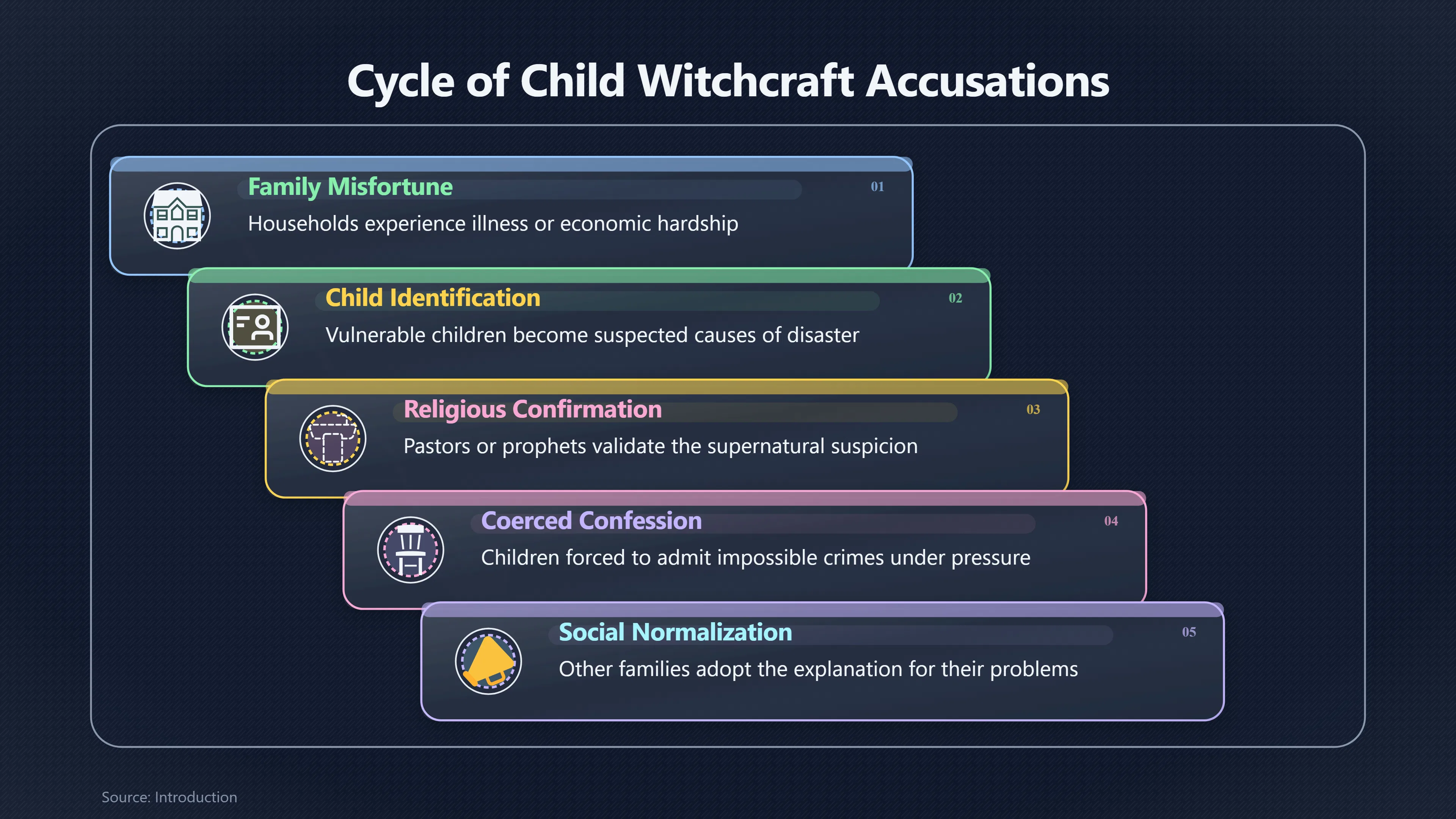
The process became self-reinforcing:
- A family experienced misfortune.
- A vulnerable child became the suspected cause.
- A pastor or prophet confirmed the suspicion.
- The child’s forced confession appeared to validate the accusation.
- Other families copied the same explanation for their own problems.
Researchers note that coerced confessions often became persuasive evidence for observers despite occurring under extreme psychological pressure or abuse.[savethechildren.net]resourcecentre.savethechildren.netSave the Children’s Resource Centre…

How authorities and child-protection groups responded
Congolese authorities, UNICEF, Save the Children, Human Rights Watch and numerous local organisations have worked to reduce accusations through child-protection programmes, legal reform and community education.
Responses have included:
- supporting abandoned children living on the streets;
- training pastors to reject child-witch accusations;[researchgate.net]researchgate.netSource details in endnotes.
- family mediation and reunification;
- public awareness campaigns;
- encouraging police and courts to treat abuse as a child-protection issue rather than a spiritual matter.
Progress has been uneven. Legal protections exist, but enforcement remains inconsistent, particularly where accusations are deeply embedded within local religious or family life. Child-protection workers therefore increasingly focus on changing community beliefs as well as rescuing individual children.[savethechildren.net]resourcecentre.savethechildren.netSave the Children’s Resource Centre…
Why the episode matters
Child-witch accusations in Kinshasa are sometimes described as evidence of irrational belief or religious extremism. Most specialists reject that interpretation as too simplistic.
Instead, they argue that the accusations reveal how societies under severe stress search for explanations that fit existing cultural ideas. War, poverty, bereavement, rapid urban growth and weakened institutions created conditions in which vulnerable children became convenient scapegoats. The panic therefore says as much about collapsing social protection as it does about beliefs in witchcraft.
It also demonstrates why the label “cult” should be used carefully. While some exploitative deliverance ministries profited from fear and contributed directly to abuse, many Congolese churches have become active opponents of child-witch accusations, promoting child safeguarding and theological reinterpretations that challenge earlier practices. Understanding these competing religious responses provides a more accurate picture than treating the crisis as the product of a single movement or a single belief system.[researchgate.net]researchgate.netResearch Gate(PDF) Christian Pastors and Alleged Child Witches in Kinshasa, DRCResearch Gate(PDF) Christian Pastors and Alleged Child Witches in Kinshasa, DRC
Amazon book picks
Further Reading
Books and field guides related to Why Were Children Branded as Witches?. Use these as the next step if you want deeper reading beyond the article.

The Spirit Catches You and You Fall Down
Explores clashes between belief, medicine and vulnerable families.
King Leopold's ghost
Explains long-term historical pressures affecting Congolese society.
African religions and philosophy
Introduces African beliefs without reinforcing stereotypes.
Endnotes
1.
Source: resourcecentre.savethechildren.net
Link:https://resourcecentre.savethechildren.net/document/invention-child-witches-social-cleansing-religious-commerce-and-difficulties-being-parent
Source snippet
Save the Children’s Resource Centre...
2.
Source: researchgate.net
Title: Research Gate(PDF) Christian Pastors and Alleged Child Witches in Kinshasa, DRC
Link:https://www.researchgate.net/publication/338958125_Christian_Pastors_and_Alleged_Child_Witches_in_Kinshasa_DRC
3.
Source: savethechildren.net
Title: KINSHASA, 4 September 2
Link:https://www.savethechildren.net/news/number-children-and-women-treated-after-facing-sexual-violence-drc-surges-four-fold-year-save
Source snippet
Number of children and women treated after facing sexual violence in DRC surges four-fold this year: Save the Children | Save the Childre...
4.
Source: savethechildren.net
Link:https://www.savethechildren.net/news/drc-remains-epicentre-child-suffering-war-country-tops-world-list-grave-violations-against
5.
Source: researchgate.net
Link:https://www.researchgate.net/publication/46565180_Enfants_sorciers_a_Kinshasa_RD_Congo_et_developpement_des_Eglises_du_Reveil
6.
Source: resourcecentre.savethechildren.net
Title: children accused witchcraft anthropological study contemporary practices africa
Link:https://resourcecentre.savethechildren.net/document/children-accused-witchcraft-anthropological-study-contemporary-practices-africa
7.
Source: unicef.org
Link:https://www.unicef.org/nigeria/reports/children-accused-witchcraft
8.
Source: researchgate.net
Link:https://www.researchgate.net/publication/338958229_10_Christian_Pastors_and_Child_Witches_in_Kinshasa_DRC
9.
Source: hrw.org
Link:https://www.hrw.org/reports/2006/drc0406/6.htm
10.
Source: hrw.org
Link:https://www.hrw.org/reports/2006/drc0406/1.htm
Source snippet
Human Rights WatchWhat Future? Street Children in the Democratic Republic of Congo: I. Summary...
11.
Source: hrw.org
Title: D R Congo: Enforced Disappearances Surge in Kinshasa | Human Rights Watch
Link:https://www.hrw.org/news/2026/03/10/dr-congo-enforced-disappearances-surge-in-kinshasa
Source snippet
DR Congo: Enforced Disappearances Surge in Kinshasa | Human Rights WatchMarch 10, 2026 — DR CONGO: ENFORCED DISAPPEARANCES SURGE IN KINSH...
Published: March 10, 2026
12.
Source: hrw.org
Title: D.R. Congo: Election Poses Dangers for Street Children | Human Rights Watch
Link:https://www.hrw.org/news/2006/04/04/dr-congo-election-poses-dangers-street-children
13.
Source: hrw.org
Title: les enfants de la rue en republique democratique du congo
Link:https://www.hrw.org/fr/report/2006/04/04/quel-avenir/les-enfants-de-la-rue-en-republique-democratique-du-congo
14.
Source: hrw.org
Title: R D Congo: Elections à risques pour les enfants de la rue | Human Rights Watch
Link:https://www.hrw.org/fr/news/2006/04/04/rd-congo-elections-risques-pour-les-enfants-de-la-rue
Additional References
15.
Source: savethechildren.org.uk
Link:https://www.savethechildren.org.uk/news/media-centre/press-releases/2025/number-children-and-women-treated-after-facing-sexual
Source snippet
drenSeptember 4, 2025 — KINSHASA, 4 September 2025 – The number of children and women treated for sexual violence in the Democratic Repub...
Published: September 4, 2025
16.
Source: archive.crin.org
Title: The Invention of Child Witches in the Democratic Republic of Congo | CRIN
Link:https://archive.crin.org/en/library/publications/invention-child-witches-democratic-republic-congo.html
Source snippet
The Invention of Child Witches in the Democratic Republic of Congo | CRIN...
17.
Source: ecoi.net
Link:https://www.ecoi.net/en/document/1169613.html
18.
Source: streetchildren.org
Link:https://www.streetchildren.org/resources/roots-realities-and-responses-lessons-learnt-in-tackling-witchcraft-accusations-against-children/
19.
Source: theguardian.com
Link:https://www.theguardian.com/global-development/2013/jan/24/witchcraft-children-congo-drc-poverty
20.
Source: ojs.unica.it
Link:https://ojs.unica.it/index.php/anuac/article/view/3675
21.
Source: pludoc.mesrs.gov.gn
Link:https://pludoc.mesrs.gov.gn/bib/749161
22.
Source: youtube.com
Title: The agony of Congo’s ‘child witches’
Link:https://www.youtube.com/watch?v=bPGaVv5rNww
Source snippet
Democratic Republic of the Congo: DRC's "Child Witches"...
23.
Source: youtube.com
Title: The agony of Congo’s ‘child witches’
Link:https://www.youtube.com/watch?v=UwCGxP35agE
Source snippet
Democratic Republic of Congo: Congo's Lost Children...
24.
Source: itv.com
Title: Special Report: Witchcraft problems in the DRC | ITV News London
Link:https://www.itv.com/news/london/2012-03-01/witchcraft-duo-found-guilty-of-murder/
Topic Tree