Within Senegal
Why Colonial Officials Feared the Layene Movement
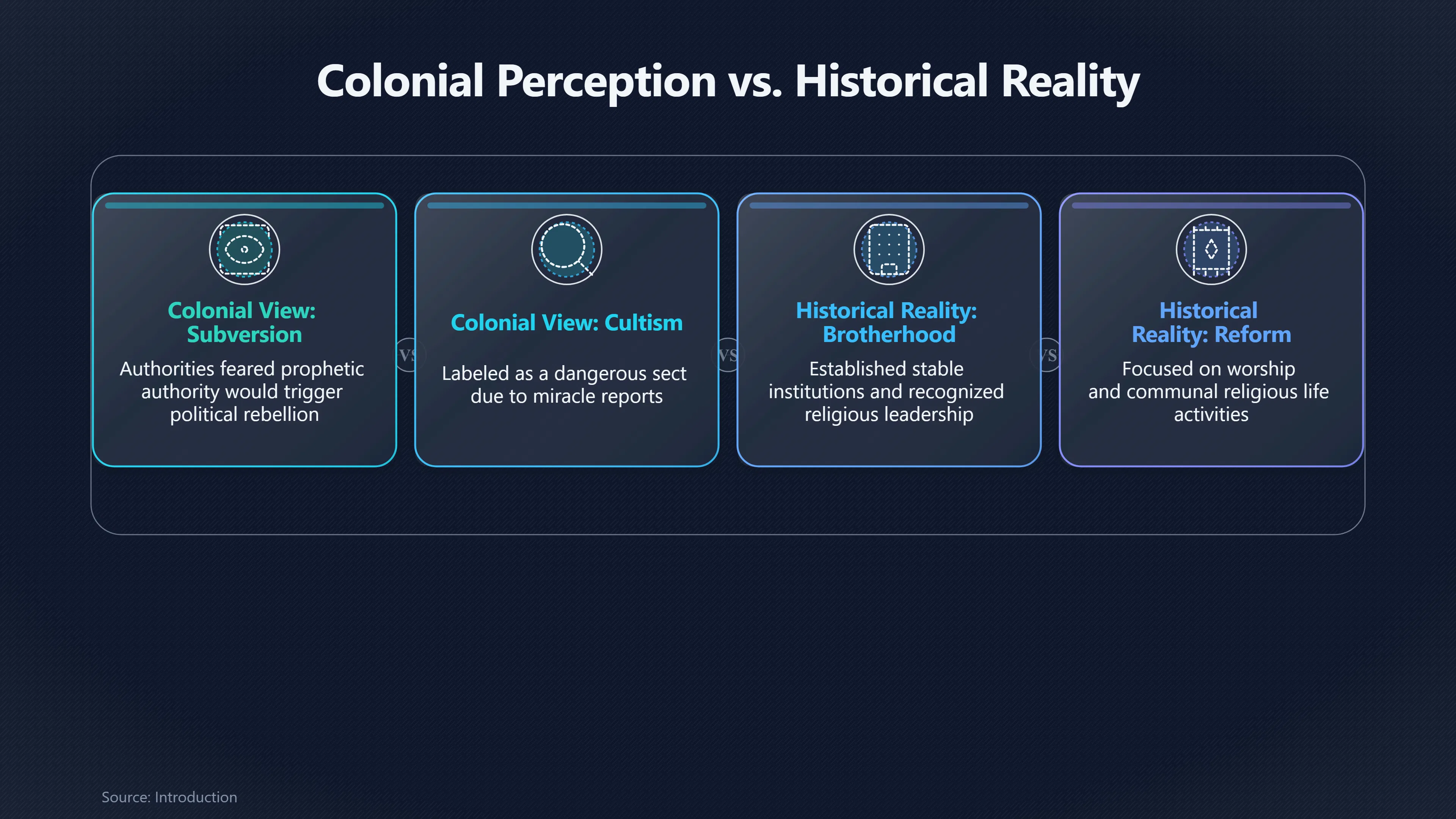
The Layene brotherhood shows how an organised religious movement could be misread as fanaticism when colonial officials feared unfamiliar authority.
On this page
- Seydina Limamou Laye and the movement's teachings
- Why colonial authorities saw prophetic authority as dangerous
- The difference between a religious brotherhood and a cult label
Page outline Jump by section
Introduction
The Layene movement is one of Senegal’s best examples of how a new religious community could be mistaken for a political threat during the colonial era. Founded by Seydina Mouhamadou Limamou Laye near Dakar in the late nineteenth century, the movement centred on his declaration that he was the Mahdi, a divinely guided renewer of Islam. To followers, this was a call to moral reform, equality and spiritual renewal. To many French colonial officials, however, any rapidly growing movement built around charismatic prophetic authority appeared potentially subversive. The result was surveillance, restrictions and periods of detention that reflected colonial anxieties as much as the movement’s actual activities. Historians today generally distinguish between the Layene brotherhood as an established Islamic community and the “cult” language that some colonial observers and opponents used to discredit it.[africabib.org]africabib.orgAfricaBib | Les persecutions de Seydina Mouhamadou Limamou Lâye par les autorités coloniales…

Seydina Limamou Laye and the movement’s teachings
Seydina Mouhamadou Limamou Laye (1843–1909) was born in the Lebu fishing community of Yoff, on the Cap-Vert peninsula near present-day Dakar. In 1884 he publicly announced that he had been called to fulfil the role of the Mahdi. His message urged stricter observance of Islam, regular prayer, charity, moral discipline and the rejection of practices that he believed had become mixed with older local religious traditions.[wikipedia.org]WikipediaSeydina Mouhammadou Limamou LayeSeydina Mouhammadou Limamou Laye
The movement also developed distinctive beliefs that set it apart from Senegal’s larger Sufi brotherhoods. Layene tradition identifies Limamou Laye as the promised Mahdi and attributes a unique spiritual role to his son, Seydina Issa Rohou Laye. The community stresses equality among believers, encourages simple white clothing as a symbol of purity and social equality, and has long been notable for the visible participation of women in religious life. These characteristics made the brotherhood unusual but not secretive; it organised public worship, pilgrimages and communal religious observances rather than operating as an isolated sect.[ebrary.net]ebrary.netThe LayenneThe Layenne - Routledge Handbook on Sufism…
Why colonial authorities saw prophetic authority as dangerous
French officials did not view the Layene movement in isolation. Across North and West Africa during the nineteenth century, colonial governments associated claims to be the Mahdi with the possibility of rebellion. The Mahdist uprising in Sudan had demonstrated that prophetic movements could mobilise large numbers of followers against colonial rule. Consequently, administrators often treated new claimants with suspicion before examining the local circumstances.[Ebrary]ebrary.netThe LayenneThe Layenne - Routledge Handbook on Sufism…
When Limamou Laye’s preaching attracted increasing numbers of followers around Dakar, French authorities feared that his influence might destabilise the colony, particularly because the movement was expanding close to the colonial capital. Reports from the period reveal concerns that large gatherings, miraculous claims and growing personal loyalty to a prophetic leader might evolve into political resistance, even though clear evidence for an organised anti-colonial conspiracy was lacking.[africabib.org]africabib.orgAfricaBib | Les persecutions de Seydina Mouhamadou Limamou Lâye par les autorités coloniales…
These fears culminated in official intervention. In 1887 Limamou Laye was arrested and confined on Gorée Island for several months before being released under restrictions. Some followers were discouraged from settling in Yoff, contributing to the later development of the Layene community at Cambérène. Modern historians generally interpret these actions as precautionary measures driven by colonial anxiety rather than responses to proven plans for insurrection.[ebrary.net]ebrary.netThe LayenneThe Layenne - Routledge Handbook on Sufism…
Why the movement acquired a “cult” reputation in colonial eyes
The label of a dangerous religious “sect” or “cult” emerged from several overlapping factors rather than from evidence of coercive behaviour.
First, Limamou Laye claimed exceptional spiritual authority. Such claims challenged established religious leaders and attracted criticism from some Muslim scholars who rejected his interpretation of Islamic prophecy. Religious disagreement therefore reinforced official suspicion.[Africabib]africabib.orgAfricaBib | Les persecutions de Seydina Mouhamadou Limamou Lâye par les autorités coloniales…
Second, reports of miracles and healings spread rapidly among supporters. For believers these confirmed divine favour, while sceptics interpreted them as evidence of fanaticism or mass credulity. Colonial administrators often lacked the cultural and theological background needed to distinguish ordinary expressions of popular religion from signs of political mobilisation.[Ebrary]ebrary.netThe LayenneThe Layenne - Routledge Handbook on Sufism…
Third, the movement expanded quickly within the Lebu population around Dakar. Colonial governments commonly regarded any organisation capable of attracting hundreds or thousands of committed followers outside direct administrative control as a potential security problem. In this context, growth itself became suspicious.[Africabib]africabib.orgAfricaBib | Les persecutions de Seydina Mouhamadou Limamou Lâye par les autorités coloniales…

The difference between a religious brotherhood and a cult label
Modern scholarship draws an important distinction between colonial language and the historical reality of the Layene movement.
Calling the Layene community a “cult” largely reflects the vocabulary of colonial officials and some contemporary opponents rather than an accepted description used by historians today. The brotherhood developed stable institutions, recognised leadership, enduring places of worship and a continuing religious tradition that has remained part of Senegal’s Islamic landscape for well over a century.[africabib.org]africabib.orgAfricaBib | Les persecutions de Seydina Mouhamadou Limamou Lâye par les autorités coloniales…
Nor does the historical evidence support the idea that the movement relied primarily on secrecy, coercion or violent confrontation with the state. Although followers believed in Limamou Laye’s prophetic status and accepted teachings that many other Muslims rejected, the community’s central activities focused on worship, moral reform and communal religious life. The colonial administration’s concerns were shaped less by documented violence than by uncertainty about how prophetic authority might influence a rapidly growing population living near the administrative centre of French Senegal.[Ebrary]ebrary.netThe LayenneThe Layenne - Routledge Handbook on Sufism…
This distinction matters because colonial governments frequently described unfamiliar religious movements in ways that blurred theological disagreement with political danger. The Layene experience illustrates how official fears can transform an unconventional but organised religious community into a perceived security threat.
Why the episode matters in Senegal’s history of collective fear
The Layene story belongs in Senegal’s wider history of collective fears because it demonstrates a form of institutional suspicion rather than popular mass hysteria. Instead of crowds being swept up by rumours, it was colonial authorities who interpreted unfamiliar prophetic claims through a framework of security concerns inherited from other parts of Africa.
The episode also shows how labels can outlive the circumstances that produced them. While nineteenth-century officials worried that the movement might become an anti-colonial uprising, the Layene brotherhood survived as a recognised component of Senegalese Islam. Annual commemorations of Limamou Laye’s public declaration continue to attract large numbers of worshippers, underscoring the difference between temporary colonial fears and the movement’s lasting religious significance.
Amazon book picks
Further Reading
Books and field guides related to Why Colonial Officials Feared the Layene Movement. Use these as the next step if you want deeper reading beyond the article.
Muslim societies in African history
Explains how African Muslim communities developed and how religious authority interacted with political power.
West Africa before the colonial era
Provides useful background on West African societies and religious traditions preceding French colonial rule.
Citizen and subject
Helps explain the colonial administrative mindset that viewed independent religious authority with suspicion.

The Mourides of Senegal
Although focused on the Mourides, it illuminates the relationship between colonial authorities and Senegalese religious movements.
Endnotes
1.
Source: africabib.org
Link:https://www.africabib.org/rec.php?DB=i&RID=191767549
Source snippet
AfricaBib | Les persecutions de Seydina Mouhamadou Limamou Lâye par les autorités coloniales...
2.
Source: ebrary.net
Title: The Layenne
Link:https://ebrary.net/261668/education/layenne
Source snippet
The Layenne - Routledge Handbook on Sufism...
3.
Source: Wikipedia
Title: Seydina Mouhammadou Limamou Laye
Link:https://en.wikipedia.org/wiki/Seydina_Mouhammadou_Limamou_Laye
4.
Source: larousse.fr
Link:https://www.larousse.fr/encyclopedie/divers/Lay%C3%A8nes/182168
Source snippet
Layènes - LAROUSSE...
5.
Source: public.sn
Link:https://www.public.sn/index.php/2023/02/21/16225/
Source snippet
LE PUBLICSeydina Limamou Laye: le Mahdi sénégalais (1843-1909) - LE PUBLIC...
Additional References
6.
Source: apnews.com
Link:https://apnews.com/article/066e9121d2e8b8ab6d4506ebc5573661
Source snippet
The event, known as "L'Appel" or "The Call," marked the occasion with prayers, chants, and pilgrimages to a sacred grotto. Followers wore...
7.
Source: igfm.sn
Title: 139ème Appel -Le mythe du Mahdi, Limamou Thiaw devenu Seydina Limamou Laye
Link:https://www.igfm.sn/139eme-appel-de-seydina-limamoulaye-al-mahdi-adjibo-dahiya-laye-ya-marsaral-ins-wal-djin-ini-raasouloulahi-ileykoum
Source snippet
139ème Appel -Le mythe du Mahdi, Limamou Thiaw devenu Seydina Limamou Laye...
8.
Source: youtube.com
Title: Ahmadou Bamba
Link:https://www.youtube.com/watch?v=HtzUfbHMoWE
Source snippet
Sufi Movements: Organization, Migration, and Meaning...
9.
Source: youtube.com
Title: Islamic Pacifism in West Africa
Link:https://www.youtube.com/watch?v=R-0iPcjQdrI
Source snippet
Ahmadou Bamba - The Muslim Who Fought French Colonialism Through Non-Violence...
10.
Source: youtube.com
Title: Senegal’s Layene Sufi Muslims celebrate Prophet Muhammad’s birthday
Link:https://www.youtube.com/watch?v=9HZe1Nvss-A
Source snippet
Islamic Pacifism in West Africa...
11.
Source: youtube.com
Title: Sufi Movements: Organization, Migration, and Meaning
Link:https://www.youtube.com/watch?v=58ocrCJe33E
Source snippet
Sheikh Amadou Bamba...
12.
Source: youtube.com
Title: Sheikh Amadou Bamba
Link:https://www.youtube.com/watch?v=aXvFms7Vjz0
Topic Tree