When Did Fear Take Hold in Norway?
Norway’s history of collective fear is not a single story of crowds suddenly losing reason. It is a series of episodes in which genuine danger, inherited beliefs, institutional pressure and dramatic storytelling became entangled.
Page outline Jump by section
Introduction
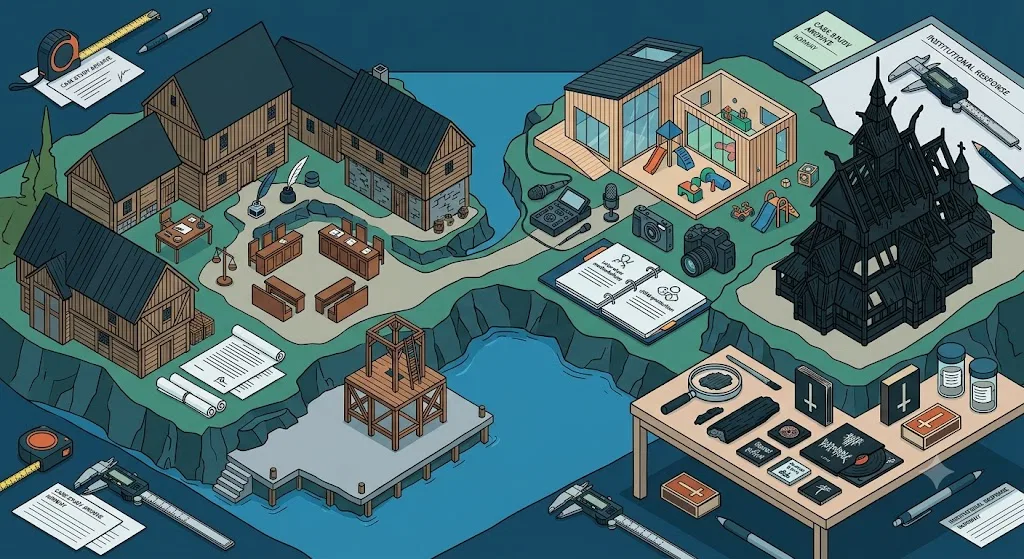
These cases matter because they show three different mechanisms. Witch persecution turned misfortune into evidence of a hidden supernatural conspiracy. Bjugn showed how legitimate concern about child abuse could combine with suggestive interviewing and escalating suspicion. The black metal scare began with serious crimes but expanded through provocative self-mythology and sensational reporting. Norway also developed UFO groups and shared in international internet scares, but the evidence does not support portraying the country as unusually prone to classic outbreaks of mass psychogenic illness.[snl.no]snl.noStore norske leksikontrolldomsprosessene i NorgeNorges verste hekseprosess der minst 19 kvinner ble «straffet på deres liv til ild og bål…
Witch trials: fear made into law
Between the late sixteenth and early eighteenth centuries, Norwegian courts prosecuted hundreds of people for alleged witchcraft. The intensity varied greatly by region. Finnmark, in the far north, suffered the most concentrated and deadly persecution: 91 people were executed there during the seventeenth century. Across Norway as a whole, scholars commonly estimate that roughly 300 people were executed, although totals depend on which surviving records and categories are counted.[snl.no]snl.noStore norske leksikontrolldomsprosessene i NorgeNorges verste hekseprosess der minst 19 kvinner ble «straffet på deres liv til ild og bål…
These were not merely outbreaks of spontaneous village superstition. Witchcraft was a recognised crime, investigated by courts and interpreted through the religious and legal assumptions of the Danish-Norwegian state. Learned European ideas about pacts with the Devil, nocturnal gatherings and organised conspiracies mixed with local accusations about harmful magic. Officials therefore helped turn individual suspicions into chain prosecutions in which one accused person was pressured to name others.[snl.no]snl.noStore norske leksikontrolldomsprosessene i NorgeNorges verste hekseprosess der minst 19 kvinner ble «straffet på deres liv til ild og bål…
Why Finnmark became so deadly
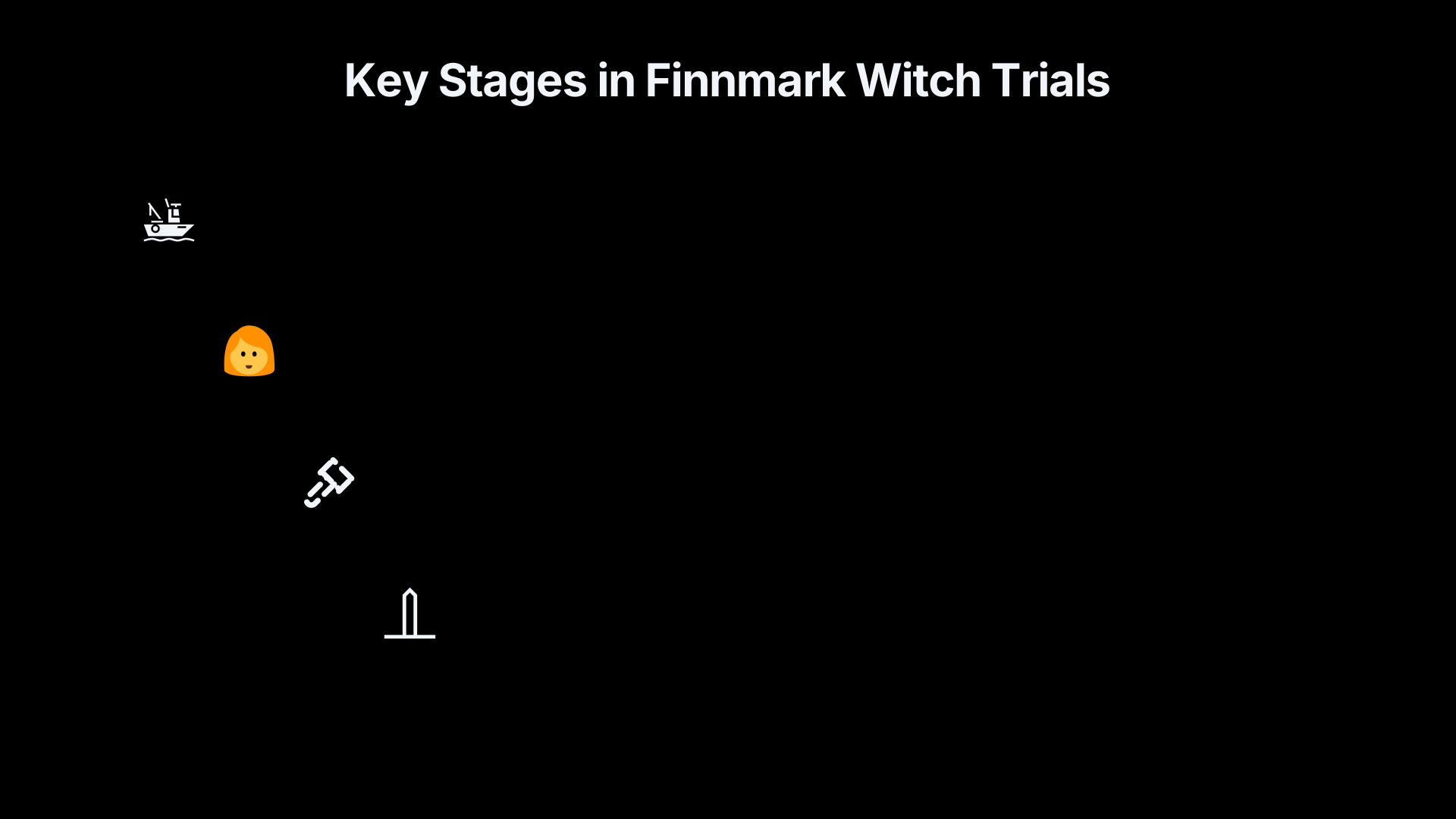
The Finnmark trials unfolded in small coastal communities exposed to dangerous weather, economic insecurity and sudden bereavement. A catastrophic storm on Christmas Eve 1617 drowned 40 men when fishing boats were overwhelmed. During trials beginning several years later, accused women were said to have created the storm by manipulating a rope and releasing the wind. Confessions implicated further suspects, producing an expanding picture of a secret conspiracy responsible for a disaster that had devastated the community.[The Guardian]theguardian.comThe Guardian Norway's witch trials: the woman killed for a fatal stormThe Guardian Norway's witch trials: the woman killed for a fatal storm
The evidence did not emerge through neutral fact-finding. Accused people faced intense psychological pressure and, in important cases, torture. Some were subjected to the water ordeal: a bound suspect who floated could be treated as guilty, while sinking supposedly indicated innocence, despite the obvious danger and unreliability of the test. Accounts of gatherings with Satan, animal-shaped demons and dances on the mountain near Vardø often appeared after coercive interrogation.[Store norske leksikon]snl.noStore norske leksikontrolldomsprosessene i NorgeNorges verste hekseprosess der minst 19 kvinner ble «straffet på deres liv til ild og bål…
The prosecutions also reflected Finnmark’s position at a political and cultural frontier. Danish-Norwegian authorities were attempting to strengthen religious discipline and state control in the north. Several Sámi men were accused in cases shaped by outsiders’ suspicions of Sámi ritual knowledge, healing and relationships with the landscape. It would nevertheless be misleading to reduce all Finnmark prosecutions to a single campaign against the Sámi: most of those executed were women from Norwegian-speaking coastal communities. Gender, poverty, reputation and local conflict all influenced who became vulnerable.[uit.no]en.uit.noOpen source on uit.no.
The 1662–63 chain prosecution
Norway’s most severe witch-hunt occurred in eastern Finnmark during 1662 and 1663. At least 19 women were condemned to death within a few months. Testimonies described witches travelling to a mountain gathering, dancing while Satan played a red violin and plotting collective harm. Such detail can make the records sound like descriptions of an underground religion, but historians treat them principally as products of demonological expectations, repeated questioning and the narrative momentum of chain accusations.[Store norske leksikon]snl.noStore norske leksikontrolldomsprosessene i NorgeNorges verste hekseprosess der minst 19 kvinner ble «straffet på deres liv til ild og bål…
Children were drawn into this episode as accusers and alleged participants. Their stories helped extend the accusations, but the authorities eventually became more sceptical of the proliferating claims. This shift illustrates a recurring feature of panics: the same institutions that validate a conspiracy can later restrict it when allegations become too expansive, internally inconsistent or socially disruptive.
The trials should therefore not be called “mass hysteria” in a medical sense. There was no epidemic of unexplained bodily symptoms. They were a judicial and religious persecution sustained by accepted law, coercive procedures and a shared explanatory system. Fear spread through testimony and authority rather than through physical contagion.
From condemned witches to commemorated victims
Norway’s later treatment of the trials has reversed their moral meaning. Steilneset Memorial opened at Vardø in 2011 to commemorate the 91 people executed in Finnmark. Designed by architect Peter Zumthor with an installation by Louise Bourgeois, it gives each victim an individual place rather than presenting the dead as an anonymous mass.[GTSVN]gtsvn.uit.noGTSVNMonument to witchcraft trial victimsThe witchcraft trials… Liv Helene Willumsen, who…
This memorialisation matters because popular culture often turns witch trials into picturesque folklore. The court records instead reveal ordinary people caught in a system that treated coerced supernatural narratives as legal evidence. Modern historians use the trials to examine state-building, gender, religious discipline, frontier politics and the way institutions can transform rumour into irreversible punishment.[UiT Norges arktiske universitet]en.uit.noOpen source on uit.no.
Bjugn: when child protection became an expanding suspicion
In 1992, allegations of sexual abuse at a nursery in Bjugn, a small community in central Norway, triggered one of the country’s most consequential modern criminal investigations. Seven adults were arrested on suspicion of abusing children. Police conducted more than 550 interviews with 220 witnesses, while 40 children took part in 61 judicial hearings. Charges against six suspects were dropped; the remaining defendant was acquitted in 1994 after a lengthy trial.[Springer Link]link.springer.comThe police conducted…Read more…
The case developed during an international period of intense anxiety about hidden abuse in nurseries and schools. In the United States, Britain and several other countries, investigators had encountered allegations involving secret tunnels, masked ceremonies, group assaults and Satanic rituals. Some individual abuse cases were real, but claims of vast, organised ritual conspiracies repeatedly failed to produce matching physical evidence. Ideas, training materials and alarming media reports travelled between countries, influencing what professionals and parents considered possible.[British Society of Criminology]britsoccrim.orgOpen source on britsoccrim.org.
Bjugn should not be dismissed as a case in which people simply invented concern about children. Child sexual abuse is real, frequently concealed and historically neglected. The central problem was how concern was converted into evidence. Repeated or suggestive questions can alter a child’s answers, particularly when adults communicate that a denial is incomplete, disappointing or incorrect. Once several ambiguous statements are interpreted as confirmation, investigators may begin questioning other children with a stronger expectation that abuse occurred.[springer.com]link.springer.comThe police conducted…Read more…
The investigation consequently became a landmark in Norwegian thinking about forensic interviews. Later reforms emphasised specialist training, open-ended questions, careful recording and procedures designed to reduce repeated interviewing. The aim was not to make children less believable, but to preserve the reliability of their accounts while avoiding pressure that could contaminate memory or testimony.[Springer Link]link.springer.comThe police conducted…Read more…
Bjugn is often described as a moral panic because the social reaction became disproportionate to the evidence ultimately sustained in court. Yet the label needs care. It should identify failures of process—escalating allegations, confirmation bias, media pressure and weak interview methods—not ridicule frightened families or imply that every reported concern was absurd. Its lasting lesson is that urgency and procedural restraint are not opposites. A child-protection system must be capable of acting quickly without deciding in advance what every interview is supposed to prove.
Black metal: real crimes inside an enlarged Satanic story
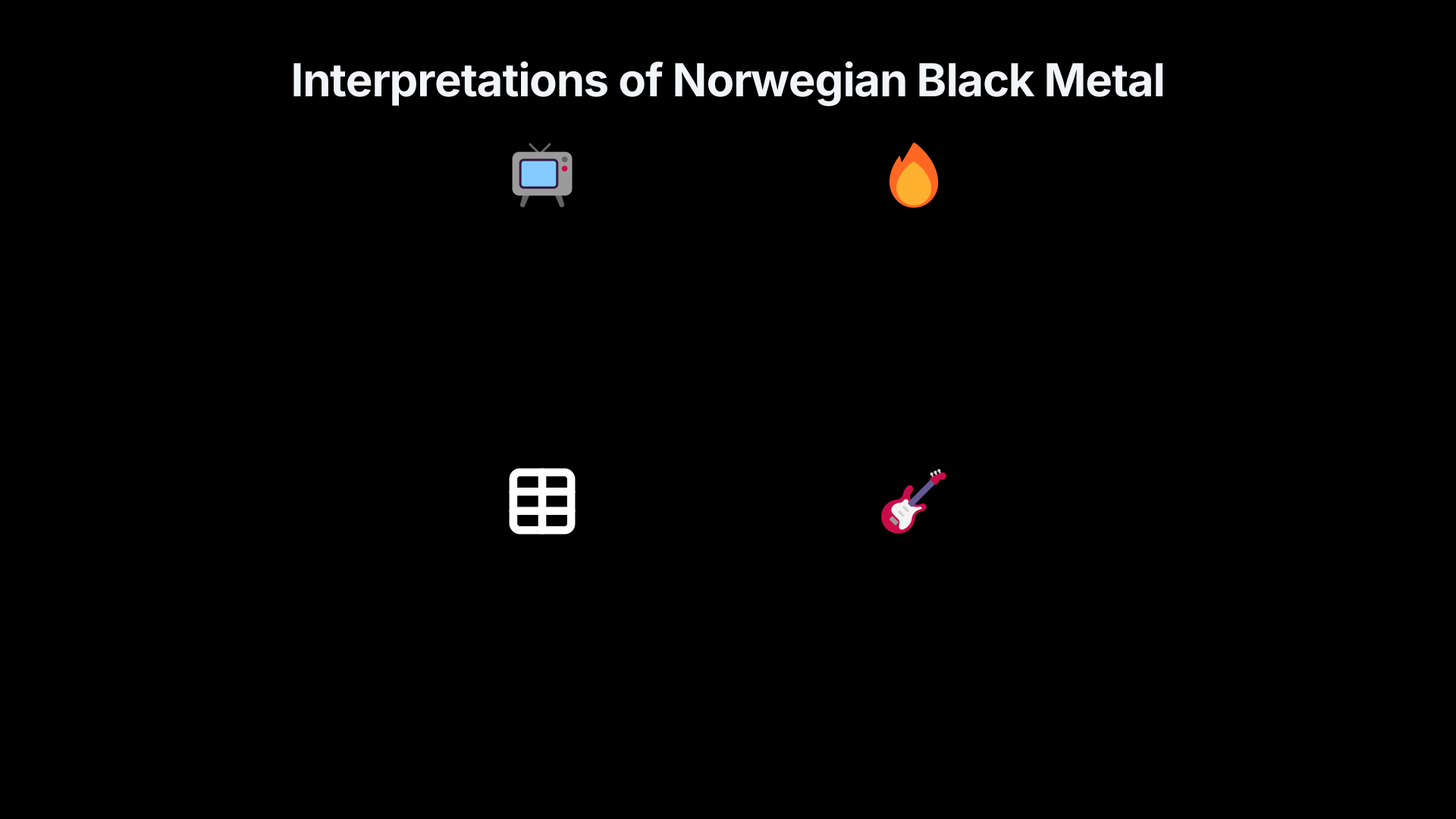
Norwegian black metal became internationally notorious in the early 1990s. A small, highly provocative music scene used corpse-like make-up, inverted Christian imagery, stage names and declarations of hostility towards established religion. Around the scene, a number of people committed serious crimes, including church arsons, assault and murder. The destruction of historic churches gave the public a visible symbol of cultural attack, while the 1993 killing of Mayhem guitarist Øystein Aarseth by musician Varg Vikernes made the scene appear lethally self-destructive.[equinoxpub.com]journal.equinoxpub.comOpen source on equinoxpub.com.
This was therefore not a scare created from nothing. Churches were burned, people were convicted and one firefighter died while responding to a church fire. Vikernes was convicted of several arsons, attempted arson, possessing explosives and murdering Aarseth. Other musicians or associates were also convicted of attacks. Any account that treats the episode solely as media hysteria erases the victims and the deliberate destruction involved.[Wikipedia]WikipediaEarly Norwegian black metal sceneEarly Norwegian black metal scene
The moral-panic element lay in the leap from a small network of offenders to the idea of an extensive, disciplined Satanic underground. Reporters often treated theatrical statements, rumours and boasts as direct intelligence about a coherent organisation. Members of the scene also encouraged this interpretation. Claims of devil worship, secret power and impending violence generated publicity, status and fear. In this sense, the supposed conspiracy was jointly produced by perpetrators seeking notoriety and media institutions seeking a dramatic explanatory frame.[Edinburgh Research]research.ed.ac.uktotal fing armageddon disentangling the mythologies of early norwinburgh ResearchTotal F***ing Armageddon: Disentangling the Mythologies…by L Weir · 2019 — My analysis examines sensationalised repo…
Even the religious meaning of the arsons was less uniform than the standard Satanism narrative suggested. Researchers have identified several overlapping motives: anti-Christian hostility, romanticised pre-Christian nationalism, personal rivalry, thrill-seeking, competition for standing within the scene and imitation after earlier attacks received publicity. Some offenders used Satanic language; others framed the destruction as retaliation for the Christianisation of Norway or drew on selective ideas about Norse paganism.[Masarykova univerzita | MUNI]muni.czOpen source on muni.cz.
The term “cult” is therefore a poor description of Norwegian black metal as a whole. It was a music-based subculture with loose social networks, competing personalities and no single doctrine or command structure. A small inner circle committed or celebrated grave crimes, while most listeners did not. Treating every fan as a potential arsonist reproduced a familiar moral-panic pattern in which clothing, music and symbols became proxies for criminal guilt.
The episode’s cultural afterlife adds another layer. Black metal grew into a major Norwegian cultural export, and sites associated with its once-feared underground became destinations for fans and organised tours. This transformation from public menace to heritage product does not make the violence unreal. It shows how rapidly a society can package a threatening subculture once its danger feels historically contained.[Pitchfork]pitchfork.com8916 ya8916 ya
UFO belief without a national panic
Norway participated in the post-war international fascination with flying saucers. Informal groups appeared during the 1950s, including a notable circle in Bergen, and Norwegian enthusiasts discussed sightings, extraterrestrial intelligence and alleged contact with beings from other worlds. Some accounts took on spiritual themes familiar from international contactee movements, in which advanced visitors were imagined as moral teachers warning humanity about war or ecological destruction.[Brill]brill.comUFO Movements in NorwayUFO case also in Norway, which saw the formation of some informal groups in the 1950s, the most prominent of…
There is little evidence, however, that Norway developed a large, dangerous UFO religion comparable to the best-known apocalyptic groups elsewhere. UFO interest generally belonged to a mixed field of clubs, investigators, spiritual seekers and popular entertainment. The distinction is important: an unusual belief does not become a cult merely because outsiders find it implausible.
Norway is especially associated with unexplained lights in the Hessdalen valley, but that continuing subject belongs primarily to UFO observation and scientific investigation rather than collective panic. Witness reports have encouraged competing physical explanations and long-term monitoring. They have not produced a documented national outbreak of fear or a coercive millenarian movement. UFO history belongs within Norway’s landscape of contagious belief, but it should not be inflated into a crisis unsupported by the evidence.
Viral scares in a highly connected society
Recent Norwegian scares increasingly arrive through international media networks rather than emerging from isolated local communities. The 2016 “killer clown” craze and later warnings about alleged online challenges followed a recognisable pattern: ambiguous or staged incidents were copied, warnings spread faster than verified evidence, and official concern sometimes increased public awareness of the very behaviour it hoped to prevent.[wikipedia.org]Wikipedia2016 clown sightings2016 clown sightings
The “Momo Challenge” offered an especially clear digital example. International reports claimed that a frightening image was being inserted into children’s videos or used in messages instructing young people to harm themselves. Investigators and child-safety organisations found no evidence of a widespread organised game matching the claims. The warnings themselves nevertheless exposed more families to the image and encouraged pranksters and imitators.[wikipedia.org]WikipediaMomo Challenge hoaxMomo Challenge hoax
Norway’s experience of such scares should be understood within the wider Nordic and European media environment. Parents’ concerns about children’s online safety are not irrational: harmful content, grooming and harassment are genuine risks. Panic arises when a striking but weakly verified story displaces proportionate discussion of those real dangers. Research on supposed online “suicide games” has found that media reports and official warnings can amplify a largely mythical challenge culture even when intended as prevention.[arXiv]arxiv.orgarXiv Online Suicide Games: A Form of Digital Self-harm or A Myth?arXiv Online Suicide Games: A Form of Digital Self-harm or A Myth?
The practical distinction is between a warning based on confirmed incidents and a warning based mainly on other warnings. Repetition can create an illusion of independent evidence when every account traces back to the same unverified post. Norwegian authorities, schools and journalists face the same dilemma as their counterparts elsewhere: silence may appear irresponsible, but premature publicity can supply a hoax with its audience.

What Norway’s cases have in common
Norway’s strongest documented cases do not support a national stereotype of irrational crowds. They show that collective fear becomes powerful when it is attached to trusted institutions and a socially credible threat.
A hidden enemy explains visible suffering. In Finnmark, storms and deaths were attributed to secret witches. In Bjugn, ambiguous statements were organised into a theory of concealed group abuse. In the black metal scare, real offenders were interpreted as evidence of a wider Satanic network.
Investigations can generate fresh allegations. Coerced witchcraft confessions produced more names. Repeated questioning in child-abuse investigations could produce more elaborate narratives. Publicity surrounding church burnings gave imitators a recognised script and offenders a route to notoriety.[snl.no]snl.noStore norske leksikontrolldomsprosessene i NorgeNorges verste hekseprosess der minst 19 kvinner ble «straffet på deres liv til ild og bål…
Authorities do not merely respond to panics. Courts, police, clergy, welfare professionals and news organisations decide which claims receive credibility. Their involvement can calm uncertainty, but it can also harden suspicion into an official account before the evidence has been adequately tested.
Real harm and exaggerated interpretation can coexist. Fishing communities really suffered catastrophic loss. Children really require protection from abuse. Churches really burned, and people were killed. Recognising a moral panic does not require denying the underlying danger; it means examining whether the attributed cause, scale or conspiracy exceeded the available evidence.
Later retellings simplify mixed events. Witch trials become stories about primitive superstition, Bjugn becomes either proof that children cannot be trusted or proof that authorities never listen, and black metal becomes either glamorous rebellion or an organised Satanic campaign. Each simplification removes the institutional and social mechanisms that made the episode possible.
Why this history still matters
The most important Norwegian lesson is that collective fear often looks reasonable from inside the moment. People rarely believe they are joining a panic. They believe they are protecting their neighbours, children, religion or community from a danger that established institutions have finally recognised.
Good responses therefore require more than telling the public to remain calm. Authorities must investigate credible risks while separating observation from interpretation, avoiding coercive or leading procedures and stating clearly what remains unverified. Journalists must distinguish evidence of individual crimes from claims about hidden networks. Experts must also avoid using terms such as “hysteria” in ways that imply stupidity, fabrication or mental illness.
Norway’s history moves from forced confessions in seventeenth-century courtrooms to suggestive interviews, subcultural publicity and viral warnings. The technology changes, but the central risk remains familiar: once a frightening story acquires official authority and social momentum, every new ambiguity can be absorbed as confirmation. The enduring safeguard is not disbelief in every alarming claim. It is disciplined curiosity—taking harm seriously while demanding evidence strong enough to justify the story being told.
Amazon book picks
Further Reading
Books and field guides related to When Did Fear Take Hold in Norway?. Use these as the next step if you want deeper reading beyond the article.

Folk Devils and Moral Panics the Creation of the Mods and Roc...
First published 1972. Subjects: Youth, great britain, Deviant behavior, Case studies, Subculture, Young adults.
Folk devils and moral panics
Explains recurring patterns behind fear and public scares.
Endnotes
1.
Source: link.springer.com
Link:https://link.springer.com/chapter/10.1007/978-3-319-58388
Source snippet
The police conducted...Read more...
2.
Source: brill.com
Link:https://brill.com/display/book/9789004325968/B9789004325968_082.pdf?srsltid=AfmBOopC0dV6NOqbVYkBfL7jCDywnNc6A8M2sIGRyzHbHEO-eTrLgsnm
Source snippet
UFO Movements in NorwayUFO case also in Norway, which saw the formation of some informal groups in the 1950s, the most prominent of...
3.
Source: gtsvn.uit.no
Title: GTSVNMonument to witchcraft trial victims
Link:https://gtsvn.uit.no/freecorpus/orig/eng/admin/gonagasviessu.no/nyhet.html_tid%3D92483.html
Source snippet
The witchcraft trials... Liv Helene Willumsen, who...
4.
Source: septentrio.uit.no
Link:https://septentrio.uit.no/index.php/SCS/article/view/7331
Source snippet
H. (2010). The Witchcraft Trials in Finnmark, Northern Norway. Trans. Edwardsen, K. L. Varanger museum Skald. Willumsen, L. H...
5.
Source: en.uit.no
Link:https://en.uit.no/ansatte/person?p_document_id=55457
6.
Source: septentrio.uit.no
Link:https://septentrio.uit.no/index.php/nordlit/article/view/4977
7.
Source: unodc.org
Link:https://www.unodc.org/documents/commissions/CCPCJ/CCPCJ_Sessions/CCPCJ_31/PNI/Child_forensic_interviewing_in_online_cases.pdf
8.
Source: journal.equinoxpub.com
Link:https://journal.equinoxpub.com/PMH/article/view/13541
9.
Source: pitchfork.com
Title: 8916 ya
Link:https://pitchfork.com/features/article/8916-ya
10.
Source: Wikipedia
Title: Early Norwegian black metal scene
Link:https://en.wikipedia.org/wiki/Early_Norwegian_black_metal_scene
11.
Source: muni.cz
Link:https://www.muni.cz/en/research/publications/1351916
12.
Source: journal.equinoxpub.com
Link:https://journal.equinoxpub.com/POM/article/view/10272
13.
Source: Wikipedia
Link:https://en.wikipedia.org/wiki/List_of_UFO_religions
14.
Source: Wikipedia
Title: 2016 clown sightings
Link:https://en.wikipedia.org/wiki/2016_clown_sightings
15.
Source: arxiv.org
Title: arXiv Online Suicide Games: A Form of Digital Self-harm or A Myth?
Link:https://arxiv.org/abs/2012.00530
16.
Source: Wikipedia
Title: Momo Challenge hoax
Link:https://en.wikipedia.org/wiki/Momo_Challenge_hoax
17.
Source: arxiv.org
Link:https://arxiv.org/abs/2108.02512
18.
Source: Wikipedia
Title: Mass psychogenic illness
Link:https://en.wikipedia.org/wiki/Mass_psychogenic_illness
19.
Source: Wikipedia
Title: Vardø witch trials (1662–1663)
Link:https://en.wikipedia.org/wiki/Vard%C3%B8witch_trials%281662%E2%80%931663%29
20.
Source: Wikipedia
Title: List of mass panic cases
Link:https://en.wikipedia.org/wiki/List_of_mass_panic_cases
21.
Source: Wikipedia
Title: Day care sex abuse hysteria
Link:https://en.wikipedia.org/wiki/Day-care_sex-abuse_hysteria
22.
Source: Wikipedia
Title: Satanic panic
Link:https://en.wikipedia.org/wiki/Satanic_panic
23.
Source: Wikipedia
Link:https://en.wikipedia.org/wiki/Contactee
24.
Source: Wikipedia
Title: Doomsday cult
Link:https://en.wikipedia.org/wiki/Doomsday_cult
25.
Source: Wikipedia
Link:https://en.wikipedia.org/wiki/Ufology
26.
Source: en.uit.no
Link:https://en.uit.no/tavla/artikkel/382311/demons_and_witches_the_impact_of_demonology_on_e
27.
Source: en.uit.no
Title: polar night celebration 2024 the finnmark witchc
Link:https://en.uit.no/tavla/artikkel/863226/polar_night_celebration_2024_the_finnmark_witchc
28.
Source: septentrio.uit.no
Link:https://septentrio.uit.no/index.php/nordlit/article/download/4958/4788/17484
29.
Source: en.uit.no
Title: apent seminar om rettshistorie fra tidlig nytid
Link:https://en.uit.no/tavla/artikkel/865520/apent_seminar_om_rettshistorie_fra_tidlig_nytid
30.
Source: ubdigital.uit.no
Link:https://ubdigital.uit.no/bitstream/handle/10037.2/531/Utropia_38aar_2013_nr13.pdf?isAllowed=y&sequence=1
31.
Source: septentrio.uit.no
Link:https://septentrio.uit.no/index.php/SCS/article/download/7331/7745/31962
32.
Source: folklore.ee
Link:https://www.folklore.ee/FOAFtale/ftn43.htm
33.
Source: journal.equinoxpub.com
Link:https://journal.equinoxpub.com/searc/article/view/24098
34.
Source: brill.com
Link:https://brill.com/display/book/9789004252929/B9789004252929_010.pdf?srsltid=AfmBOop0C2Hj7HHn6j71-5EtiepVVqeqBnYiMwS1gT3gNHu1ADcZ1KIK
35.
Source: snl.no
Link:https://snl.no/trolldomsprosessene_i_Norge
Source snippet
Store norske leksikontrolldomsprosessene i NorgeNorges verste hekseprosess der minst 19 kvinner ble «straffet på deres liv til ild og bål...
36.
Source: research.ed.ac.uk
Title: total fing armageddon disentangling the mythologies of early norw
Link:https://www.research.ed.ac.uk/en/publications/total-fing-armageddon-disentangling-the-mythologies-of-early-norw/
Source snippet
inburgh ResearchTotal F***ing Armageddon: Disentangling the Mythologies...by L Weir · 2019 — My analysis examines sensationalised repo...
37.
Source: snl.no
Title: John Cunningham
Link:https://snl.no/John_Cunningham
38.
Source: theguardian.com
Title: The Guardian Norway’s witch trials: the woman killed for a fatal storm
Link:https://www.theguardian.com/news/2021/apr/27/norways-witch-trials-the-woman-killed-for-a-fatal-storm
39.
Source: lille.snl.no
Title: Lille norske leksikontrolldomsprosessene i Norge
Link:https://lille.snl.no/trolldomsprosessene_i_Norge
40.
Source: britsoccrim.org
Link:https://www.britsoccrim.org/volume3/004.pdf
41.
Source: religionunplugged.com
Title: lords of chaos film brings back norwegian black metal
Link:https://religionunplugged.com/news/2019/5/13/lords-of-chaos-film-brings-back-norwegian-black-metal
42.
Source: theguardian.com
Title: the great clown panic of 2016 a volatile mix of fear and contagion
Link:https://www.theguardian.com/culture/2016/oct/31/the-great-clown-panic-of-2016-a-volatile-mix-of-fear-and-contagion
43.
Source: theguardian.com
Title: viral momo challenge is a malicious hoax say charities
Link:https://www.theguardian.com/technology/2019/feb/28/viral-momo-challenge-is-a-malicious-hoax-say-charities
44.
Source: snl.no
Link:https://snl.no/heks
45.
Source: facebook.com
Title: Momo challenge
Link:https://www.facebook.com/PSHEassociation/posts/momo-challenge-a-hoax-but-potentially-distressing-read-our-advice-on-how-to-addr/10157241465822873/
46.
Source: theguardian.com
Title: carol morley the falling mass hysteria is a powerful group activity
Link:https://www.theguardian.com/film/2015/mar/29/carol-morley-the-falling-mass-hysteria-is-a-powerful-group-activity
47.
Source: theguardian.com
Link:https://www.theguardian.com/music/2019/mar/22/before-you-know-it-its-not-a-big-deal-to-kill-a-man-norwegian-black-metals-murderous-past
48.
Source: ebsco.com
Link:https://www.ebsco.com/research-starters/social-sciences-and-humanities/mass-hysteria
49.
Source: research.ed.ac.uk
Title: Moral Panics and Social Work
Link:https://www.research.ed.ac.uk/files/15151045/Moral_Panics_and_Social_Work.pdf
50.
Source: sajp.org.za
Link:https://sajp.org.za/index.php/sajp/article/view/1671/2648
51.
Source: thearda.com
Title: Millenarian Movement
Link:https://www.thearda.com/us-religion/history/timelines/entry?eid=23&etype=3
52.
Source: enchantedpodcast.net
Link:https://enchantedpodcast.net/episodes/507
Additional References
53.
Source: researchgate.net
Link:https://www.researchgate.net/publication/331541118_4_Child_Sexual_Abuse_An_Implementation_Paradox
54.
Source: academia.edu
Link:https://www.academia.edu/1525334/A_Blaze_in_the_Northern_Sky_Black_Metal_and_Crimes_against_Culture
55.
Source: researchgate.net
Link:https://www.researchgate.net/publication/319367953_Second_wave_true_Norwegian_black_metal_an_ideologically_evil_music_scene
56.
Source: researchgate.net
Link:https://www.researchgate.net/publication/323633597_Pagan_Terror_The_Role_of_Pagan_Ideology_in_Church_Burnings_and_the_1990s_Norwegian_Black_Metal_Subculture
57.
Source: reddit.com
Link:https://www.reddit.com/r/AskHistorians/comments/vke6wh/90s_norwegian_black_metal_bands_were_infamously/
58.
Source: apsac.org
Link:https://apsac.org/wp-content/uploads/2025/10/APSAC-Advisor-38.2-Literature-on-Child-Forensic-Interviewing-from-January-2022-to-February-2025-Other-Topics.pdf
Published: January 2022
59.
Source: reddit.com
Link:https://www.reddit.com/r/decadeology/comments/1f7jey2/anyone_else_remember_the_whole_killer_clown_scare/
60.
Source: scup.com
Link:https://www.scup.com/doi/10.18261/9788215031415
61.
Source: facebook.com
Link:https://www.facebook.com/groups/625436697499583/posts/7266561173387069/
62.
Source: reddit.com
Link:https://www.reddit.com/r/exjw/comments/1j12yzm/doomsday_cults_through_the_centuries/
Topic Tree
Follow this branch
Related pages 192
- Antigua and Barbuda
- Argentina Belief Scares
- Azerbaijan Belief
- Bahrain Beliefs
- North Korea
- +187 more in sidebar