Within Mauritania
How One Blog Post Reshaped Blasphemy Law
Mohamed Cheikh Ould Mkhaitir's prosecution shows how public outrage, street pressure and state policy reinforced one another.
On this page
- The article, arrest and death sentence
- Why demonstrations continued for years
- Detention, legal reform and the cost of appeasement
Page outline Jump by section
Introduction
The prosecution of blogger Mohamed Cheikh Ould Mkhaitir became one of the defining legal and political controversies in modern Mauritania. What began in early 2014 as an online essay criticising the use of religion to justify inherited social hierarchy quickly developed into a years-long confrontation between public outrage, religious authority and state power. Rather than remaining a single criminal case, it became a test of how far the government could respond to intense demands for punishment while also facing international pressure over freedom of expression and human rights.
The case matters because it did more than threaten one writer with execution. It helped reshape Mauritania’s blasphemy legislation, demonstrating how sustained public mobilisation and political calculation reinforced one another. The legal changes that followed made the country’s apostasy and blasphemy provisions significantly harsher, even as Mkhaitir’s own death sentence was eventually overturned.[Human Rights Watch]hrw.orgHuman Rights WatchMauritania: Quash Blogger Mkhaitir’s Death Sentence | Human Rights WatchNovember 7, 2017…
The article, arrest and death sentence
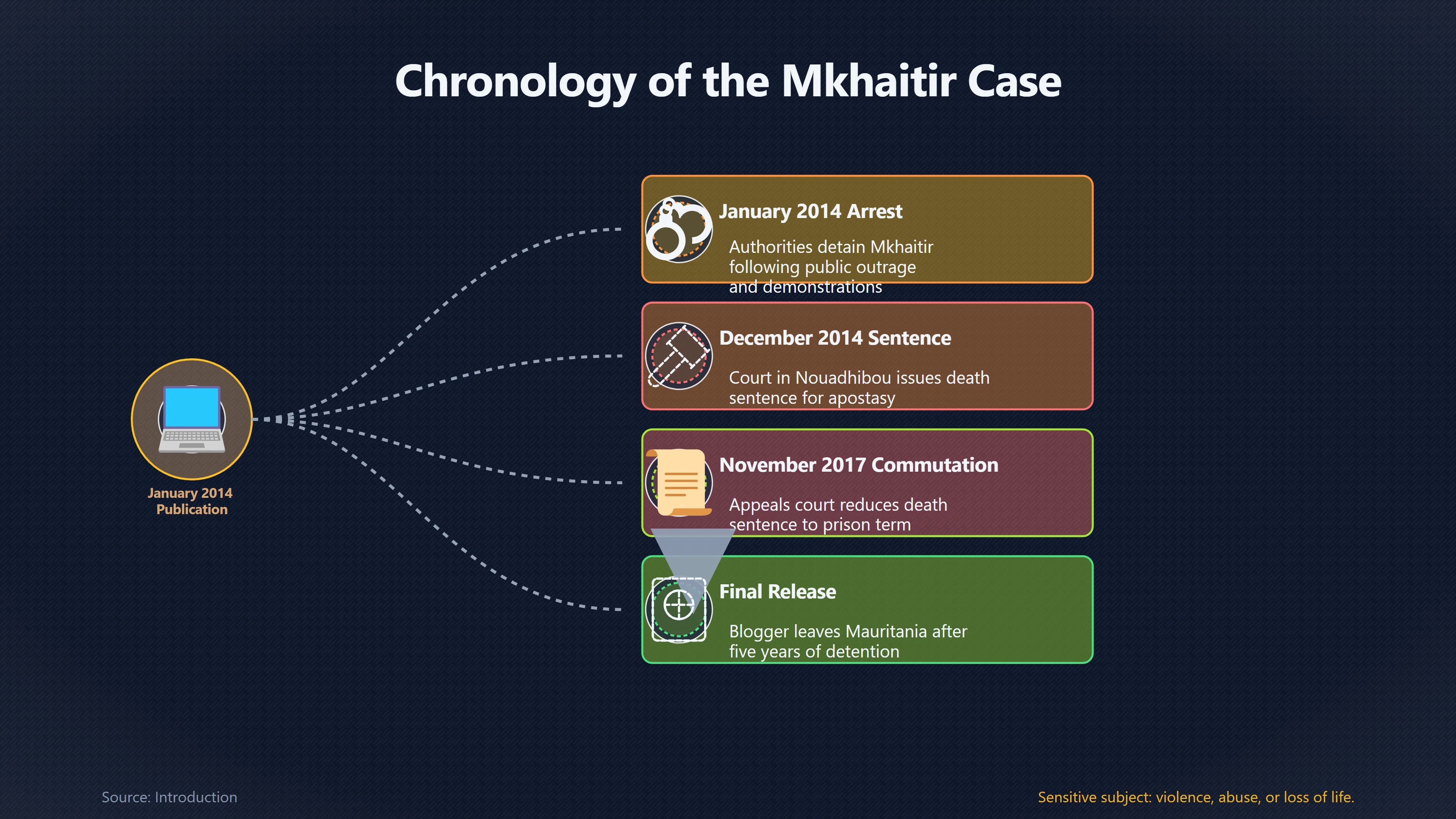
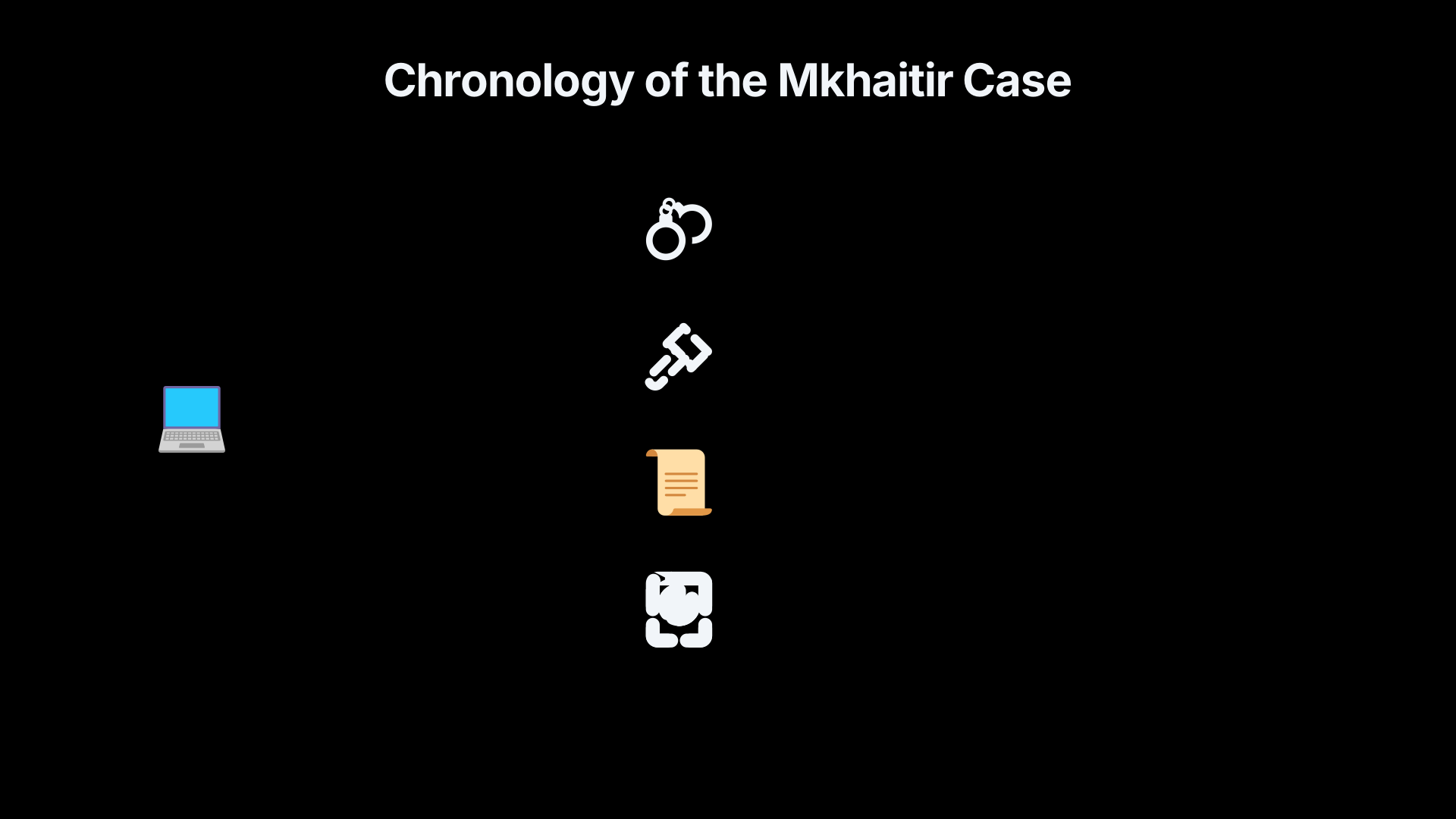
Mohamed Cheikh Ould Mkhaitir, a young engineer from the traditionally marginalised blacksmith community, published an online article in January 2014 arguing that historical episodes from early Islamic history had been selectively interpreted to defend caste-like discrimination in Mauritania. His target, according to both his own explanations and later human rights reporting, was not Islam itself but the social use of religious arguments to preserve inequality.[Human Rights Watch]hrw.orgHuman Rights WatchMauritania: Quash Blogger Mkhaitir’s Death Sentence | Human Rights WatchNovember 7, 2017…
Many readers interpreted the article very differently. Religious leaders, politicians and sections of the public accused him of insulting the Prophet Muhammad and committing apostasy. Within days, demonstrations demanded his execution, while senior political figures publicly condemned the article. The controversy spread rapidly through newspapers, sermons and social media, turning a dispute over social hierarchy into a broader test of religious loyalty.[Human Rights Watch]hrw.orgOpen source on hrw.org.
Authorities arrested Mkhaitir on 2 January 2014. Despite repeated statements of repentance during the legal process, a court in Nouadhibou sentenced him to death for apostasy in December 2014. Although Mauritania had retained the death penalty for apostasy in law, it had not carried out an execution for that offence since independence, making the sentence especially significant.[Human Rights Watch]hrw.orgOpen source on hrw.org.
The case illustrated how accusations of blasphemy could become intertwined with other sensitive issues. Mkhaitir’s criticism of hereditary discrimination challenged entrenched social structures at the same time that it touched deeply held religious beliefs. For many supporters, he had exposed injustice; for many opponents, he had crossed an absolute religious boundary. Those competing interpretations shaped everything that followed.
Why demonstrations continued for years
Unlike many short-lived public controversies, the protests surrounding Mkhaitir did not quickly fade. Demonstrations repeatedly called for the death sentence to be upheld, sometimes drawing thousands of participants. Religious organisations, influential clerics and activists portrayed any reduction in punishment as an unacceptable weakening of Islam’s protection under the law.[Human Rights Watch]hrw.orgHuman Rights WatchMauritania: Quash Blogger Mkhaitir’s Death Sentence | Human Rights WatchNovember 7, 2017…
Several factors helped sustain the mobilisation:
- Religious symbolism: Many protesters viewed the case not as a debate about social criticism but as a defence of the Prophet and the country’s Islamic identity.
- Political pressure: The government faced competing pressures from domestic religious opinion and international human rights organisations, making every court decision politically sensitive.
- Media amplification: Continuous reporting and discussion on traditional and online media kept the controversy visible long after the original publication.
- Identity and inequality: Because the article addressed discrimination against lower-status communities, debates over race, caste and religion became tightly intertwined rather than remaining separate issues.[Human Rights Watch]hrw.orgHuman Rights WatchMauritania: Quash Blogger Mkhaitir’s Death Sentence | Human Rights WatchNovember 7, 2017…
The demonstrations therefore reflected more than spontaneous anger. They became a form of sustained public pressure on both the courts and political leaders. Human rights organisations also documented death threats against people who publicly defended Mkhaitir or argued for his release, illustrating how difficult open discussion of the case became.[Human Rights Watch]hrw.orgHuman Rights WatchMauritania: Quash Blogger Mkhaitir’s Death Sentence | Human Rights WatchNovember 7, 2017…
For historians of moral panics and collective belief, the episode is notable because a genuine disagreement over religious boundaries evolved into a prolonged public campaign in which symbolic defence of religion became inseparable from demands for exemplary punishment.
Detention, legal reform and the cost of appeasement
After several appeals, Mauritania’s Supreme Court ordered a fresh review. In November 2017, a new appeals court accepted that Mkhaitir had repented, commuted the death sentence to a prison term and a fine, and imposed a sentence that he had already effectively served. Under ordinary circumstances, this would have resulted in his immediate release.[Human Rights Watch]hrw.orgHuman Rights WatchMauritania: Quash Blogger Mkhaitir’s Death Sentence | Human Rights WatchNovember 7, 2017…
Instead, authorities kept him in undisclosed administrative detention, arguing that releasing him publicly could endanger his safety because of continuing threats. Human rights organisations criticised the arrangement as arbitrary detention, while officials maintained that the exceptional security situation justified it.[Human Rights Watch]hrw.orgOpen source on hrw.org.
The political consequences extended beyond Mkhaitir himself. Only days after the appeals court reduced his sentence, the government approved draft legislation replacing Article 306 of the Criminal Code. The revised law, adopted in 2018, removed the earlier legal possibility that repentance could spare someone convicted of certain apostasy-related offences from the death penalty. It also broadened punishments for offences framed as violating Islamic values. Human rights organisations argued that the timing strongly suggested the legislation was intended to reassure domestic critics angered by the court’s decision in Mkhaitir’s case.[Human Rights Watch]hrw.orgOpen source on hrw.org.
In this sense, the legal outcome was paradoxical. Mkhaitir himself escaped execution, yet the law became more severe for future defendants. The government appeared to seek a compromise between avoiding an internationally controversial execution and demonstrating that it remained firmly committed to protecting Islam through criminal law.[Human Rights Watch]hrw.orgOpen source on hrw.org.
Mkhaitir was eventually released in 2019 after more than five years in custody and later left Mauritania under conditions intended to protect his safety. His prolonged detention after his sentence had effectively expired remained a central criticism from international rights organisations.[Human Rights Watch]hrw.orgOpen source on hrw.org.
Why the case remains important
The Mkhaitir case occupies an unusual place in Mauritania’s recent history because it combined debates over religion, race, inherited social status and state authority in a single legal proceeding. It also demonstrates that moral panics are not necessarily based on false rumours or imaginary threats. Here, the controversy arose from a real publication, but the public reaction transformed it into a symbolic struggle over national identity and religious legitimacy.
For the wider history of collective religious alarm in Mauritania, the case shows how public demonstrations, legal institutions and political leaders can reinforce one another. Popular demands for severe punishment did not simply accompany the legal process; they became part of the environment in which legislators chose to strengthen blasphemy law. That interaction between public pressure and state policy is what makes the prosecution of Mohamed Cheikh Ould Mkhaitir one of the country’s most consequential examples of a modern moral panic centred on religion and perceived apostasy.[Human Rights Watch]hrw.orgOpen source on hrw.org.

Amazon book picks
Further Reading
Books and field guides related to How One Blog Post Reshaped Blasphemy Law. Use these as the next step if you want deeper reading beyond the article.

Islam and the arab awakening
Places modern religious controversies in political context.
Folk Devils and Moral Panics the Creation of the Mods and Roc...
First published 1972. Subjects: Youth, great britain, Deviant behavior, Case studies, Subculture, Young adults.
Endnotes
1.
Source: hrw.org
Link:https://www.hrw.org/news/2017/11/07/mauritania-quash-blogger-mkhaitirs-death-sentence
Source snippet
Human Rights WatchMauritania: Quash Blogger Mkhaitir’s Death Sentence | Human Rights WatchNovember 7, 2017...
Published: November 7, 2017
2.
Source: hrw.org
Link:https://www.hrw.org/news/2018/05/04/mauritania-mandatory-death-penalty-blasphemy
3.
Source: hrw.org
Link:https://www.hrw.org/news/2017/01/26/mauritania-blogger-faces-execution-apostasy
4.
Source: hrw.org
Link:https://www.hrw.org/news/2018/11/08/mauritania-one-year-blogger-still-detained
5.
Source: end-blasphemy-laws.org
Link:https://end-blasphemy-laws.org/countries/middle-east-and-north-africa/mauritania/
Source snippet
June 18, 2020 — Countries / Middle East and North Africa / MAURITANIA Slavery has been described as a major human rights issue in Maurita...
Published: June 18, 2020
6.
Source: hrw.org
Title: Mauritania: Blogger in ‘Blasphemy’ Case Freed After 5 Years | Human Rights Watch
Link:https://www.hrw.org/news/2019/07/30/mauritania-blogger-blasphemy-case-freed-after-5-years
7.
Source: hrw.org
Title: President Should Free Mauritanian Jailed for Online Article | Human Rights Watch
Link:https://www.hrw.org/news/2019/06/21/president-should-free-mauritanian-jailed-online-article
8.
Source: hrw.org
Link:https://www.hrw.org/news/2019/05/31/mauritania-blogger-mkhaitirs-fate-lies-hands-president
9.
Source: hrw.org
Link:https://www.hrw.org/world-report/2020/country-chapters/mauritania
10.
Source: youtube.com
Link:https://www.youtube.com/watch?v=MRv-j8e0w1Y
Source snippet
Muslim clerics urge for blogger's death penalty to be applied...
Additional References
11.
Source: GOV.UK
Title: From: UK Mission to the WTO, UN and other international organisations (G
Link:https://www.gov.uk/government/news/upr51-uk-statement-on-mauritania
Source snippet
www.gov.ukUPR51: UK Statement on Mauritania - GOV.UKFebruary 3, 2026 — UPR51: UK STATEMENT ON MAURITANIA Delivered at Mauritania's Univer...
Published: February 3, 2026
12.
Source: humanists.international
Title: Mohammed Ould Shaikh Ould Mkhaitir
Link:https://humanists.international/case-of-concern/mohammed-ould-shaikh-ould-mkhaitir/
Source snippet
January 27, 2022 — CASES OF CONCERN Image MOHAMMED OULD SHAIKH OULD MKHAITIR * Location / Mauritania * Current Sta...
Published: January 27, 2022
13.
Source: youtube.com
Title: Mauritanie, Possible peine capitale pour Cheikh Ould Mkhaitir
Link:https://www.youtube.com/watch?v=TdYKJHG-qCM
Source snippet
Mauritanie: libéré, le blogueur taxé de blasphème quitte le pays...
14.
Source: youtube.com
Title: Muslim clerics urge for blogger’s death penalty to be applied
Link:https://www.youtube.com/watch?v=bVr53zdXaBY
Source snippet
Mauritanie, Possible peine capitale pour Cheikh Ould Mkhaitir...
15.
Source: docstore.ohchr.org
Title: Files Handler.ashx
Link:https://docstore.ohchr.org/SelfServices/FilesHandler.ashx?enc=SFcR4AeZm0iSQMKZfxtKLAryeMkv2DVSogZzQrpSBLFM76dwOCboQxesC2pboLzf4rw9om8xG50TeJp%2BgfZnMA%3D%3D
Source snippet
5, 2022 — | United Nations | CCPR/C/MRT/FCO/2 | International Covenant on Civil and Political R ights | Distr.: General 4 May 2022 Englis...
Published: May 2022
16.
Source: ungeneva.org
Link:https://www.ungeneva.org/en/news-media/meeting-summary/2019/07/human-rights-committee-considers-civil-and-political-rights
17.
Source: amnesty.org
Link:https://www.amnesty.org/en/latest/news/2018/11/mauritania-blogger-still-detained-one-year-after-court-decision/
18.
Source: amnesty.org.uk
Link:https://www.amnesty.org.uk/knowledge-hub/all-resources/mauritania-blogger-mohamed-mkhaitir-released-after-five-years-detention-publishing/
19.
Source: ecoi.net
Link:https://www.ecoi.net/en/document/2010637.html
20.
Source: reutersconnect.com
Link:https://www.reutersconnect.com/item/mauritanian-blogger-who-faced-death-penalty-for-apostasy-to-be-freed/dGFnOnJldXRlcnMuY29tLDIwMTc6bmV3c21sX1ZBNzZSOTA3Qg
Topic Tree