Within Suriname
How Witchcraft Accusations Reshaped Maroon Communities
In some Maroon communities, witchcraft accusations could reshape inheritance, destroy reputations and lead to execution.
On this page
- Why Misfortune Triggered Public Accusations
- Oracles, Kinship and Political Conflict
- Executions, Memory and Contested Verdicts
Page outline Jump by section
Introduction
Witchcraft accusations have long been one of the most sensitive and consequential forms of conflict within some of Suriname’s Maroon communities. Rather than representing isolated outbreaks of panic, accusations formed part of wider systems of customary law, religious belief and communal justice. When unexplained illness, sudden death, infertility, repeated accidents or economic failure struck a family, many people sought explanations that combined social, spiritual and moral responsibility. In some cases, these investigations ended with reconciliation. In others, they destroyed reputations, altered inheritance, divided kin groups and, historically, resulted in execution. Modern scholarship therefore treats these accusations not as irrational episodes detached from society, but as mechanisms through which communities debated responsibility, authority and social order.[Cambridge University Press & Assessment]cambridge.orgCambridge University Press & Assessment“It's your family that kills you”: Responsibility, Evidence, and Misfortune in the Making of Ndyuk…
Unlike the colonial suppression of Winti, this history unfolded largely within autonomous Maroon societies that had developed their own political institutions after escaping slavery. Understanding these accusations requires recognising that belief in harmful spiritual action existed alongside established procedures for evidence, consultation and public decision-making, even if those procedures could still produce grave injustices.
Why Misfortune Triggered Public Accusations
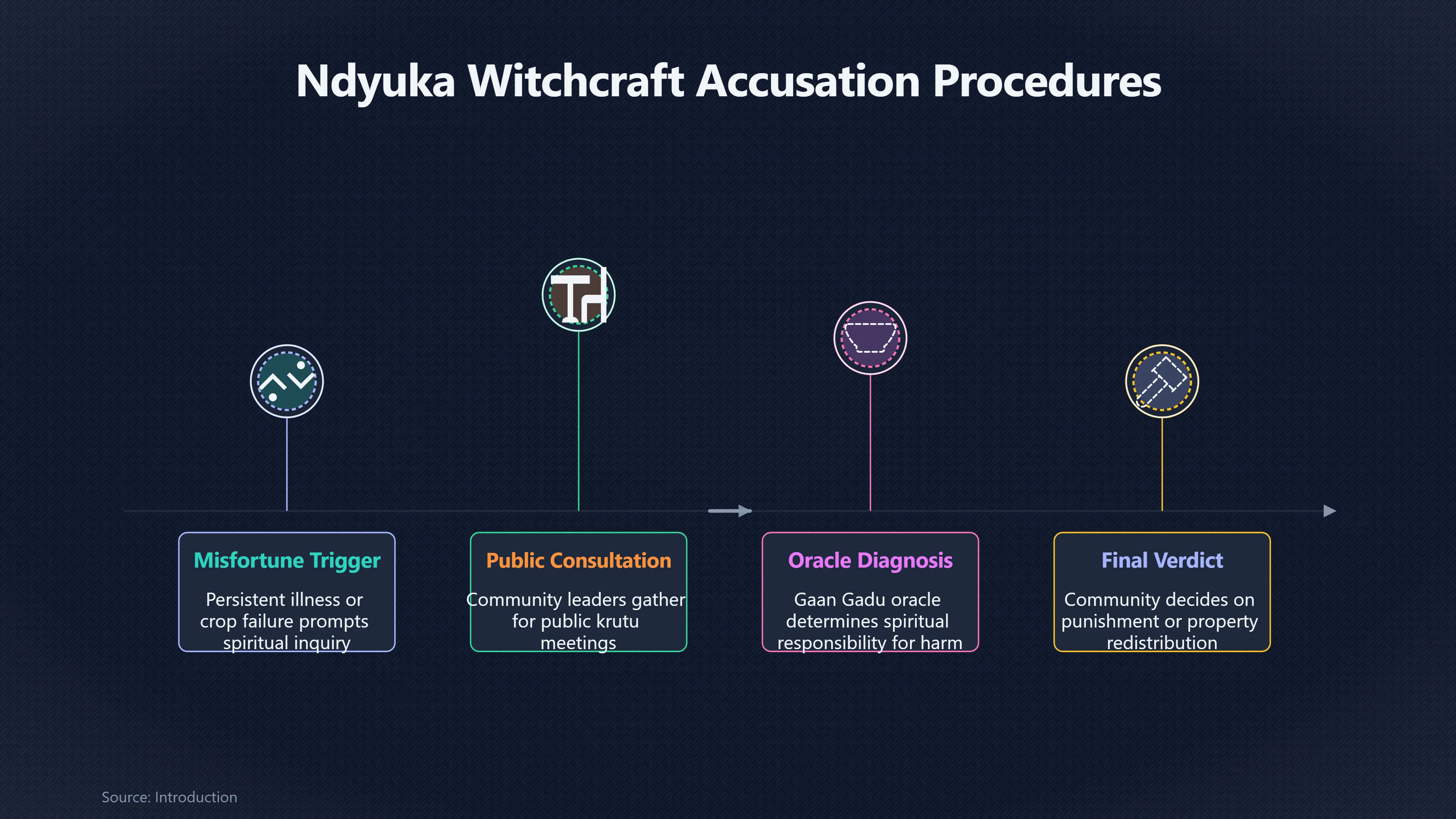
In many Maroon communities, particularly among the Ndyuka (historically also called Djuka or Okanisi), severe misfortune was rarely treated as random. A serious illness, repeated deaths within one family, crop failure or unexpected financial loss often prompted questions about hidden causes rather than simple chance. Anthropologists have described witchcraft beliefs as a social language through which communities interpreted jealousy, broken obligations, unresolved disputes and damaged relationships.[Cambridge University Press & Assessment]cambridge.orgCambridge University Press & AssessmentThe Okanisi: A Surinamese Maroon Community, c.1712–2010* | International Review of Social History…
This did not mean that every misfortune led to an accusation. Most disputes remained private, and many illnesses were attributed to natural or other spiritual causes. However, when suffering appeared persistent or especially destructive, suspicion could spread through extended families and villages. Because Maroon societies were organised around strong matrilineal kinship groups, accusations rarely affected only one individual. Entire lineages could become entangled in questions of responsibility, loyalty and shared moral standing.[Cambridge University Press & Assessment]cambridge.orgCambridge University Press & Assessment“It's your family that kills you”: Responsibility, Evidence, and Misfortune in the Making of Ndyuk…
The consequences extended beyond personal reputation. If someone was believed to have caused deaths through witchcraft, relatives might question whether inherited land, wealth or ritual responsibilities had been acquired through wrongful means. In this way, accusations could reshape family politics as much as spiritual belief.
Oracles, Kinship and Political Conflict
Accusations were not normally settled through private revenge alone. Many Maroon communities relied on recognised procedures involving elders, councils and ritual specialists. Public meetings, often referred to as krutu by anthropologists, brought together community leaders to hear disputes, evaluate testimony and determine an appropriate response. These councils were embedded within wider institutions of kinship and religious authority rather than operating as separate courts in the modern sense.[Taylor & Francis Online]tandfonline.comOpen source on tandfonline.com.
Diagnosis frequently involved consultation with oracles or recognised spiritual authorities. Among the Ndyuka, the Gaan Gadu oracle became particularly influential in determining whether a death or illness had resulted from witchcraft. Oracle findings could affect not only an individual’s reputation but also the disposition of property after death. Scholars describe cases in which the possessions of someone judged to have been a witch were confiscated, redistributed or ritually purified because they were believed to carry dangerous spiritual associations.[Cambridge University Press & Assessment]cambridge.orgCambridge University Press & Assessment“It's your family that kills you”: Responsibility, Evidence, and Misfortune in the Making of Ndyuk…
These procedures were never purely religious. Anthropological research consistently finds that accusations emerged within broader struggles over inheritance, marriage, leadership, economic resources and obligations between kin groups. Jealousy, competition and longstanding family disagreements often shaped who became vulnerable to suspicion, even though participants understood the dispute primarily in spiritual terms. Rather than viewing witchcraft accusations simply as reflections of interpersonal hostility, researchers argue that they operated within an entire social field involving lineage membership, collective responsibility and village politics.[Taylor & Francis Online]tandfonline.comOpen source on tandfonline.com.
Executions, Memory and Contested Verdicts
Historical evidence indicates that accusations sometimes culminated in the execution of those identified as witches. The best-known estimates come from anthropologists Bonno Thoden van Velzen and Wilhelmina van Wetering, whose work on the Okanisi suggests that roughly two dozen suspected witches were burned during the nineteenth century. Precise numbers remain uncertain because surviving documentation is limited and much of the evidence comes from oral history combined with ethnographic reconstruction.[Cambridge University Press & Assessment]cambridge.orgCambridge University Press & AssessmentThe Okanisi: A Surinamese Maroon Community, c.1712–2010* | International Review of Social History…
Executions were not understood by participants as arbitrary punishment. They were presented as protecting the wider community from continuing supernatural harm. Nevertheless, modern historians emphasise that accusations could never be separated entirely from existing political rivalries, family conflict or unequal influence within village institutions. Even where formal procedures existed, verdicts reflected human judgement operating under intense social pressure.
Collective memory also preserves disagreements about past cases. Some descendants remember executions as necessary acts of communal protection, while others interpret them as miscarriages of justice shaped by personal rivalries or manipulation of religious authority. These competing memories illustrate that witchcraft accusations were never universally accepted, even within the communities where they occurred.[Taylor & Francis Online]tandfonline.comOpen source on tandfonline.com.
Changing Ideas About Justice
During the twentieth century, several developments altered how accusations were handled. Greater integration with the Surinamese state, migration to Paramaribo, education, Christianity, wage labour and increased contact with national courts all reduced the authority of traditional mechanisms in many communities. Anthropologists note that important elements of the older “social idiom” surrounding witchcraft have weakened alongside broader processes of urbanisation and globalisation.[Taylor & Francis Online]tandfonline.comOpen source on tandfonline.com.
One particularly significant turning point came in the 1970s, when the prophet Akalali challenged the authority of the influential Gaan Gadu oracle. He argued that its priests had themselves become corrupt and were manipulating accusations for personal gain, leading to a sweeping anti-witchcraft movement that dismantled much of the oracle’s former authority. This episode demonstrates that conflicts over witchcraft were also conflicts over who possessed legitimate spiritual and political authority.[Cambridge University Press & Assessment]cambridge.orgCambridge University Press & Assessment“It's your family that kills you”: Responsibility, Evidence, and Misfortune in the Making of Ndyuk…
Contemporary Maroon communities continue to maintain distinctive customary institutions, but these now coexist with Suriname’s national legal system. Researchers studying restorative justice have argued that traditional councils remain important because they are deeply embedded in kinship, mediation and collective responsibility rather than functioning as isolated courts. At the same time, scholars stress that modern justice requires safeguards against the kinds of irreversible harm that historical witchcraft accusations sometimes produced.[Taylor & Francis Online]tandfonline.comOpen source on tandfonline.com.

Why This History Matters
Maroon witchcraft accusations are best understood neither as simple superstition nor as episodes of mass hysteria. They formed part of sophisticated systems through which autonomous societies interpreted suffering, maintained social order and resolved disputes in the absence of colonial authority. Yet those same systems could also intensify suspicion, concentrate power in spiritual authorities and legitimise severe punishments against people judged responsible for hidden harm.
For historians and anthropologists, the subject remains important because it reveals how beliefs about unseen forces became intertwined with inheritance, kinship, justice and political authority. It also shows that accusations of witchcraft were rarely only about religion: they were equally about who could be trusted, who controlled communal resources, and how a society balanced collective protection against the danger of condemning the innocent.[cambridge.org]cambridge.orgCambridge University Press & Assessment“It's your family that kills you”: Responsibility, Evidence, and Misfortune in the Making of Ndyuk…
Amazon book picks
Further Reading
Books and field guides related to How Witchcraft Accusations Reshaped Maroon Communities. Use these as the next step if you want deeper reading beyond the article.
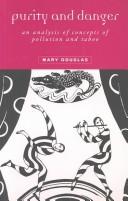

Witchcraft, Oracles and Magic among the Azande
Best-known analysis of witchcraft accusation systems.
Endnotes
1.
Source: cambridge.org
Link:https://www.cambridge.org/core/journals/comparative-studies-in-society-and-history/article/its-your-family-that-kills-you-responsibility-evidence-and-misfortune-in-the-making-of-ndyuka-history/6467A1D8632F2EF19D000A3C32374E88
Source snippet
Cambridge University Press & Assessment“It's your family that kills you”: Responsibility, Evidence, and Misfortune in the Making of Ndyuk...
2.
Source: cambridge.org
Link:https://www.cambridge.org/core/journals/international-review-of-social-history/article/okanisi-a-surinamese-maroon-community-c17122010/FEB980D8422F82D4154CEFAE020DAA04
Source snippet
Cambridge University Press & AssessmentThe Okanisi: A Surinamese Maroon Community, c.1712–2010* | International Review of Social History...
3.
Source: tandfonline.com
Link:https://www.tandfonline.com/doi/full/10.1080/10282580.2023.2216706
4.
Source: tandfonline.com
Link:https://www.tandfonline.com/doi/pdf/10.1080/10282580.2023.2216706
5.
Source: tandfonline.com
Link:https://www.tandfonline.com/doi/abs/10.1080/10282580.2023.2216706
Source snippet
May 29, 2023 — Contemporary Justice Review Issues in Criminal, Social, and Restorative Justice Volume 26, 2023 - Issue 1 Submit an articl...
Published: May 29, 2023
6.
Source: tandfonline.com
Link:https://www.tandfonline.com/doi/abs/10.1080/10282580.2023.2216706?aria-labelledby=reprints-perm&role=tab&scroll=top&tab=permissions
Source snippet
May 29, 2023 — CrossRef citations to date 0 Altmetric Listen Research Article MAROON JUSTICE IN SURINAME: PASTS AND PRESENTS WORTH FIGHTI...
Published: May 29, 2023
7.
Source: tandfonline.com
Link:https://www.tandfonline.com/doi/abs/10.1080/2049677X.2017.1385266
8.
Source: tandfonline.com
Link:https://www.tandfonline.com/doi/full/10.1080/08263663.2016.1187363
9.
Source: tandfonline.com
Link:https://www.tandfonline.com/doi/abs/10.1080/08263663.2016.1187363
10.
Source: independent.academia.edu
Title: Bonno Thoden
Link:https://independent.academia.edu/BonnoThoden
Additional References
11.
Source: nature.com
Link:https://www.nature.com/articles/s41598-022-10315-8
Source snippet
April 22, 2022 — Same-sex competition and sexual conflict expressed through witchcraft accusations Download PDF Download PDF * Article *...
Published: April 22, 2022
12.
Source: researchgate.net
Link:https://www.researchgate.net/publication/371154597_Maroon_justice_in_Suriname_pasts_and_presents_worth_fighting_for
Source snippet
May 29, 2023 — ISSN: (Print) (Online) Journal homepage: [https://www.tandfonline.com/loi/gcjr20](https://www.tandfonline.com/loi/gcjr20) Maroon justice in Suriname: pasts and pres...
Published: May 29, 2023
13.
Source: youtube.com
Title: The Saramaka People of Suriname and French Guiana
Link:https://www.youtube.com/watch?v=wpWH0FLuX8o
Source snippet
The Maroons of Suriname is highly relevant as it offers an in-depth look into the unique ancestral spiritual traditions, social order, an...
14.
Source: nature.com
Link:https://www.nature.com/nature-index/topics/l4/witchcraft-accusations-and-socio-cultural-dynamics-in-africa
15.
Source: researchgate.net
Link:https://www.researchgate.net/publication/228741843_Risk_attitudes_and_mitigation_among_gold_miners_and_others_in_the_Suriname_rainforest
16.
Source: sciencedirect.com
Link:https://www.sciencedirect.com/org/science/article/pii/S138223731500080X
17.
Source: brill.com
Link:https://brill.com/view/journals/nwig/89/3-4/article-p417_48.xml
18.
Source: maroonheritage.com
Link:https://maroonheritage.com/richard-en-sally-price-antropologen/news
19.
Source: dbnl.org
Link:https://www.dbnl.org/tekst/_oso001200401_01/_oso001200401_01_0028.php
20.
Source: dbnl.org
Link:https://www.dbnl.org/tekst/_oso001201601_01/_oso001201601_01_0016.php
Topic Tree