Within Samoa
Why Did Christianity Spread So Fast in Samoa?
Rapid Christian conversion spread through families, villages and chiefly alliances without amounting to mass hysteria.
On this page
- The Great Samoan Awakening of 1839
- How chiefs and families shaped religious choice
- Why collective conversion was not mass hysteria
Page outline Jump by section
Introduction
The rapid spread of Christianity through Samoa during the 1830s is sometimes described as the Great Samoan Awakening, but the phrase can be misleading if it suggests a sudden outbreak of religious frenzy. What happened was instead a remarkable process of collective conversion: villages, extended families and chiefly alliances adopted Christianity together through political negotiation, social trust and local adaptation rather than through uncontrolled mass hysteria. Within less than a decade of the arrival of permanent London Missionary Society (LMS) missionaries in 1830, Christianity had become the dominant public religion across most of Samoa, and by 1839 Samoan Christians were themselves leaving as missionaries to other Pacific islands.[World Council of Churches]oikoumene.orgOpen source on oikoumene.org.
Understanding why this transformation happened so quickly helps explain an important feature of Samoan history. Religious change was embedded in Samoa’s existing social and political structures rather than replacing them overnight. Chiefs, families and local teachers shaped the movement as much as foreign missionaries did, while Samoans interpreted Christian teaching through their own cultural values and institutions.[The Australian National University]researchportalplus.anu.edu.auThe Australian National UniversityChanging covenants in samoa? from brothers and sisters to husbands and wives? - The Australian National…
The Great Samoan Awakening of 1839
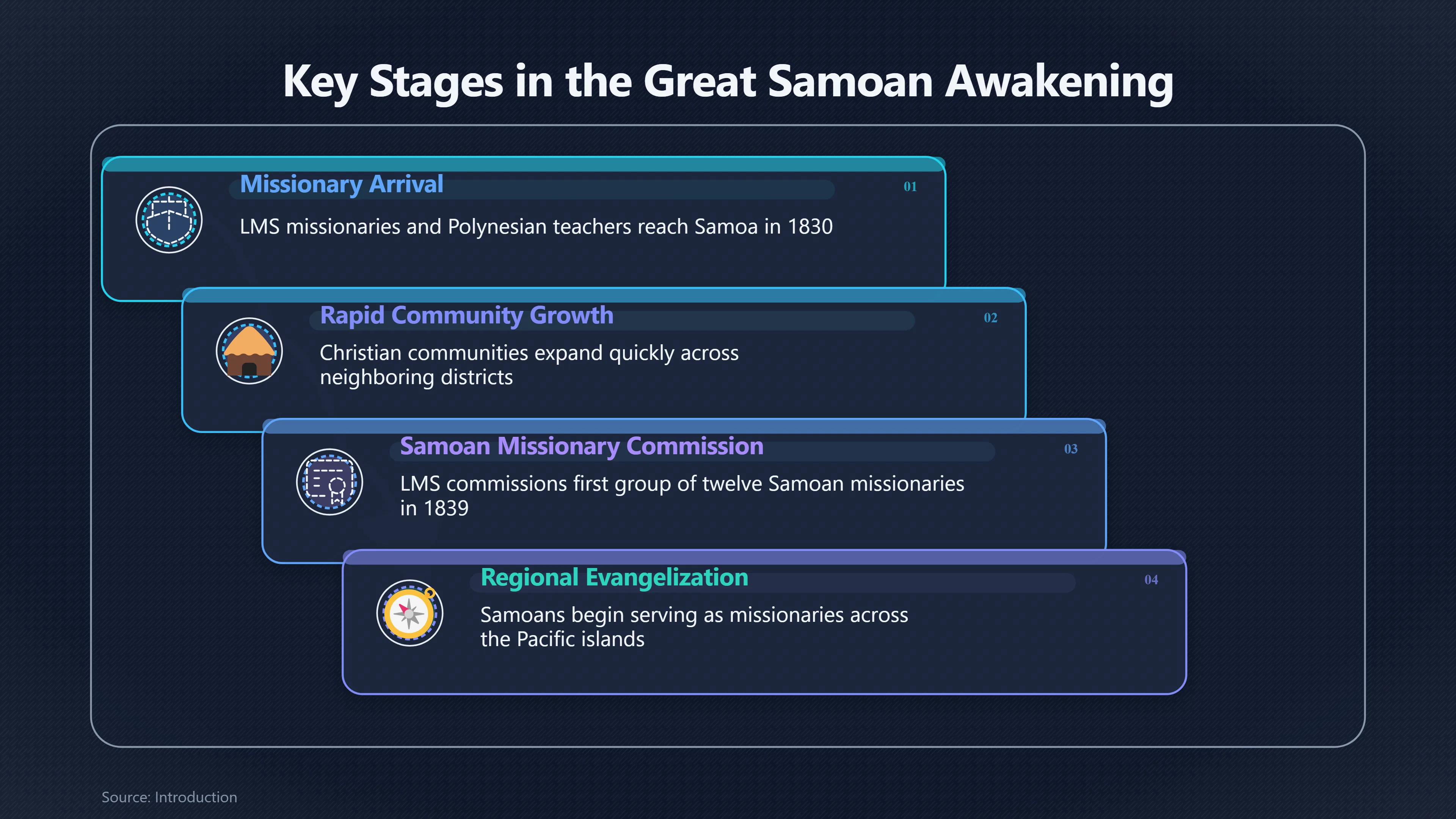
Missionaries led by John Williams and the London Missionary Society reached Samoa in 1830, accompanied not only by Europeans but also by experienced Polynesian Christian teachers from Tahiti, the Cook Islands and Tonga. This mixed missionary presence mattered because Christianity did not initially appear as an entirely foreign religion but as one already circulating through Pacific networks.[World Council of Churches]oikoumene.orgOpen source on oikoumene.org.
The years that followed saw exceptionally rapid growth in Christian communities. As influential districts accepted the new faith, neighbouring communities often followed. Church historians later referred to this period as a “Great Awakening” because of its speed and scale, but contemporary evidence shows an organised pattern of community decisions rather than spontaneous emotional revival meetings of the kind associated with some Protestant awakenings in Europe or North America.[World Council of Churches]oikoumene.orgOpen source on oikoumene.org.
By 1839, only nine years after the first permanent mission, Samoa had become so strongly identified with Christianity that the LMS commissioned its first group of twelve Samoan missionaries for work elsewhere in the Pacific. Over the following decades, hundreds more Samoans served in Melanesia, Micronesia and Polynesia, demonstrating that Samoa had become a centre of regional evangelisation rather than merely a recipient of missionary activity.[Open Research Repository]openresearch-repository.anu.edu.auOpen Research RepositoryThe role of London Missionary Society: Samoan Missionaries in the evangelisation of the South West Pacific 1839…
How chiefs and families shaped religious choice
The speed of conversion makes more sense when viewed through Samoan social organisation.
Religion in nineteenth-century Samoa was rarely treated as a purely private matter. Villages were organised around chiefly authority, extended kin groups and reciprocal obligations. When respected leaders accepted Christianity, their decision often influenced entire communities.
Several mechanisms reinforced one another:
- Chiefly leadership: Paramount chiefs could publicly endorse missionaries, allowing churches to be established under recognised local authority rather than through coercion alone.
- Village consensus: Religious affiliation was commonly discussed and adopted collectively, reflecting existing patterns of political decision-making.
- Family networks: Extended families transmitted new beliefs through everyday relationships, making conversion a shared social experience.
- Competition between districts: Success in one district encouraged neighbouring communities to consider Christianity, especially when conversion appeared compatible with peace, prestige or new political alliances.[oikoumene.org]oikoumene.orgOpen source on oikoumene.org.
This does not mean everyone converted for identical reasons. Individuals were motivated by spiritual conviction, hopes for peace after prolonged conflict, access to literacy and education, relationships with missionaries, or strategic political considerations. Collective conversion allowed these different motivations to coexist within the same community.
Why Christianity spread so quickly
Rapid conversion reflected several overlapping conditions rather than a single dramatic event.
First, Samoa in the early nineteenth century experienced significant political competition between leading chiefly families. Missionaries often arrived as advocates of peace and offered a religious framework that some communities associated with ending cycles of warfare. Church traditions emphasise that many people welcomed what they understood as a “gospel of peace” during a period of instability.[World Council of Churches]oikoumene.orgOpen source on oikoumene.org.
Second, Christianity offered practical advantages. Literacy, new forms of education and connections to expanding Pacific and European networks carried clear social value. Mission stations became centres of learning as well as worship.
Third, Samoans actively reshaped Christianity instead of simply receiving it unchanged. Research on Samoan conversion shows that local people interpreted Christian ideas through existing concepts of kinship, authority and sacred relationships. Rather than abandoning Samoan social life, many communities incorporated Christian institutions into it, producing a distinctly Samoan form of church life.[The Australian National University]researchportalplus.anu.edu.auThe Australian National UniversityChanging covenants in samoa? from brothers and sisters to husbands and wives? - The Australian National…
Finally, conversion gained momentum because new Christian communities themselves became missionaries. Samoan teachers carried their language, customs and faith across the Pacific, demonstrating that Christianity had become embedded locally rather than remaining dependent on European personnel.[Open Research Repository]openresearch-repository.anu.edu.auOpen Research RepositoryThe role of London Missionary Society: Samoan Missionaries in the evangelisation of the South West Pacific 1839…
Why collective conversion was not mass hysteria
The Great Samoan Awakening is sometimes grouped loosely with episodes of contagious religious enthusiasm, but the evidence does not support describing it as mass hysteria.
Several features distinguish it:
- Deliberate decision-making: Conversion generally unfolded over years, with negotiation between missionaries and local leaders rather than sudden emotional outbreaks.
- Stable long-term commitment: Christianity became a durable social institution instead of disappearing after failed prophecies or emotional excitement.
- Institutional development: Schools, churches, translated scriptures and trained local teachers created lasting organisational structures.
- Local adaptation: Samoan Christians reinterpreted doctrine through existing cultural values instead of abandoning their social world entirely.[The Australian National University]researchportalplus.anu.edu.auThe Australian National UniversityChanging covenants in samoa? from brothers and sisters to husbands and wives? - The Australian National…
This differs from episodes of documented mass psychogenic illness or millenarian panic, where beliefs spread primarily through fear, rumour or emotionally contagious behaviour. Samoa certainly experienced prophetic movements, such as the independent Siovili movement discussed elsewhere, but the mainstream Christian conversion of the 1830s followed a much broader and more organised social process.
A transformation shaped by Samoans
Older missionary accounts often portrayed Christianity as something introduced to passive islanders. Modern scholarship presents a more balanced picture.
Researchers increasingly emphasise Samoan agency. Local converts selected which teachings to embrace, interpreted Christian ideas through Samoan cultural frameworks and eventually became missionaries themselves. The growth of Christianity therefore represented a negotiation between imported beliefs and established Samoan institutions rather than simple cultural replacement.[Open Research Repository]openresearch-repository.anu.edu.auOpen Research RepositoryThe role of London Missionary Society: Samoan Missionaries in the evangelisation of the South West Pacific 1839…
Studies of changing family and church relationships likewise show that Christian conversion altered ideas about authority, gender and community, but these changes were neither automatic nor one-sided. Samoan society accepted some missionary ideals, resisted others and transformed many into new forms that reflected local priorities.[The Australian National University]researchportalplus.anu.edu.auThe Australian National UniversityChanging covenants in samoa? from brothers and sisters to husbands and wives? - The Australian National…
Why the Great Samoan Awakening still matters
The nineteenth-century conversion of Samoa remains one of the Pacific’s clearest examples of how religious change can spread rapidly without fitting the model of mass hysteria or irrational collective panic.
Its importance lies less in dramatic emotional scenes than in the power of trusted social networks. Christianity spread because it travelled through families, villages and chiefly alliances that already organised Samoan society. Those same networks enabled Samoa, within a single generation, to become one of the Pacific’s most active sources of indigenous missionaries.
For historians of collective belief, the episode illustrates an important distinction: rapid, society-wide religious change does not necessarily arise from crowd psychology or delusion. It can also emerge through deliberate collective decisions, cultural adaptation and the authority of enduring social institutions.[edu.au]openresearch-repository.anu.edu.auOpen Research RepositoryThe role of London Missionary Society: Samoan Missionaries in the evangelisation of the South West Pacific 1839…

Endnotes
1.
Source: oikoumene.org
Link:https://www.oikoumene.org/member-churches/congregational-christian-church-in-samoa
2.
Source: openresearch-repository.anu.edu.au
Link:https://openresearch-repository.anu.edu.au/items/554ac3cd-b175-411c-884a-a7d505eddc68
Source snippet
Open Research RepositoryThe role of London Missionary Society: Samoan Missionaries in the evangelisation of the South West Pacific 1839...
3.
Source: researchportalplus.anu.edu.au
Link:https://researchportalplus.anu.edu.au/en/publications/changing-covenants-in-samoa-from-brothers-and-sisters-to-husbands/
Source snippet
The Australian National UniversityChanging covenants in samoa? from brothers and sisters to husbands and wives? - The Australian National...
4.
Source: openresearch-repository.anu.edu.au
Title: anu.edu.au Changing covenants in Samoa?
Link:https://openresearch-repository.anu.edu.au/handle/1885/13557
Source snippet
From brothers and sisters to husbands and wives?March 25, 2015 — CHANGING COVENANTS IN SAMOA? FROM BROTHERS AND SISTERS TO HUSBANDS AND W...
Published: March 25, 2015
5.
Source: adb.anu.edu.au
Title: anu.edu.au Biography
Link:https://adb.anu.edu.au/biography/williams-john-2793
6.
Source: openresearch-repository.anu.edu.au
Link:https://openresearch-repository.anu.edu.au/items/554ac3cd-b175-411c-884a-a7d505eddc68/full
7.
Source: openresearch-repository.anu.edu.au
Link:https://openresearch-repository.anu.edu.au/items/acdc1081-9df9-45ea-bb80-1424baa219b1/full
8.
Source: asiapacific.anu.edu.au
Title: anu.edu.au Williams, John
Link:https://asiapacific.anu.edu.au/pambu/catalogue/index.php/williams-john-and-bourne-robert%3Bisaar?sf_culture=pt
9.
Source: asiapacific.anu.edu.au
Title: anu.edu.au Williams, John
Link:https://asiapacific.anu.edu.au/pambu/catalogue/index.php/williams-john-and-bourne-robert
11.
Source: digitalpasifik.org
Link:https://digitalpasifik.org/items/199655
12.
Source: books.openedition.org
Link:https://books.openedition.org/pacific/1923
13.
Source: asiapacific.anu.edu.au
Title: anu.edu.au Letter from Rev. Williams to his sister Mary
Link:https://asiapacific.anu.edu.au/pambu/catalogue/index.php/letter-from-rev-williams-to-his-sister-mary-2
Additional References
14.
Source: researchgate.net
Title: 353292776 Pasifika Churches Trapped in the Missionary Era A Case in Samoa
Link:https://www.researchgate.net/publication/353292776_Pasifika_Churches_Trapped_in_the_Missionary_Era_A_Case_in_Samoa
Source snippet
Pasifika Churches Trapped in the Missionary Era: A Case in Samoa | Request PDFJuly 1, 2021 — PASIFIKA CHURCHES TRAPPED IN THE MISSIONARY...
Published: July 1, 2021
15.
Source: natlib.govt.nz
Title: Changing covenants in Samoa?
Link:https://natlib.govt.nz/records/36236070
Source snippet
From bro... | Items | National Library of New Zealand | National Library of New ZealandMarch 1, 2015 — JOURNAL CHANGING COVENANTS IN SAMO...
Published: March 1, 2015
16.
Source: youtube.com
Title: Building Understanding Series: American Samoa: Past and Present: Part 1
Link:https://www.youtube.com/watch?v=liNqZ890kfo
Source snippet
O le Sulu Samoa: A legacy of light in the archives...
17.
Source: onlinelibrary.wiley.com
Link:https://onlinelibrary.wiley.com/doi/abs/10.1002/ocea.5076
Source snippet
From Brothers and Sisters to Husbands and Wives? - Latai - 2015 - Oceania - Wiley Online LibraryMarch 25, 2015 — CHANGING COVENANTS IN SA...
Published: March 25, 2015
18.
Source: youtube.com
Title: Congregationalism in Samoa and the Diaspora
Link:https://www.youtube.com/watch?v=2MWumBuD8qQ
Source snippet
Building Understanding Series: American Samoa: Past and Present: Part 1...
19.
Source: youtube.com
Title: O le Sulu Samoa: A legacy of light in the archives
Link:https://www.youtube.com/watch?v=CqYdFm7UN_U
Source snippet
Christianity Is Not Samoan Culture — Let's Talk About It...
20.
Source: sciencedirect.com
Link:https://www.sciencedirect.com/science/article/abs/pii/S1352023704000838
21.
Source: academic.oup.com
Link:https://academic.oup.com/edinburgh-scholarship-online/book/62133/chapter-abstract/549441344
Source snippet
"Ross (ed.) et al. [https://doi.org/10.3366/edinburgh/9781474480079.001.0001..."](https://doi.org/10.3366/edinburgh/9781474480079.001.0001...")...
22.
Source: youtube.com
Title: Christianity Is Not Samoan Culture — Let’s Talk About It
Link:https://www.youtube.com/watch?v=AHNTO5iO7tI
Source snippet
Samoan History in 3 Minutes...
23.
Source: profilpelajar.com
Title: Congregational Christian Church of Samoa
Link:https://profilpelajar.com/en/Congregational_Christian_Church_of_Samoa
Topic Tree