When Belief Became Resistance in Solomon Islands
Solomon Islands has no well-documented equivalent of the Salem witch trials or a famous nationwide outbreak of mass psychogenic illness. Its most revealing episodes of contagious belief belong instead to the history of anti-colonial movements, Christian revival, prophecy, sorcery fears and disputes over what outsiders called “cargo cults”.
Page outline Jump by section
Introduction
The clearest cases are Maasina Rule, which British officials treated as a dangerous and partly millenarian movement; the Moro Movement on Guadalcanal, which combined cultural restoration, political organisation and sacred history; and prophetic Christian movements descended from the revival of 1970. Sorcery accusations form a darker, more persistent strand. They can turn illness, death or personal conflict into communal suspicion and sometimes violence. Taken together, these histories show why labels such as “cult” and “mass hysteria” often conceal more than they explain.
Why “cargo cult” can be a misleading label
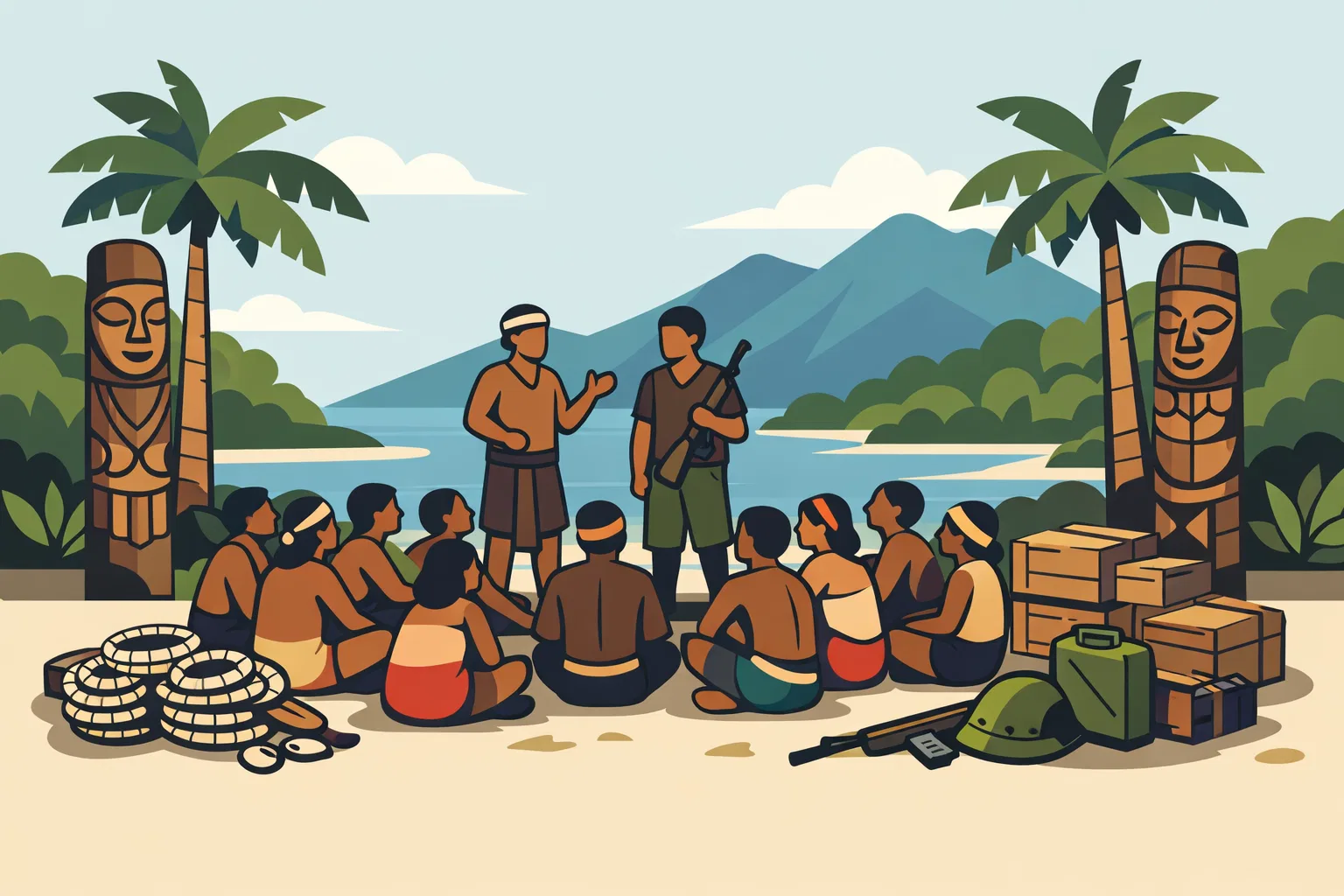
The phrase “cargo cult” was coined by colonial commentators in the wider Melanesian region during the 1940s. It came to describe movements supposedly expecting manufactured goods to arrive through supernatural means. Later popular accounts often reduced such movements to stories of islanders imitating Europeans, building symbolic airstrips or waiting passively for ships and aircraft.
That stereotype is a poor guide to Solomon Islands. Movements placed under the cargo-cult heading commonly pursued practical objectives: higher living standards, control of land and labour, political representation, religious independence and an explanation for the enormous material inequality between islanders and Europeans. Modern Pacific historians therefore treat “cargo cult” as an outsider’s category that selected the most exotic rumours while minimising coherent political demands. Historical surveys note that colonial protest movements such as Maasina Rule were dismissed as cargo cults rather than recognised as labour or political resistance.[dokumen.pub]dokumen.pubcargo cult and culture critique 0824828518 9780824828516Cargo, Cult, and Culture Critique 0824828518…An Australian expatriate named Norris Bird introduced “cargo cult” in an article in whic…
This does not mean that expectations of miraculous wealth never existed. Prophecies, rumours of returning ancestors and hopes that Americans would bring goods did circulate in parts of Melanesia. The important question is whether such beliefs defined a whole movement or represented one current within a much broader coalition. In Solomon Islands, the evidence usually supports the second interpretation.
Maasina Rule: rebellion, prophecy or colonial panic?
Maasina Rule emerged on Malaita during the closing stages of the Second World War and became the most important mass movement in the colonial history of Solomon Islands. Its leaders and organisers included men who had served in the Solomon Islands Labour Corps, where wartime employment and contact with American forces exposed them to new wages, machinery, racial relationships and forms of organisation. Returning workers had seen that Europeans did not possess a single, naturally superior civilisation. They also saw how quickly vast quantities of food, equipment and infrastructure could be mobilised when powerful governments considered it necessary.[hawaii.edu]scholarspace.manoa.hawaii.eduColonialism, Maasina Rule, and the Origins of Malaitan…by DW Akin · 2013 · Cited by 151 — This book, while focusing on Mal…
The movement called for Indigenous-led government, economic cooperation, improved villages, agricultural development and the codification of local law. Supporters created their own organisational structures and increasingly withdrew cooperation from the British administration. Its ideology also helped turn kastom—custom understood as a consciously defended social and political system—into a language of resistance to colonial rule.[hawaii.edu]scholarspace.manoa.hawaii.eduColonialism, Maasina Rule, and the Origins of Malaitan…by DW Akin · 2013 · Cited by 151 — This book, while focusing on Mal…
British officials found this alarming. Administrators encountered a movement communicating through village networks, collecting money, rejecting official councils and presenting its leaders as more legitimate than colonial officers. Rumours that America would liberate Malaita or provide wealth were taken as evidence that followers had succumbed to a cargo cult. Yet historians have warned that officials sometimes exaggerated or even helped construct this interpretation because it made organised opposition appear deluded rather than political.[solomonencyclopaedia.net]solomonencyclopaedia.netConcept: Maasina RuleIn its seminal form Maasina Rule advocated improvements in agriculture, concentration into larger, cleaner villagers…
In 1947 the administration launched a major operation against Maasina Rule, arresting its leaders and seizing records and funds. The arrests did not immediately destroy the movement. They encouraged civil disobedience and further mass detentions, demonstrating that participation rested on organised solidarity rather than a single prophet’s charisma. A change in colonial policy followed: leaders were released, local councils were reformed and the administration conceded more space for Indigenous political representation. Maasina Rule is consequently remembered as an important predecessor of national independence, achieved in 1978.[hawaii.edu]scholarspace.manoa.hawaii.eduColonialism, Maasina Rule, and the Origins of Malaitan…by DW Akin · 2013 · Cited by 151 — This book, while focusing on Mal…
What did followers actually believe?
There was no single creed shared uniformly across Malaita. Some supporters apparently entertained millenarian hopes: that colonial rule would end abruptly, that Americans might return, or that a transformed social order was near. Such ideas made sense in a region where the war had produced an almost unimaginable influx of foreign soldiers and goods, followed by a sudden return to colonial scarcity.
But the movement’s everyday programme was less mysterious. It promoted larger and cleaner settlements, economic cooperation, Indigenous courts, collective funds and political autonomy. The strongest interpretation is therefore not that Maasina Rule was either a rational nationalist movement or an irrational religious eruption. It combined political organisation, moral renewal, wartime expectation and, in some places, prophetic hope. Reducing all of this to “cargo belief” repeats the colonial authorities’ most convenient account.[hawaii.edu]scholarspace.manoa.hawaii.eduColonialism, Maasina Rule, and the Origins of Malaitan…by DW Akin · 2013 · Cited by 151 — This book, while focusing on Mal…
The Moro Movement and the recovery of Isatabu
A second major revitalisation movement developed on the Weather Coast and other parts of Guadalcanal under Pelise Moro. Beginning in the mid-twentieth century, it sought to rebuild social order through communal settlements, cultural preservation, economic cooperation and renewed attachment to ancestral land. Its supporters favoured the name Isatabu for Guadalcanal, rejecting the colonial name and asserting an Indigenous identity that later entered national political language.[wikipedia.org]WikipediaMoro MovementMoro Movement
Moro’s authority drew on several sources at once. He was a cultural and political leader, a person associated with inherited ritual knowledge and the centre of a movement that blended Christian and customary ideas. Followers organised councils and communal villages, collected contributions, preserved shell money and artefacts, and established ventures including stores, plantations and a school. Sacred stones and other objects were gathered in a house devoted to the movement’s history. Church critics regarded some of these objects as connected to forbidden ancestral worship, while movement members described them as memorials and evidence of clan histories.[Wikipedia]WikipediaMoro MovementMoro Movement
This disagreement illustrates a recurring pattern in Solomon Islands religious history. Mission churches often classified older ritual objects and practices as dangerous spirits or superstition. Communities did not necessarily accept the choice between Christianity and custom. The Moro Movement constructed a new moral order from both, treating Christianity as important while refusing to surrender land-based histories and Indigenous authority.
Some followers did circulate recognisably millenarian stories. In 1965 two local figures reportedly told people to expect cargo from America. Evidence preserved in accounts of the movement also indicates that Moro and other senior members opposed this claim. It would therefore be inaccurate to make the American-cargo prophecy the defining belief of the entire organisation. It was a disputed episode inside a movement whose larger concerns were land, unity, cultural recovery and self-government.[Wikipedia]WikipediaMoro MovementMoro Movement
The Moro Movement survived long enough to participate publicly in the celebrations marking independence in 1978. Its continuing cultural significance is visible in later commemorations of Pelise Moro and in the political use of the name Isatabu. This endurance is difficult to reconcile with the image of a short-lived cult collapsing after a failed prediction. It functioned more like a durable social and political community built around a charismatic founder.[Wikipedia]WikipediaMoro MovementMoro Movement
Revival, prophecy and the Christian remaking of Malaita
Christian conversion in Solomon Islands did not simply replace traditional belief with a fixed European religion. Islanders created their own churches, evangelists and revival traditions, often linking biblical history with local identity. One important turning point came in 1970, when an interdenominational evangelical revival spread through congregations in Honiara and Malaita. Contemporary religious accounts describe intense public repentance, weeping, reconciliation, prayer and claims of the Holy Spirit’s presence. Such sources are testimonies of believers rather than detached investigations, but academic work confirms that the revival became a lasting reference point in Malaitan Christianity.[revival-library.org]revival-library.org1970 solomon islands revival1970 solomon islands revival
The revival’s emotional intensity should not automatically be described as mass hysteria. Collective crying, confession and ecstatic worship occurred within a recognised religious setting and were understood by participants as spiritually meaningful. There is no strong evidence that the events were an outbreak of unexplained illness or involuntary symptoms of the kind normally studied as mass psychogenic illness. The more useful comparison is with revival movements elsewhere, in which expectation, preaching, music, social pressure and shared interpretation produce powerful group experiences.
Over subsequent decades, revival Christianity generated prophetic leaders and movements with political as well as religious ambitions. Reverend Michael Maeliau, associated with the movement All Pacific Arise, presented revelations concerning Malaita’s past and future. Recent scholarship describes a vision of Malaita as a Christian nation whose institutions would express both divine purpose and Malaitan identity. In this theology, Christianity is not treated simply as a foreign import; it becomes the fulfilment of local history.[berghahnbooks.com]berghahnbooks.comTimmer Sea introTimmer Sea intro
Such movements may appear millenarian because they expect a profound moral and political transformation, sometimes under prophetic guidance. Yet the word “cult” would be especially unhelpful here. These networks emerged from established evangelical churches and from a revival remembered positively by many believers. Scholars study them as forms of prophetic Christianity, postcolonial nation-building and religious innovation. Whether their political theology is persuasive is separate from whether followers are irrational or manipulated.
Their deeper importance lies in the way they answer a persistent historical problem: how can Malaitans embrace a religion introduced through colonial-era missions without accepting colonial cultural inferiority? Prophetic Christianity resolves the tension by claiming that Malaita has its own place in sacred history and may even have a special role in the future of the Pacific.
Sorcery fears and the danger of accusation
Belief in harmful supernatural action remains widespread across parts of Solomon Islands, although terminology and practice vary by island and language group. A Solomon Islands contribution to a regional study identifies distinct traditions on Guadalcanal, North Malaita and in Marovo Lagoon. These beliefs should not be treated as one uniform national system. They may involve fears that illness, death, crop failure, personal misfortune or criminal success has been caused deliberately through invisible means.[JSTOR]jstor.orgResponses to Sorcery and Witchcraft Beliefs and PracticesResponses to Sorcery and Witchcraft Beliefs and Practices
Sorcery belief is not itself the same as a witch panic. Many people hold such ideas without attacking anyone, and churches or chiefs may respond through prayer, mediation or reconciliation. The panic begins when an unexplained event is converted into certainty that a named person is responsible, especially when rumour spreads faster than evidence and punishment is demanded.
Consultations undertaken by the Solomon Islands Law Reform Commission revealed how deeply divided public responses could be. Some contributors wanted sorcery punished as seriously as murder, argued that chiefs should adjudicate cases or regarded threats of sorcery as offences. The same consultations recorded allegations of suspected practitioners being beaten or killed. This produces a basic legal dilemma: recognising supernatural claims as proof may legitimise accusations, but ignoring the fear surrounding them can leave conflicts to escalate outside formal institutions.[lawreform.gov.sb]lawreform.gov.sbSolomon Islands Law Reform CommissionSolomon Islands Law Reform Commission
The inherited criminal law contained an offence relating to sorcery, but legal analysis has noted both its very low maximum penalty and the apparent absence of successful prosecutions. More fundamentally, courts cannot reliably prove that a supernatural act caused an illness or death. Physical assault, threats, murder, destruction of property and banishment, however, can be investigated through ordinary evidence.[ResearchGate]researchgate.netOpen source on researchgate.net.
Sorcery accusations are therefore best understood as a social-danger issue rather than a question that criminal courts can settle by deciding whether magic is real. An accusation can provide an explanation for grief, but it can also redirect anger towards a vulnerable neighbour or relative. Personal disputes over land, inheritance, jealousy or domestic relationships may become inseparable from supernatural suspicion. Regional research warns that people accused of witchcraft or sorcery can be expelled, displaced or killed even where the initial misfortune had an ordinary medical or social cause.[jstor.org]jstor.orgResponses to Sorcery and Witchcraft Beliefs and PracticesResponses to Sorcery and Witchcraft Beliefs and Practices
Solomon Islands has not documented sorcery-accusation violence on the scale reported in parts of Papua New Guinea. That distinction matters: evidence from a neighbouring country should not be imported as though it describes Solomon Islands directly. The shared Melanesian setting is useful mainly because it shows how weak health services, sudden deaths, gender inequality and limited policing can allow a supernatural explanation to become a collective accusation. The Solomon Islands material itself points to real but unevenly recorded cases, making caution preferable to dramatic national claims.
How collective beliefs spread across islands
The major Solomon Islands movements spread through social structures that were already trusted. Information travelled through kinship, churches, labour networks, village leaders and face-to-face meetings. These channels could mobilise people more effectively than the small colonial administration and, in many rural areas, more effectively than the later national state.
Several pressures repeatedly strengthened contagious beliefs:
- War and sudden inequality: During the Second World War, islanders witnessed military abundance on an extraordinary scale. The contrast between wartime logistics and colonial underdevelopment made rumours of hidden knowledge or deliberately withheld wealth credible.
- Colonial distrust: Officials often spoke to islanders through chiefs, missionaries or labour recruiters rather than as political equals. When authorities dismissed demands as superstition, they strengthened the suspicion that important truths were being concealed.
- Religious transformation: Christianity introduced powerful narratives of apocalypse, resurrection, miracles and a coming kingdom. Islanders interpreted these ideas through existing understandings of ancestors, land and spiritual power rather than adopting a completely separate mental world.
- Illness without adequate explanation: Where medical diagnosis or treatment is difficult to obtain, sorcery offers an intentional cause for otherwise bewildering suffering. Once a suspected perpetrator is named, grief may become anger and private suspicion may become communal action.
- Charismatic authority: Figures such as Maasina organisers, Pelise Moro and later Christian prophets could connect practical grievances with a larger moral story. Charisma mattered, but successful movements also built councils, funds, settlements, churches and disciplined networks.
These mechanisms do not prove that every belief was correct or harmless. They explain why certain messages became persuasive. Collective belief spreads most readily when it interprets visible injustice, uses a familiar moral language and travels through relationships people already trust.
What should count as panic or mass hysteria?
The Solomon Islands record rewards careful classification. Several different phenomena are easily confused:
A political movement subjected to a moral panic: British officials portrayed Maasina Rule as dangerous, irrational and potentially subversive. The exaggerated fear may have belonged as much to the colonial administration as to the movement it suppressed.
A revitalisation movement with disputed millenarian elements: The Moro Movement included sacred history and occasional cargo prophecy, but it also maintained economic, cultural and political institutions. Calling the whole movement a cargo cult gives one contested episode too much weight.
A religious revival: The events of 1970 involved emotional contagion and claims of divine action, but emotional intensity alone does not establish psychogenic illness. The available evidence places the episode within collective worship and religious renewal.
A sorcery scare: When illness or death prompts rumours, naming of suspects and demands for retaliation, the process resembles a witch panic. The central harm comes not from belief in the abstract but from accusation, certainty without evidence and collective punishment.
Mass psychogenic illness: This term normally refers to genuine physical symptoms spreading within a group without a sufficient toxic, infectious or structural cause. No comparably well-substantiated Solomon Islands case stands out in the accessible historical and medical record. Claims that the country experienced a classic mass-hysteria epidemic should therefore be treated cautiously unless supported by clinical investigation.
This distinction protects both accuracy and dignity. It prevents anti-colonial resistance from being pathologised, avoids treating worshippers as patients merely because they cried or trembled, and keeps attention on victims when supernatural accusations become violent.

Why these histories still matter
Solomon Islands’ collective-belief history is fundamentally about authority: who has the right to explain misfortune, promise a better future, define legitimate religion and decide whether a social movement is reasonable. Colonial officials once used the language of cargo cults to turn political resistance into a psychological curiosity. Missionaries sometimes treated the preservation of ancestral objects as spiritual danger. Prophets later reversed the direction of judgement by placing Malaita or Isatabu within a divinely ordered future.
The same struggle continues whenever an unexplained death produces competing explanations from relatives, churches, chiefs, medical workers and police. A response that simply mocks sorcery belief may deepen distrust. A response that treats accusation as proof may expose an innocent person to exclusion or attack. Effective intervention requires respect for grief and cultural context while insisting that no one should be punished without evidence.
For readers interested in cults, panics and mass hysteria, Solomon Islands offers a warning against beginning with the label. The most famous “cult-like” movements were frequently projects of political emancipation, cultural reconstruction or Christian nation-building. Their supernatural claims mattered, but so did taxation, racial hierarchy, land loss, mission history and the unequal distribution of wealth. The central lesson is not that island communities were unusually credulous. It is that periods of violent social change produce stories capable of organising hope as powerfully as fear.
Amazon book picks
Further Reading
Books and field guides related to When Belief Became Resistance in Solomon Islands. Use these as the next step if you want deeper reading beyond the article.

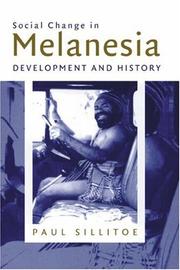
Social Change in Melanesia
First published 2000. Subjects: Melanesia, Social conditions, History, Conditions sociales, Histoire.
Endnotes
1.
Source: dokumen.pub
Title: cargo cult and culture critique 0824828518 9780824828516
Link:https://dokumen.pub/cargo-cult-and-culture-critique-0824828518-9780824828516.html
Source snippet
Cargo, Cult, and Culture Critique 0824828518...An Australian expatriate named Norris Bird introduced “cargo cult” in an article in whic...
2.
Source: jstor.org
Link:https://www.jstor.org/content/oa_chapter_edited/j.ctv1h45mj4.5
Source snippet
Unequal Lives in the Western PacificThe label 'cargo cult' drew attention to only one aspect of such movements: an attempt to access...
3.
Source: openresearch-repository.anu.edu.au
Title: Open Research Repository Pacific Islands History
Link:https://openresearch-repository.anu.edu.au/bitstreams/fa336538-32b6-49bd-8b37-6b49e0c7c6c8/download
Source snippet
Open Research RepositoryPacific Islands History - ANU Open ResearchFor example, protest movements such as Maasina Rule were dismissed as...
4.
Source: nvdatabase.swarthmore.edu
Link:https://nvdatabase.swarthmore.edu/content/solomon-islanders-withdraw-colonialism-maasina-rule
Source snippet
elopment and self-government outside of the purview of the colonial state.Read more...
5.
Source: solomonencyclopaedia.net
Link:https://www.solomonencyclopaedia.net/biogs/E000181b.htm
Source snippet
Concept: Maasina RuleIn its seminal form Maasina Rule advocated improvements in agriculture, concentration into larger, cleaner villagers...
6.
Source: openresearch-repository.anu.edu.au
Link:https://openresearch-repository.anu.edu.au/bitstreams/37b3b711-8b67-49e6-8b31-b353e368653f/download
Source snippet
Open Research RepositoryA Post-Colonial Analysis of Why the Solomon Islands Truth...by C Cronin · 2019 · Cited by 4 — Allen describes ho...
7.
Source: Wikipedia
Title: Solomon Islands
Link:https://en.wikipedia.org/wiki/Solomon_Islands
8.
Source: Wikipedia
Title: Moro Movement
Link:https://en.wikipedia.org/wiki/Moro_Movement
9.
Source: researchgate.net
Link:https://www.researchgate.net/publication/375635986_Review_of_Moro_and_the_Weather_Coast_A_Revitalization_Movement_in_the_Solomon_Islands_by_Gulbun_Coker_O%27Connor_2022_Durham_NC_USA_Carolina_Academic_Press
10.
Source: solomonencyclopaedia.net
Link:https://www.solomonencyclopaedia.net/biogs/E000605b.htm
11.
Source: revival-library.org
Title: 1970 solomon islands revival
Link:https://revival-library.org/histories/1970-solomon-islands-revival/
12.
Source: researchgate.net
Link:https://www.researchgate.net/publication/376647346_Wounded_by_Grace_Becoming_a_Prophet_in_an_Evangelical_Revival_in_Solomon_Islands
13.
Source: researchers.mq.edu.au
Link:https://researchers.mq.edu.au/en/publications/wounded-by-grace-becoming-a-prophet-in-an-evangelical-revival-in-/
14.
Source: berghahnbooks.com
Title: Timmer Sea intro
Link:https://www.berghahnbooks.com/downloads/intros/TimmerSea_intro.pdf
15.
Source: jstor.org
Link:https://www.jstor.org/stable/44161350
16.
Source: jstor.org
Title: Responses to Sorcery and Witchcraft Beliefs and Practices
Link:https://www.jstor.org/stable/j.ctt169wd7b
17.
Source: researchgate.net
Link:https://www.researchgate.net/publication/321881157_The_Belief_in_Sorcery_in_Solomon_Islands
18.
Source: lawreform.gov.sb
Title: Solomon Islands Law Reform Commission
Link:https://www.lawreform.gov.sb/publications/other-reports/consultation-papers/10-sorcery-consultation-paper.html
19.
Source: png-data.sprep.org
Title: Talking it Through
Link:https://png-data.sprep.org/system/files/Talking%20it%20Through%20Responses%20to%20Sorcery%20and%20Witchcraft%20Beliefs%20and%20Practices%20in%20Melanesia.pdf
20.
Source: Wikipedia
Title: Cargo cult
Link:https://en.wikipedia.org/wiki/Cargo_cult
21.
Source: Wikipedia
Title: List of mass panic cases
Link:https://en.wikipedia.org/wiki/List_of_mass_panic_cases
22.
Source: digitalcollections.anu.edu.au
Link:https://digitalcollections.anu.edu.au/bitstreams/d9faa856-dab9-4173-91f2-25aaf5cc80fd/download
23.
Source: openresearch-repository.anu.edu.au
Link:https://openresearch-repository.anu.edu.au/bitstreams/e1873f96-65c5-4dbd-90ab-c7128a6ebac0/download
24.
Source: solomonencyclopaedia.net
Title: Party: Moro Movement
Link:https://www.solomonencyclopaedia.net/biogs/E000207b.htm
25.
Source: jstor.org
Link:https://www.jstor.org/stable/10.1086/322556
26.
Source: jstor.org
Link:https://www.jstor.org/stable/2796794
27.
Source: jstor.org
Link:https://www.jstor.org/stable/20877388
28.
Source: jstor.org
Link:https://www.jstor.org/stable/26858307
29.
Source: jstor.org
Link:https://www.jstor.org/stable/3134480
30.
Source: jstor.org
Link:https://www.jstor.org/stable/4030746
31.
Source: jstor.org
Link:https://www.jstor.org/stable/23162991
32.
Source: jstor.org
Link:https://www.jstor.org/stable/40331184
33.
Source: jstor.org
Link:https://www.jstor.org/stable/2949230
34.
Source: jstor.org
Link:https://www.jstor.org/stable/40330695
35.
Source: researchgate.net
Link:https://www.researchgate.net/publication/333578030_Cargo_Cult_Strange_Stories_of_Desire_from_Melanesia_and_Beyond
36.
Source: researchgate.net
Link:https://www.researchgate.net/publication/290858788_Colonialism_Maasina_Rule_and_the_origins_of_Malaitan_kastom
37.
Source: researchgate.net
Link:https://www.researchgate.net/publication/264218067_Handling_Sorcery_in_a_State_System_of_Law_Magic_Violence_and_Kastom_in_Vanuatu
38.
Source: lawreform.gov.sb
Link:https://lawreform.gov.sb/publications/other-reports/consultation-papers.html
39.
Source: solomons.gov.sb
Title: 2016 Annual Report
Link:https://solomons.gov.sb/wp-content/uploads/2020/02/2016-Annual-Report.pdf
40.
Source: history.com
Title: mysterious illnesses mass hysteria
Link:https://www.history.com/articles/mysterious-illnesses-mass-hysteria
41.
Source: espace.library.uq.edu.au
Title: uq.edu.au Solomon Islands’ Constitutional Dilemma
Link:https://espace.library.uq.edu.au/view/UQ%3A672523/s4273960_final_thesis.pdf
42.
Source: youtube.com
Title: Moro Movement
Link:https://www.youtube.com/watch?v=YtcBsHabX3Y
Source snippet
Cargo Cults: When WWII Supplies Became a Religion...
43.
Source: scholarspace.manoa.hawaii.edu
Link:https://scholarspace.manoa.hawaii.edu/bitstreams/30eb2e13-3272-443a-84b8-6a2a6ab8a269/download
Source snippet
Colonialism, Maasina Rule, and the Origins of Malaitan...by DW Akin · 2013 · Cited by 151 — This book, while focusing on Mal...
44.
Source: degruyterbrill.com
Link:https://www.degruyterbrill.com/document/doi/10.1515/9780824838157-010/html?srsltid=AfmBOorc4a4TqVxJYDemUaGbOkntlwGq5hPwSfyG0QiubXrZY8nD_kbS
45.
Source: scholarspace.manoa.hawaii.edu
Link:https://scholarspace.manoa.hawaii.edu/bitstreams/b08f6f45-a462-4ffd-879c-6ad09fb79608/download
46.
Source: romans1015.com
Title: solomon islands
Link:https://romans1015.com/solomon-islands/
47.
Source: researchcommons.waikato.ac.nz
Link:https://researchcommons.waikato.ac.nz/bitstreams/ec2be1c9-aa48-4d35-8eb1-fc4827de091a/download
Additional References
48.
Source: facebook.com
Link:https://www.facebook.com/kathmandupost/posts/mass-hysteria-is-a-misunderstood-psychological-phenomenon-in-which-stress-and-an/1459992042828712/
49.
Source: academia.edu
Link:https://www.academia.edu/122567345/The_Belief_in_Sorcery_in_Solomon_Islands
50.
Source: historysnob.com
Link:https://www.historysnob.com/war-and-historical-events/20-chilling-cases-mass-hysteria-throughout-history
51.
Source: stopsorceryviolence.org
Link:https://www.stopsorceryviolence.org/articles-and-documents/
52.
Source: dwu.ac.pg
Link:https://www.dwu.ac.pg/en/images/All_Attachements/Research%20Journals/vol_03/3%20Sullivan.pdf
53.
Source: newworldencyclopedia.org
Link:https://www.newworldencyclopedia.org/entry/Cargo_cult
54.
Source: pacificdata.org
Link:https://pacificdata.org/data/dataset/?_member_countries_limit=0&_topic_limit=0&member_countries=sb&q=%21dataset_type%3Apublications&tags=ending-violence-against-women&type=publications
55.
Source: cap-press.com
Link:https://cap-press.com/pdf/2098.pdf?srsltid=AfmBOoojgL1BBy0kK4BjXg2ahCFWyS_cGf6w8qLS1yzrpLgwA6n7wtqj
56.
Source: academia.edu
Link:https://www.academia.edu/7537144/Inside_the_Cult_Religious_Innovation_and_Transmission_In_Papua_New_Guinea_Inside_the_Cult_Religious_Innovation_and_Transmission_In_Papua_New_Guinea
57.
Source: verywellmind.com
Link:https://www.verywellmind.com/understanding-groupthink-2671595
Topic Tree
Follow this branch
Related pages 192
- Antigua and Barbuda
- Argentina Belief Scares
- Azerbaijan Belief
- Bahrain Beliefs
- North Korea
- +187 more in sidebar