Within Barbados Panics
Did Spiritual Belief Fuel Bussa's Rebellion?
After the 1816 revolt, officials treated rituals, oaths and protective medicines as part of a wider machinery of rebellion.
On this page
- What is known about the 1816 uprising
- How officials linked ritual power to resistance
- Where documented rebellion ends and moral panic begins
Page outline Jump by section
Introduction
The 1816 uprising commonly known as Bussa’s Rebellion was a real, organised revolt against slavery, not a rumour or imagined conspiracy. Yet the colonial authorities did not simply suppress the rebellion itself. They also became deeply suspicious of the spiritual practices, ritual oaths and protective medicines associated with enslaved Africans, treating them as part of the machinery of resistance. In the years that followed, fear of hidden spiritual influence expanded beyond the individuals who had fought, helping to justify stricter action against African-derived religious traditions, particularly those labelled by colonial officials as Obeah. The result was a blend of genuine security concerns and a broader moral panic in which spiritual belief itself became suspect.[The National Archives]nationalarchives.gov.ukThe National Archives Bussa's rebellionThe National ArchivesBussa's rebellion - The National Archives…
Did Spiritual Belief Fuel Bussa’s Rebellion?
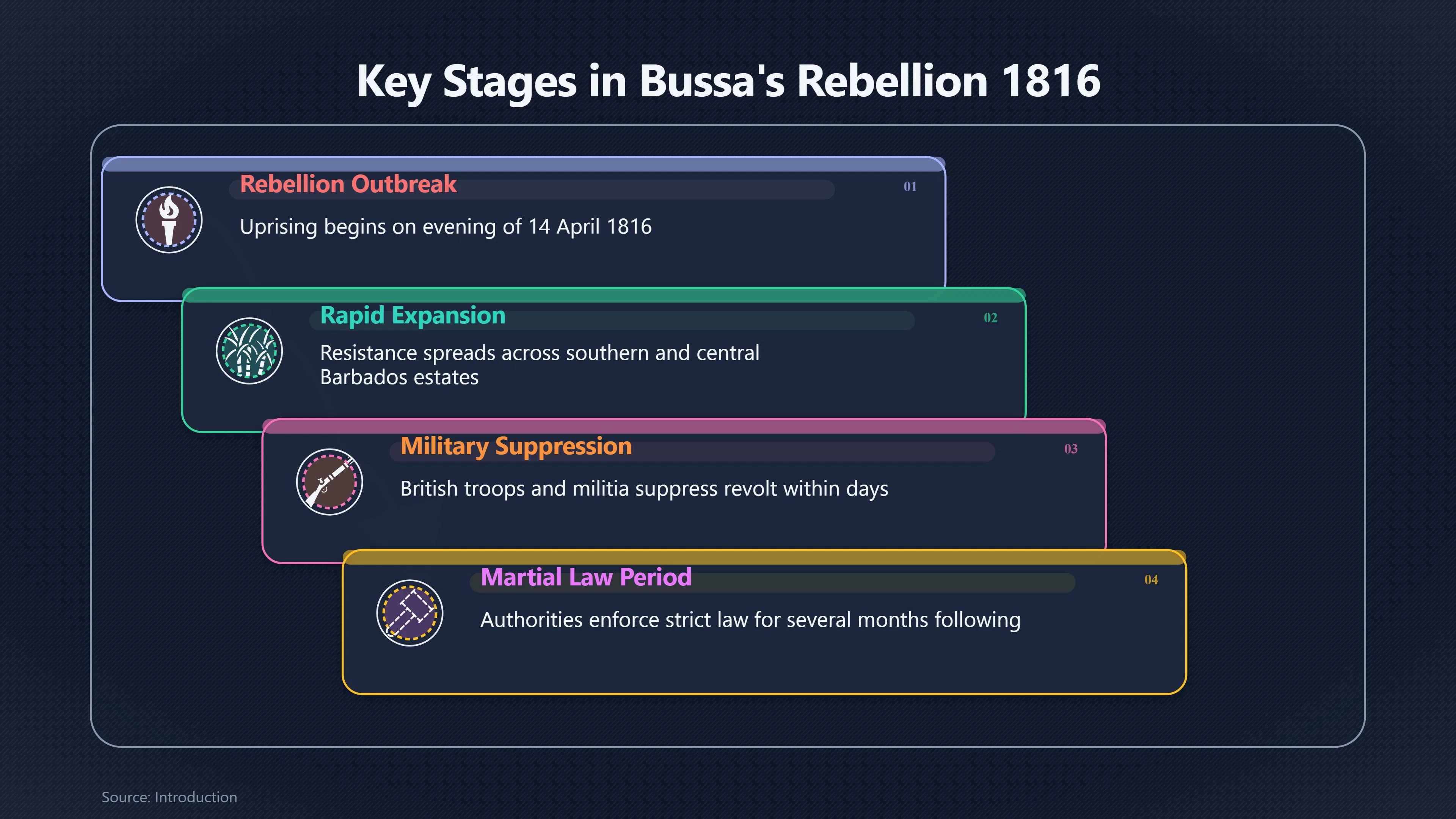
The rebellion began on the evening of 14 April 1816, spreading rapidly across plantations in southern and central Barbados before being suppressed within a few days by militia and British troops. It was organised by leading enslaved figures including Bussa, Nanny Grigg, Jackey and King Wiltshire, who coordinated action across numerous estates. Martial law remained in force for several months while hundreds of people were executed, transported or otherwise punished.[The National Archives]nationalarchives.gov.ukThe National Archives Bussa's rebellionThe National ArchivesBussa's rebellion - The National Archives…
The surviving evidence does not show that the revolt was primarily driven by religious prophecy or millenarian expectations. Instead, historians point to political and social motives: hopes raised by debates over imperial reforms, the mistaken belief that Britain intended emancipation, and long-standing resistance to slavery. Contemporary military reports themselves placed considerable emphasis on rumours surrounding proposed reforms and emancipation rather than on supernatural beliefs as the immediate cause of the uprising.[The National Archives]nationalarchives.gov.ukThe National Archives Bussa's rebellionThe National ArchivesBussa's rebellion - source 4b - The National ArchivesApril 24, 1816…
This distinction matters. Later memories sometimes blur together armed resistance, African spirituality and Obeah. The historical record, however, provides stronger evidence for organised political planning than for any coordinated religious movement directing the rebellion.
How Officials Linked Ritual Power to Resistance
Although the revolt itself was real, colonial officials viewed African spiritual practices through a lens of suspicion. Plantation societies across the British Caribbean had long associated Obeah with secret organisation, oath-taking, healing, protection and the ability to influence others. After the rebellion, these associations hardened.
Authorities feared several related possibilities:
- Secret oaths that might bind participants together and prevent informers from revealing plans.
- Protective medicines or charms believed by some participants to offer physical or spiritual protection.
- Religious gatherings that could also function as opportunities for political organisation.
- Respected spiritual practitioners whose social authority extended beyond individual plantations.
From the perspective of colonial officials, these practices were not merely religious customs but potential tools of conspiracy. Whether or not such fears accurately reflected events in 1816, they shaped investigations and legislation after the revolt.[The National Archives]nationalarchives.gov.ukThe National Archives Bussa's rebellionThe National ArchivesBussa's rebellion - The National Archives…
The concern was not entirely invented. Across the Caribbean, enslaved communities sometimes used rituals, symbols and shared beliefs to reinforce trust and solidarity under extreme repression. However, colonial governments often assumed that any African-derived ritual automatically indicated sedition, an assumption that went far beyond the available evidence.
Where Documented Rebellion Ends and Moral Panic Begins
The strongest evidence concerns the rebellion itself: plantations were attacked, cane fields burned, property destroyed and armed clashes took place. Official correspondence records the mobilisation of troops, declarations of martial law and subsequent executions. These events are well documented.[The National Archives]nationalarchives.gov.ukThe National Archives Bussa's rebellionThe National ArchivesBussa's rebellion - The National Archives…
The evidence becomes less certain when officials attributed broad political significance to spiritual practices.
Several factors contributed to this shift:
- Colonial investigations relied overwhelmingly on testimony gathered after defeat, often under coercive conditions.
- Most surviving records were written by governors, military officers and plantation owners rather than by the enslaved themselves.
- Officials frequently interpreted ordinary cultural or religious practices through the assumption that hidden conspiracies were everywhere.
- Laws targeting Obeah expanded suspicion beyond those directly involved in the uprising, affecting wider enslaved communities.
In this sense, a documented rebellion generated a wider climate of fear in which spiritual authority itself became suspect. Rather than distinguishing between individuals who had taken part in armed resistance and people practising African healing or protective traditions, colonial authorities often treated both as elements of the same threat.[The National Archives]nationalarchives.gov.ukThe National Archives Bussa's rebellionThe National ArchivesBussa's rebellion - The National Archives…
Why Fear of Spiritual Power Mattered
The colonial state’s response reflected more than military necessity. Plantation rule depended upon controlling communication, leadership and solidarity among the enslaved population. Spiritual practitioners could command respect across estate boundaries, making them appear politically dangerous even where there was little evidence of direct involvement in rebellion.
By portraying Obeah and related practices as inherently subversive, authorities justified broader surveillance and punishment. This approach reinforced longstanding colonial stereotypes that African religious traditions were irrational, dangerous or criminal, stereotypes that outlived slavery itself.
Modern historians generally interpret this as a case where genuine resistance and exaggerated suspicion became intertwined. The uprising unquestionably occurred, but the colonial reaction expanded the category of suspected enemies to include cultural and spiritual practices that were not, in themselves, proof of rebellion.[The National Archives]nationalarchives.gov.ukThe National Archives Bussa's rebellionThe National ArchivesBussa's rebellion - The National Archives…

Lasting Significance
Bussa’s Rebellion remains one of the defining events in Barbadian history because it demonstrated organised resistance to slavery and helped expose the instability of the plantation system. At the same time, it illustrates how governments confronted with real threats can broaden suspicion far beyond those directly responsible.
For the history of collective fear in Barbados, the important lesson is not that the rebellion was based on supernatural belief. Rather, it is that colonial officials came to believe—or at least acted as though they believed—that African spiritual traditions themselves represented a continuing political danger. The fear of hidden ritual power became part of the machinery of colonial control, shaping legal policy and public attitudes long after the fighting had ended.[The National Archives]nationalarchives.gov.ukThe National Archives Bussa's rebellionThe National ArchivesBussa's rebellion - The National Archives…
Amazon book picks
Further Reading
Books and field guides related to Did Spiritual Belief Fuel Bussa's Rebellion?. Use these as the next step if you want deeper reading beyond the article.
Interesting Narrative of the Life of Olaudah Equiano
Essential background on slavery and African experience.
Endnotes
1.
Source: nationalarchives.gov.uk
Title: The National Archives Bussa’s rebellion
Link:https://www.nationalarchives.gov.uk/education/resources/bussas-rebellion/
Source snippet
The National ArchivesBussa's rebellion - The National Archives...
2.
Source: nationalarchives.gov.uk
Title: The National Archives Bussa’s rebellion
Link:https://www.nationalarchives.gov.uk/education/resources/bussas-rebellion/source-1a/
Source snippet
The National ArchivesBussa's rebellion - source 1 - The National Archives...
3.
Source: nationalarchives.gov.uk
Title: The National Archives Bussa’s rebellion
Link:https://www.nationalarchives.gov.uk/education/resources/bussas-rebellion/source-4b/
Source snippet
The National ArchivesBussa's rebellion - source 4b - The National ArchivesApril 24, 1816...
Published: April 24, 1816
4.
Source: nationalarchives.gov.uk
Title: The National Archives Bussa’s rebellion
Link:https://www.nationalarchives.gov.uk/education/resources/bussas-rebellion/source-2a/
Source snippet
The National ArchivesBussa's rebellion - source 2a - The National Archives...
5.
Source: nationalarchives.gov.uk
Title: The National Archives Bussa’s rebellion
Link:https://www.nationalarchives.gov.uk/education/resources/bussas-rebellion/source-3a/
Source snippet
The National ArchivesBussa's rebellion - source 3a - The National Archives...
6.
Source: nationalarchives.gov.uk
Title: Bussa’s rebellion
Link:https://www.nationalarchives.gov.uk/education/resources/bussas-rebellion/source-3c/
7.
Source: nationalarchives.gov.uk
Title: Bussa’s rebellion
Link:https://www.nationalarchives.gov.uk/education/resources/bussas-rebellion/source-3b/
8.
Source: periodicos.capes.gov.br
Link:https://www.periodicos.capes.gov.br/index.php/acervo/buscador.html?id=W2005363808&source=all&task=detalhes
9.
Source: nationalarchives.gov.uk
Title: Bussa’s rebellion
Link:https://www.nationalarchives.gov.uk/education/resources/bussas-rebellion/source-4a/
Additional References
10.
Source: cambridge.org
Link:https://www.cambridge.org/core/journals/journal-of-british-studies/article/panic-false-news-and-the-roots-of-colonial-fear/F14D6FA47FAC798A8BB67F5ACAD392D1
Source snippet
July 24, 2023 — PANIC, FALSE NEWS, AND THE ROOTS OF COLONIAL FEAR Published online by Cambridge University Press: 24 July 2023 Zak Leonar...
Published: July 24, 2023
11.
Source: academic.oup.com
Title: References to Black
Link:https://academic.oup.com/shm/article/35/1/49/6338432
Source snippet
Healers, Surgeons and ‘Witches’: Medicine, Mobility and Knowledge Exchange in Swedish St Barthélemy 1785–1815 | Social History of Medicin...
12.
Source: onlinelibrary.wiley.com
Link:https://onlinelibrary.wiley.com/doi/abs/10.1002/9781405198073.wbierp0276
Source snippet
Wiley Online LibraryBussa (d. 1816) and the Barbados Slave Insurrection - Rome - Major Reference Works - Wiley Online Library...
13.
Source: pmc.ncbi.nlm.nih.gov
Link:https://pmc.ncbi.nlm.nih.gov/articles/PMC10162496/
Source snippet
2023 Apr 21;14:1096877. doi: 10.3389/fpsyg.2023.1096877 SOCIAL MOVEMENTS AND COLLECTIVE BEHAVIOR: AN INTEGRATION OF META-ANALYSIS AND SYS...
14.
Source: youtube.com
Title: Back From the Past
Link:https://www.youtube.com/watch?v=08XObZ7WepM
Source snippet
History of Barbados: The Island Blueprint That Shaped the New World...
15.
Source: ojp.gov
Link:https://ojp.gov/ncjrs/virtual-library/abstracts/moral-panic-its-origins-resistance-ressentiment-and-translation
16.
Source: researchgate.net
Link:https://www.researchgate.net/publication/272202097_The_politicisation_of_Popobawa_changing_explanations_of_a_collective_panic_in_Zanzibar
17.
Source: cambridge.org
Link:https://www.cambridge.org/core/journals/history-in-africa/article/abs/oral-tradition-in-changing-political-contexts-the-kisra-legend-in-northern-borgu/2BC0AB7DBA98C2B72694F25DEBA14F72
18.
Source: cambridge.org
Link:https://www.cambridge.org/core/journals/african-studies-review/article/abs/prosecuting-a-prophet-justice-psychiatry-and-rebellion-in-colonial-kenya/2A28FE69036EF721F91431AADE61D8DD
19.
Source: researchgate.net
Link:https://www.researchgate.net/publication/261731802_The_Bad_Business_of_Obeah_Power_Authority_and_the_Politics_of_Slave_Culture_in_the_British_Caribbean
Topic Tree