Within Djibouti
Was Zar Possession Really Mass Hysteria?
Zar ceremonies turned illness, distress and family conflict into a shared religious language rather than a simple outbreak of hysteria.
On this page
- How zar possession was understood
- What happened during communal ceremonies
- Why the mass hysteria label misleads
Page outline Jump by section
Introduction
Was zar possession really a form of mass hysteria? In the case of Djibouti, the evidence points in a different direction. Zar was, and in some communities remains, a shared religious and healing tradition that offered a culturally meaningful way to interpret persistent illness, emotional distress, family conflict and unexplained suffering. Rather than spreading fear through a population, zar ceremonies usually brought relatives, neighbours and ritual specialists together to identify a spiritual cause for distress and restore social balance. Anthropologists studying the wider Horn of Africa and Red Sea region consistently describe zar as a communal healing practice whose meanings cannot be reduced to panic, delusion or psychological contagion.[africabib.org]africabib.orgAfricaBib | Oromos, Slaves, and the Zar Spirits: A Contribution to the History of the Zar Cult…
Djibouti formed part of the wider cultural world in which zar beliefs circulated through migration, trade and long-standing links across the Horn of Africa, the Red Sea and the Arabian Peninsula. Although detailed studies from Djibouti itself are relatively limited, scholars consistently include the country within this regional network while stressing that local customs varied from place to place.[Africabib]africabib.orgAfricaBib | Oromos, Slaves, and the Zar Spirits: A Contribution to the History of the Zar Cult…
How zar possession was understood
For believers, zar possession was not simply strange behaviour. It was an explanation for suffering that had resisted ordinary remedies. A person experiencing chronic illness, infertility, anxiety, exhaustion, recurring headaches, emotional withdrawal or persistent family problems might be understood as having attracted a spirit. The spirit was seen not merely as an enemy but as a being with its own identity, preferences and demands.[PMC]pmc.ncbi.nlm.nih.govOpen source on nih.gov.
This understanding shaped the goal of treatment. Unlike traditions that focused entirely on driving spirits away, many zar ceremonies aimed to establish a workable relationship between the afflicted person and the possessing spirit. The objective was accommodation and balance rather than permanent expulsion. Anthropologists sometimes describe this as “adorcism” rather than exorcism: the spirit was recognised and negotiated with instead of simply being cast out.[Wikipedia]WikipediaOpen source on wikipedia.org.
Within Djibouti’s mixed Afar, Somali and broader Red Sea cultural environment, these ideas connected local communities with neighbouring Ethiopia, Eritrea, Sudan and Yemen. The practice was never completely uniform, and scholars caution against treating “zar” as a single organised religion or identical ritual across every country where it appeared.[Africabib]africabib.orgAfricaBib | Oromos, Slaves, and the Zar Spirits: A Contribution to the History of the Zar Cult…
What happened during communal ceremonies
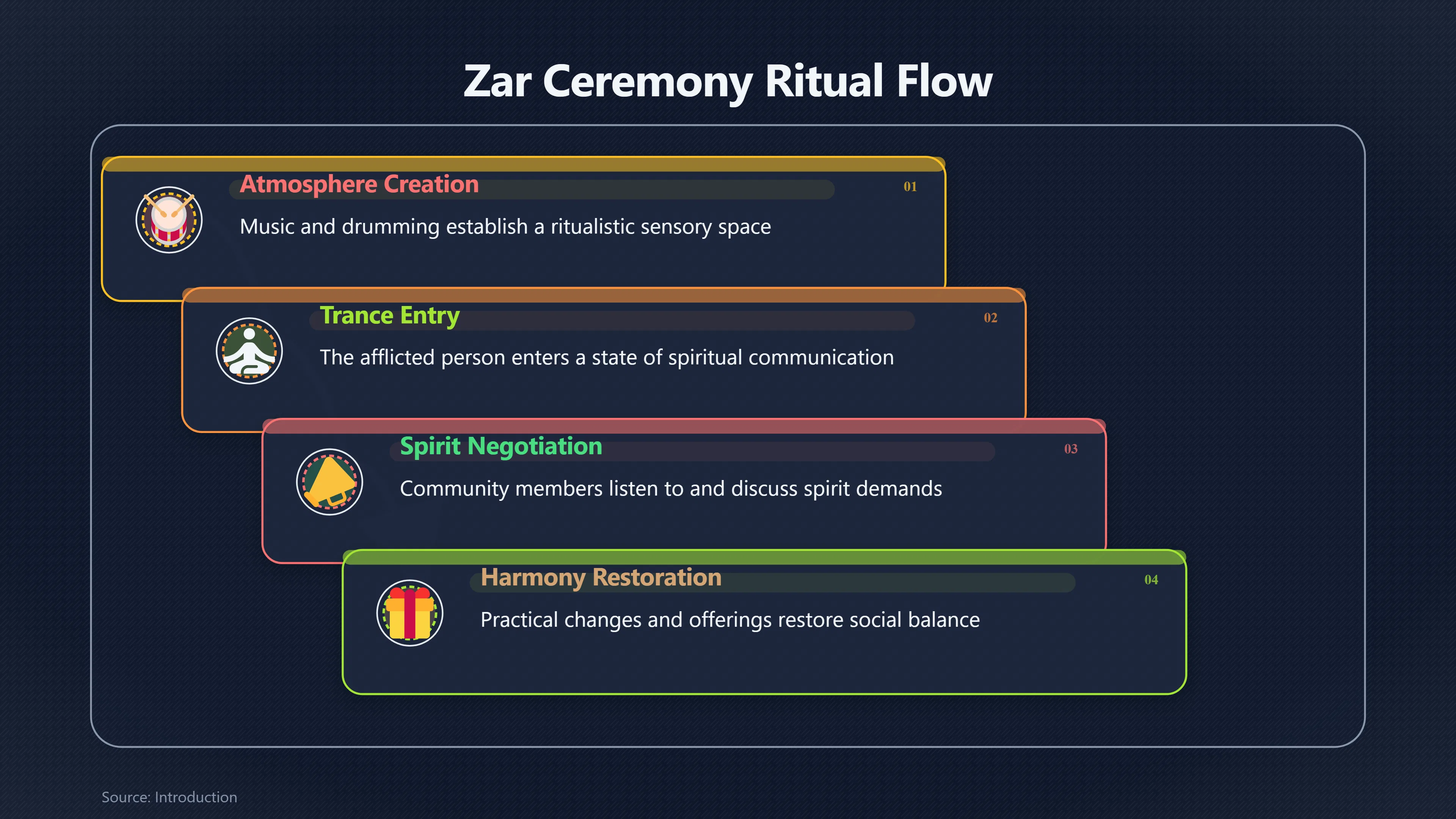
A zar ceremony was both a religious ritual and a social gathering. Music, rhythmic drumming, singing, dancing, incense, perfumes and distinctive clothing helped create an atmosphere in which the afflicted person could enter trance and communicate through the possessing spirit, according to participants’ beliefs. Family members, neighbours and ritual leaders all had recognised roles within the event.[Everand]everand.comZar by Hager El Hadidi (EbookZar by Hager El Hadidi (Ebook) - Read free for 30 days…
Rather than isolating someone who was suffering, the ceremony placed that person at the centre of collective attention. The community listened to the spirit’s supposed wishes, negotiated offerings and discussed practical changes that might restore harmony. These could include particular foods, jewellery, clothing, perfumes or future participation in ceremonies. The ritual therefore transformed private distress into a shared social responsibility.[AnthroSource]anthrosource.onlinelibrary.wiley.comspirits and selves in Northern Sudan: the cultural therapeutics of possession and trance - BODDY - 1988 - American Ethnologis…
Participation was also cumulative. Someone recognised as having a zar spirit might continue attending ceremonies over many years because possession was commonly viewed as an ongoing relationship rather than a one-off crisis. This long-term character distinguishes zar from episodes of sudden collective panic or mass psychogenic illness, which typically rise and disappear over relatively short periods.[Wikipedia]WikipediaOpen source on wikipedia.org.
Why women were often central
Across much of the Horn of Africa and neighbouring regions, women featured prominently in zar ceremonies. Researchers have linked this pattern to the social realities of marriage, domestic labour, fertility expectations and restricted opportunities for expressing frustration or emotional suffering.[AnthroSource]anthrosource.onlinelibrary.wiley.comspirits and selves in Northern Sudan: the cultural therapeutics of possession and trance - BODDY - 1988 - American Ethnologis…
Anthropologists argue that zar created a socially legitimate language through which women could communicate needs that might otherwise remain unheard. If a spirit demanded rest, gifts or changes in family behaviour, these requests could be discussed publicly without directly challenging accepted social hierarchies. This interpretation does not mean participants consciously invented possession. Rather, it suggests that spiritual beliefs and social experience became intertwined in ways that gave genuine meaning to illness and hardship.[AnthroSource]anthrosource.onlinelibrary.wiley.comspirits and selves in Northern Sudan: the cultural therapeutics of possession and trance - BODDY - 1988 - American Ethnologis…
Although women often predominated, men also participated in zar traditions in some regions, and local practices differed considerably. The common thread was communal healing rather than exclusive membership of a women’s movement.[Wikipedia]WikipediaOpen source on wikipedia.org.

Why the mass hysteria label misleads
Calling zar “mass hysteria” obscures more than it explains.
Mass psychogenic illness usually refers to symptoms spreading rapidly through a group without an identifiable physical cause, often during periods of acute stress. Moral panics describe collective fears about perceived threats, while rumours spread alarming beliefs through communities.
Zar does not fit these patterns well.
Instead, it involved:
- an established religious tradition transmitted across generations;
- recognised ritual specialists and accepted ceremonial practices;
- a shared explanation for persistent individual suffering;
- repeated communal ceremonies rather than sudden contagious outbreaks; and
- negotiated healing intended to restore family and community relationships.[wiley.com]anthrosource.onlinelibrary.wiley.comspirits and selves in Northern Sudan: the cultural therapeutics of possession and trance - BODDY - 1988 - American Ethnologis…
Some older colonial observers dismissed zar as superstition or irrational behaviour, but later anthropology and cultural psychiatry have challenged these interpretations. Researchers argue that understanding participants’ own beliefs is essential before applying modern psychiatric or psychological labels.[AnthroSource]anthrosource.onlinelibrary.wiley.comspirits and selves in Northern Sudan: the cultural therapeutics of possession and trance - BODDY - 1988 - American Ethnologis…
What modern researchers have learned
Medical anthropologists increasingly view zar as a cultural system for interpreting distress rather than evidence of collective irrationality. This does not require accepting the existence of spirits. Instead, it recognises that different societies organise experiences of illness through different religious and cultural frameworks.[PMC]pmc.ncbi.nlm.nih.govOpen source on nih.gov.
Cultural psychiatrists have also warned that unfamiliarity with zar can lead to misunderstanding. Ethiopian migrants in countries with Western medical systems have sometimes been diagnosed with severe psychiatric disorders when clinicians failed to recognise culturally specific possession beliefs. Researchers argue that careful cultural assessment can prevent inappropriate treatment while still addressing genuine mental or physical illness.[BPS PsychHub]bpspsychub.onlinelibrary.wiley.comBPS PsychHubThe ‘Zar’ possession syndrome among Ethiopian immigrants to Israel: Cultural and clinical aspects - Witztum - 1996 - British…
For Djibouti, where detailed ethnographic work remains relatively limited compared with neighbouring Sudan or Ethiopia, the wider regional scholarship provides an important reminder: zar should be understood first as a communal healing tradition embedded in local religious life. Reducing it to “mass hysteria” overlooks its social functions, its religious significance and the practical role it played in helping communities respond to suffering that had no obvious solution.[africabib.org]africabib.orgAfricaBib | Oromos, Slaves, and the Zar Spirits: A Contribution to the History of the Zar Cult…
Amazon book picks
Further Reading
Books and field guides related to Was Zar Possession Really Mass Hysteria?. Use these as the next step if you want deeper reading beyond the article.

The fortunes of Africa
First published 2014. Subjects: History, Wealth, Africa, economic conditions, Africa, history, Economic conditions.

Spirits, Saints, and Somalis
Directly covers spirit possession traditions related to Djibouti.
Endnotes
1.
Source: africabib.org
Link:https://www.africabib.org/rec.php?RID=11953844X
Source snippet
AfricaBib | Oromos, Slaves, and the Zar Spirits: A Contribution to the History of the Zar Cult...
2.
Source: everand.com
Title: Zar by Hager El Hadidi (Ebook)
Link:https://www.everand.com/book/604374449/Zar-Spirit-Possession-Music-and-Healing-Rituals-in-Egypt
Source snippet
Zar by Hager El Hadidi (Ebook) - Read free for 30 days...
3.
Source: Wikipedia
Link:https://en.wikipedia.org/wiki/Z%C4%81r
4.
Source: africabib.org
Link:https://www.africabib.org/rec.php?DB=p&RID=11953844X
5.
Source: anthrosource.onlinelibrary.wiley.com
Link:https://anthrosource.onlinelibrary.wiley.com/doi/abs/10.1525/ae.1988.15.1.02a00020
Source snippet
spirits and selves in Northern Sudan: the cultural therapeutics of possession and trance - BODDY - 1988 - American Ethnologis...
6.
Source: pmc.ncbi.nlm.nih.gov
Link:https://pmc.ncbi.nlm.nih.gov/articles/PMC4801492/
7.
Source: bpspsychub.onlinelibrary.wiley.com
Link:https://bpspsychub.onlinelibrary.wiley.com/doi/abs/10.1111/j.2044-8341.1996.tb01865.x
Source snippet
BPS PsychHubThe ‘Zar’ possession syndrome among Ethiopian immigrants to Israel: Cultural and clinical aspects - Witztum - 1996 - British...
Additional References
8.
Source: researchgate.net
Link:https://www.researchgate.net/publication/275621700_Oromos_Slaves_and_the_Zar_Spirits_A_Contribution_to_the_History_of_the_Zar_Cult
Source snippet
January 1, 1987 — Article PDF Available OROMOS, SLAVES, AND THE ZAR SPIRITS: A CONTRIBUTION TO THE HISTORY OF THE ZAR CULT * January 1987...
Published: January 1, 1987
9.
Source: cambridge.org
Title: Vecchiato * * * Article contents * Résumé * References Ge
Link:https://www.cambridge.org/core/journals/africa/article/illness-therapy-and-change-in-ethiopian-possession-cults/5BF87B180A0465F00AA5B0BB359A3BBA
Source snippet
Illness, therapy, and change in Ethiopian possession cults | Africa | Cambridge CoreDecember 7, 2011 — ILLNESS, THERAPY, AND CHANGE IN ET...
Published: December 7, 2011
10.
Source: sciencedirect.com
Title: Community and healing among the Zaramo in Tanzania
Link:https://www.sciencedirect.com/science/article/pii/0160798779900310
Source snippet
PART B: MEDICAL ANTHROPOLOGY Volume 13, Issue 3, September 1979, Pages 169-173 COMMUNITY AND HEALING AMONG THE ZARAMO IN TANZANIA https:/...
Published: September 1979
11.
Source: nli.org.il
Link:https://www.nli.org.il/he/books/NNL_ALEPH997007877004805171/NLI
12.
Source: youtube.com
Title: Sudan – Ya Zar | Traditional Sudanese Zar Music
Link:https://www.youtube.com/watch?v=pd6Aq5DCLp0
Source snippet
Zar from the island of Qeshm in the Persian Gulf...
13.
Source: uwpress.wisc.edu
Link:https://uwpress.wisc.edu/Books/W/Wombs-and-Alien-Spirits
14.
Source: youtube.com
Title: MAZAHER ENSEMBLE @Attikosxoleio BAUMSTRASSE
Link:https://www.youtube.com/watch?v=PqKhScYO8Ww
Source snippet
Sudan – Ya Zar | Traditional Sudanese Zar Music...
15.
Source: youtube.com
Title: Zar ritual: using music to heal
Link:https://www.youtube.com/watch?v=h81tvI56DFU
Source snippet
MAZAHER ENSEMBLE @Attikosxoleio BAUMSTRASSE...
16.
Source: youtube.com
Title: Zar from the island of Qeshm in the Persian Gulf
Link:https://www.youtube.com/watch?v=KLvKEjvDyvM
Source snippet
ZAR RITUAL (Cairo, Egypt)...
17.
Source: youtube.com
Title: ZAR RITUAL (Cairo, Egypt)
Link:https://www.youtube.com/watch?v=H1p1H-8DxSA
Topic Tree