Within Mongolia
Why Did People Believe Ja Lama Returned?
Ja Lama fused prophecy, warfare and political collapse into one of Mongolia's most enduring stories of charismatic power.
On this page
- The Amursana prophecy and its political meaning
- From Khovd liberator to coercive warlord
- Violence, legend and the problem of reliable evidence
Page outline Jump by section
Introduction
Ja Lama was one of the most extraordinary and controversial figures in modern Mongolian history because he combined military success, religious charisma and political prophecy into a single public persona. At the centre of his appeal was the claim that he was the returned liberator foretold in regional tradition: the eighteenth-century Oirat prince Amursana, or his reincarnation, who had come back to free western Mongolia from foreign domination. That claim was not simply a colourful legend. It gave many people living through the collapse of Qing rule a powerful way to understand political change and inspired genuine support among sections of the population. Yet Ja Lama’s career also demonstrates how charismatic authority could become deeply coercive. His reputation shifted from heroic liberator after the capture of Khovd in 1912 to feared warlord, and his life has remained surrounded by competing memories, folklore and disputed stories.[ResearchGate]researchgate.netResearchGate(PDF) Power for the Powerless: Oirot/Amursana Prophecy in Altai and Western Mongolia, 1890s-1920sJune 1, 2014…
Why did people believe Ja Lama returned?
The belief in Ja Lama rested on a much older tradition rather than appearing from nowhere. After the destruction of the Dzungar Khanate by the Qing Empire in the eighteenth century, many Oirat communities preserved stories that their defeated leader, Amursana, had not truly vanished and would one day return to restore justice and political independence. These expectations survived in oral tradition across western Mongolia and the Altai, where memories of conquest, displacement and lost autonomy remained strong.[ResearchGate]researchgate.netResearchGate(PDF) Power for the Powerless: Oirot/Amursana Prophecy in Altai and Western Mongolia, 1890s-1920sJune 1, 2014…
Rather than inventing an entirely new religion, Ja Lama attached himself to this existing prophetic tradition. Presenting himself as Amursana’s reincarnation—or at times as his descendant—allowed him to speak simultaneously as a Buddhist holy man, a military commander and the fulfilment of a long-awaited prophecy. Historian Andrei Znamenski argues that this was part of a broader pattern of millenarian belief stretching across the Altai and western Mongolia, where populations facing imperial expansion interpreted political crisis through expectations of a returning redeemer. Similar prophetic ideas also influenced the contemporary White Faith movement in the Russian Altai, suggesting that these beliefs crossed political frontiers rather than belonging to a single country.[ResearchGate]researchgate.netResearchGate(PDF) Power for the Powerless: Oirot/Amursana Prophecy in Altai and Western Mongolia, 1890s-1920sJune 1, 2014…
This helps explain why Ja Lama attracted followers despite his uncertain origins. Modern historians generally identify him as Dambiijantsan, a Kalmyk from the Russian Empire, yet many supporters regarded biography as less important than the signs that prophecy appeared to be coming true. His military successes seemed to confirm what tradition had already prepared people to expect.[CiNii Research]cir.nii.ac.jpOpen source on nii.ac.jp.
The Amursana prophecy and its political meaning
The prophecy mattered because it linked religious hope with immediate political events. In 1911 and 1912, Qing authority in Mongolia was collapsing after the Xinhai Revolution. For many western Mongols, independence was no longer an abstract dream but an urgent political question.
Against this background, Amursana represented more than an individual hero. He symbolised the possibility that the historic defeat of the Oirat peoples might finally be reversed. By claiming to embody that promise, Ja Lama offered a narrative in which political liberation was also spiritual restoration. His followers did not simply expect a military victory; they believed history itself was being corrected.[ResearchGate]researchgate.netResearchGate(PDF) Power for the Powerless: Oirot/Amursana Prophecy in Altai and Western Mongolia, 1890s-1920sJune 1, 2014…
Znamenski argues that such prophecies should not be dismissed as irrational superstition. They functioned as a language through which communities experiencing rapid political upheaval interpreted events and organised collective action. In societies where formal political institutions were weak and imperial authority was collapsing, prophecy could become an effective form of political mobilisation.[ResearchGate]researchgate.netResearchGate(PDF) Power for the Powerless: Oirot/Amursana Prophecy in Altai and Western Mongolia, 1890s-1920sJune 1, 2014…
From Khovd liberator to coercive warlord
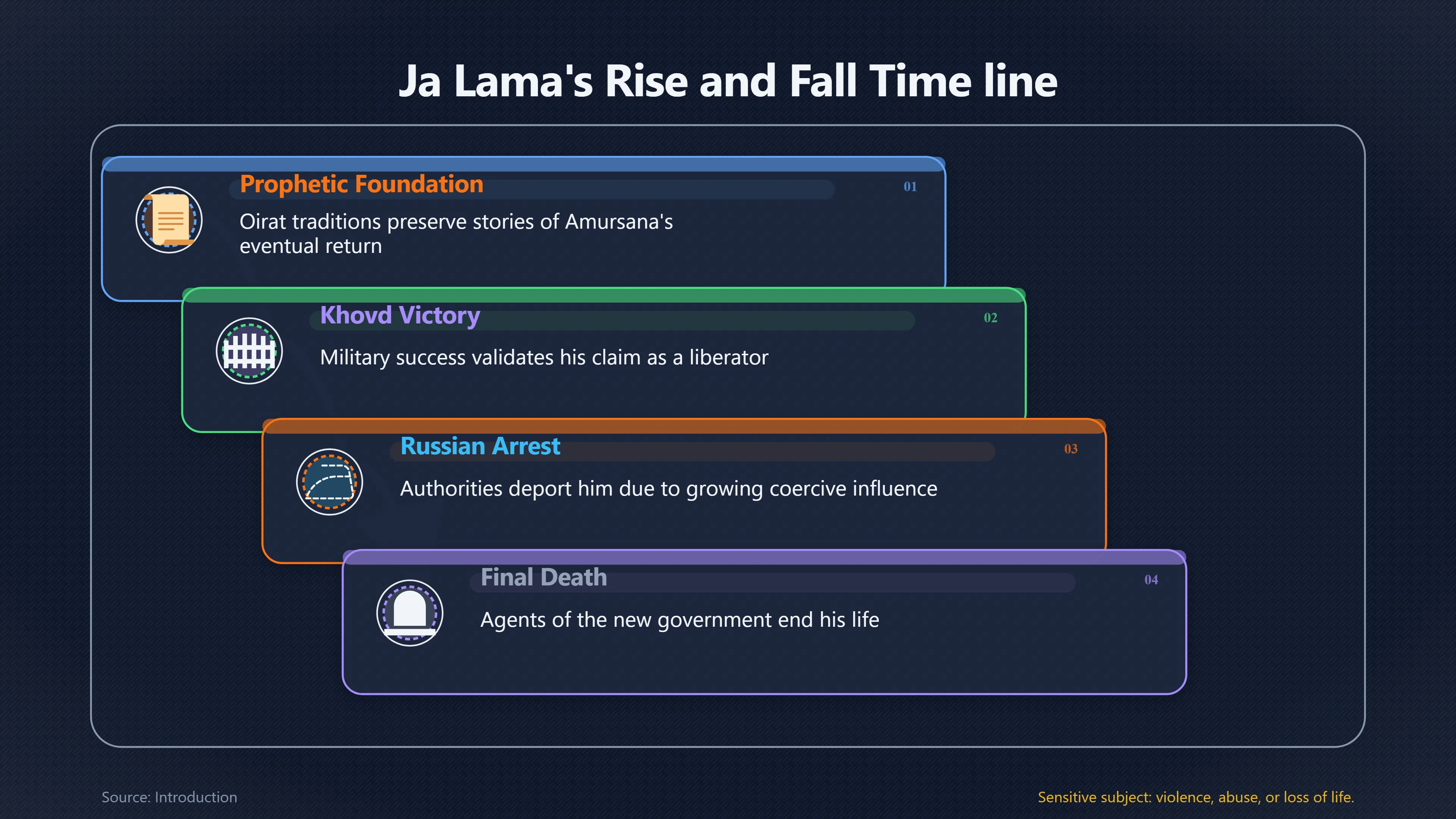
Ja Lama’s reputation was built not only on prophecy but on military achievement. During the campaign against the remaining Qing forces in western Mongolia, he played an important role in the siege and capture of Khovd in 1912. This victory transformed him into a celebrated defender of Mongolian independence and appeared, to many contemporaries, to validate his extraordinary claims.[CiNii Research]cir.nii.ac.jpOpen source on nii.ac.jp.
Following the victory, he received prestigious religious and noble titles and established control over a large territory in western Mongolia. At this point, however, the image of the liberator increasingly conflicted with reports of authoritarian rule.
Numerous contemporary complaints accused Ja Lama of:
- imposing harsh punishments;
- exercising personal rule independent of the Bogd Khan’s government;
- collecting taxes and tribute through intimidation;
- maintaining private armed forces loyal primarily to himself.
Russian officials, local nobles and rival Mongolian leaders increasingly viewed him as unpredictable and dangerous. In 1914 Russian authorities arrested and deported him, partly in response to repeated complaints about his conduct and because they feared his growing influence in the borderlands. After the Russian Revolution he returned to Mongolia, where he again attracted followers before being killed by agents of the new Mongolian People’s Government in 1922.[CiNii Research]cir.nii.ac.jpOpen source on nii.ac.jp.
His career therefore illustrates an important distinction in the history of charismatic movements. The same claims that initially inspired collective resistance against foreign rule later helped justify highly personalised and coercive authority.
Violence, legend and the problem of reliable evidence
Ja Lama’s later reputation is dominated by stories of spectacular cruelty. Accounts describe executions, torture and ritualised violence, including claims that enemies were flayed alive or sacrificed. These stories have appeared in memoirs, diplomatic reports and later retellings, making them some of the most widely repeated aspects of his biography.[Wikipedia]WikipediaJa LamaJa Lama
Historians, however, urge caution when interpreting these accounts.
Several factors complicate the evidence:
- many reports originated with political enemies or foreign observers who had strong reasons to portray him as a barbaric despot;
- revolutionary governments later had incentives to justify his assassination by emphasising his brutality;
- oral traditions often magnified dramatic episodes over time;
- different versions of the same incidents circulated across Mongolia, Russia and Xinjiang, making it difficult to establish precise details.
This does not mean the violence was invented. Contemporary evidence strongly suggests that Ja Lama ruled through intimidation and that serious abuses occurred. The uncertainty concerns the most sensational stories and whether later legend amplified genuine events into symbolic tales about a terrifying holy warrior.[CiNii Research]cir.nii.ac.jpOpen source on nii.ac.jp.
His life therefore illustrates a broader challenge in studying charismatic leaders. Heroic mythmaking and hostile propaganda can develop simultaneously, leaving historians to disentangle documented events from stories shaped by politics, fear and memory.
Why the returned liberator still matters
Ja Lama occupies an unusual place in Mongolian historical memory because he cannot easily be classified as either hero or villain. He genuinely contributed to the liberation of Khovd during Mongolia’s struggle for independence, yet he also established a regime that many contemporaries experienced as oppressive.[CiNii Research]cir.nii.ac.jpOpen source on nii.ac.jp.
His career also demonstrates how collective belief operates during periods of political collapse. The prophecy of Amursana did not spread because people were simply credulous. It drew strength from shared historical trauma, memories of lost sovereignty and the sudden possibility that imperial rule was ending. When military success appeared to confirm those expectations, belief became self-reinforcing.
For the wider history of Mongolia’s collective beliefs, Ja Lama is best understood not as the founder of a separate cult in the modern sense, but as a charismatic leader who successfully fused prophecy, nationalism and armed struggle. His story shows how deeply rooted historical myths can become politically powerful during moments of crisis, while also revealing how the authority gained through those myths can evolve into personal rule sustained by fear as much as by faith.[researchgate.net]researchgate.netResearchGate(PDF) Power for the Powerless: Oirot/Amursana Prophecy in Altai and Western Mongolia, 1890s-1920sJune 1, 2014…
Amazon book picks
Further Reading
Books and field guides related to Why Did People Believe Ja Lama Returned?. Use these as the next step if you want deeper reading beyond the article.

The True Believer:Thoughts on the Nature of Mass Movements
Helps explain charismatic leadership and committed followers.


Mongolia
First published 2019. Subjects: Mongolia, history, Asia, politics and government, History, Politics and government.
Genghis Khan and the Making of the Modern World
Broadens understanding of Mongolian political traditions.
Endnotes
1.
Source: researchgate.net
Link:https://www.researchgate.net/publication/272434256_Power_for_the_Powerless_OirotAmursana_Prophecy_in_Altai_and_Western_Mongolia_1890s-1920s
Source snippet
ResearchGate(PDF) Power for the Powerless: Oirot/Amursana Prophecy in Altai and Western Mongolia, 1890s-1920sJune 1, 2014...
Published: June 1, 2014
2.
Source: digitalcommons.memphis.edu
Link:https://digitalcommons.memphis.edu/facpubs/3970/
Source snippet
University of Memphis Digital CommonsPower for the powerless: Oirot/ Amursana prophecy in altai and Western Mongolia, 1890s-1920s...
3.
Source: Wikipedia
Title: Ja Lama
Link:https://en.wikipedia.org/wiki/Ja_Lama
4.
Source: researchgate.net
Title: (PDF) A micro-history of Fascist violence. Squadristi, victims and perpetrators
Link:https://www.researchgate.net/publication/359834397_A_micro-history_of_Fascist_violence_Squadristi_victims_and_perpetrators
5.
Source: digitalcommons.memphis.edu
Link:https://digitalcommons.memphis.edu/facpubs/3967/
6.
Source: researchgate.net
Title: 347194980 Tuva April 1914 Incorporation as a Russian Protectorate
Link:https://www.researchgate.net/publication/347194980_Tuva_April_1914_Incorporation_as_a_Russian_Protectorate
Published: April 1914
7.
Source: researchgate.net
Link:https://www.researchgate.net/publication/250173326_Mongolian_Buddhism%27s_Influence_on_the_Formation_and_Development_of_Burkhanism_in_Altai
8.
Source: cir.nii.ac.jp
Link:https://cir.nii.ac.jp/crid/1390290699822969728?lang=en
9.
Source: cir.nii.ac.jp
Title: nii.ac.jp<論説>ジャー・ラマとコブド問題: モンゴル人民共和国形成期における民族間題の一考察 | Ci Nii Research
Link:https://cir.nii.ac.jp/crid/1390290699822969728
Additional References
10.
Source: cambridge.org
Link:https://www.cambridge.org/core/journals/comparative-studies-in-society-and-history/article/if-your-ox-does-not-pull-what-are-you-going-to-do-persistent-violence-in-south-africas-deeplevel-gold-mines-and-its-contribution-to-the-1922-rand-rebellion/9F4A848BBA10D783D25C9625DB3837CF
Source snippet
o the 1922 Rand Rebellion | Comparative Studies in Society and History | Cambridge CoreAugust 14, 2024 — “IF YOUR OX DOES NOT PULL, WHAT...
Published: August 14, 2024
11.
Source: cambridge.org
Link:https://www.cambridge.org/core/journals/irish-historical-studies/article/weaver-street-bombing-in-belfast-1922-violence-politics-and-memory/7DB33077ED372E5B27EC4F2AB987D82D
Source snippet
The Weaver Street bombing in Belfast 1922: violence, politics and memory | Irish Historical Studies | Cambridge CoreFebruary 9, 2024 — TH...
Published: February 9, 2024
12.
Source: cambridge.org
Link:https://www.cambridge.org/core/journals/historical-journal/article/imperial-violence-law-and-compensation-in-the-age-of-empire-19191922/87CA76CCDC42510B5D5497BE6469141D
Source snippet
Imperial Violence, Law, and Compensation in the Age of Empire, 1919–1922 | The Historical Journal | Cambridge CoreMarch 13, 2024 — IMPERI...
Published: March 13, 2024
13.
Source: cambridge.org
Title: The March on Rome revisited
Link:https://www.cambridge.org/core/product/identifier/S1353294423000054/type/journal_article
Source snippet
Silences, historians and the power of the counter-factual | Modern Italy | Cambridge CoreMarch 6, 2023 — THE MARCH ON ROME REVISITED. SIL...
Published: March 6, 2023
14.
Source: youtube.com
Link:https://www.youtube.com/watch?v=gFxaCaQPgCU
Source snippet
Tibet and Occult: Red Shambhala with Andrei Znamenski, Part 1...
15.
Source: youtube.com
Link:https://www.youtube.com/watch?v=8HsgIWNMHEA
Source snippet
HIDDEN CHINA Silk Road RUINS The Warlord's Secret Base Along the Ancient Silk Road...
16.
Source: papers.ssrn.com
Link:https://papers.ssrn.com/sol3/papers.cfm?abstract_id=4311097
Source snippet
SSRN«Белая Вера» в Горном Алтае: Тибетский Буддизм, Монголия и Ойротское Пророчество (1880-Е — 1920-Е Гг.) (the “White Faith” Movement in...
17.
Source: britannica11.org
Link:https://britannica11.org/article/15-0341-jenghiz-khan/jenghiz_khan
18.
Source: britannica11.org
Link:https://britannica11.org/article/02-0905-s2/atlantis
19.
Source: youtube.com
Title: Ja-Lama Ruthless Warlord from Mongolia
Link:https://www.youtube.com/watch?v=3xVMUG90jUE
Source snippet
Oirot Prophecy: Arrested Buddhism in the Altai Area, 1890s-1920s...
Topic Tree