When Political Loyalty Became a Public Faith
Turkmenistan has no well-documented equivalent of the Salem witch trials, a European dance plague or a large, medically investigated outbreak of mass psychogenic illness.
Page outline Jump by section
Introduction
Under Saparmurat Niyazov, who ruled until his death in 2006, official propaganda blurred the boundaries between political loyalty, national identity and religious devotion. His book, the Ruhnama, was taught, memorised and displayed with the reverence normally associated with scripture. Later governments reduced some of its prominence but preserved the deeper machinery of compulsory celebration, censorship and fear. During the coronavirus pandemic, that machinery produced the reverse of a conventional panic: officials suppressed public acknowledgement of the danger while citizens had to navigate unofficial reports, unexplained restrictions and anxiety about discussing illness.[hrw.org]hrw.orgHuman Rights Watch Turkmenistan: Stop Religious PersecutionHuman Rights WatchTurkmenistan: Stop Religious PersecutionSeptember 28, 2005 — 27 Sept 2005 — Citizens are required to refer to the presi…
These cases should not be described simply as “mass hysteria”. They are better understood as enforced public belief, ritualised conformity, moral and political intimidation, and rumour under authoritarian conditions.
The personality cult that became a civic faith
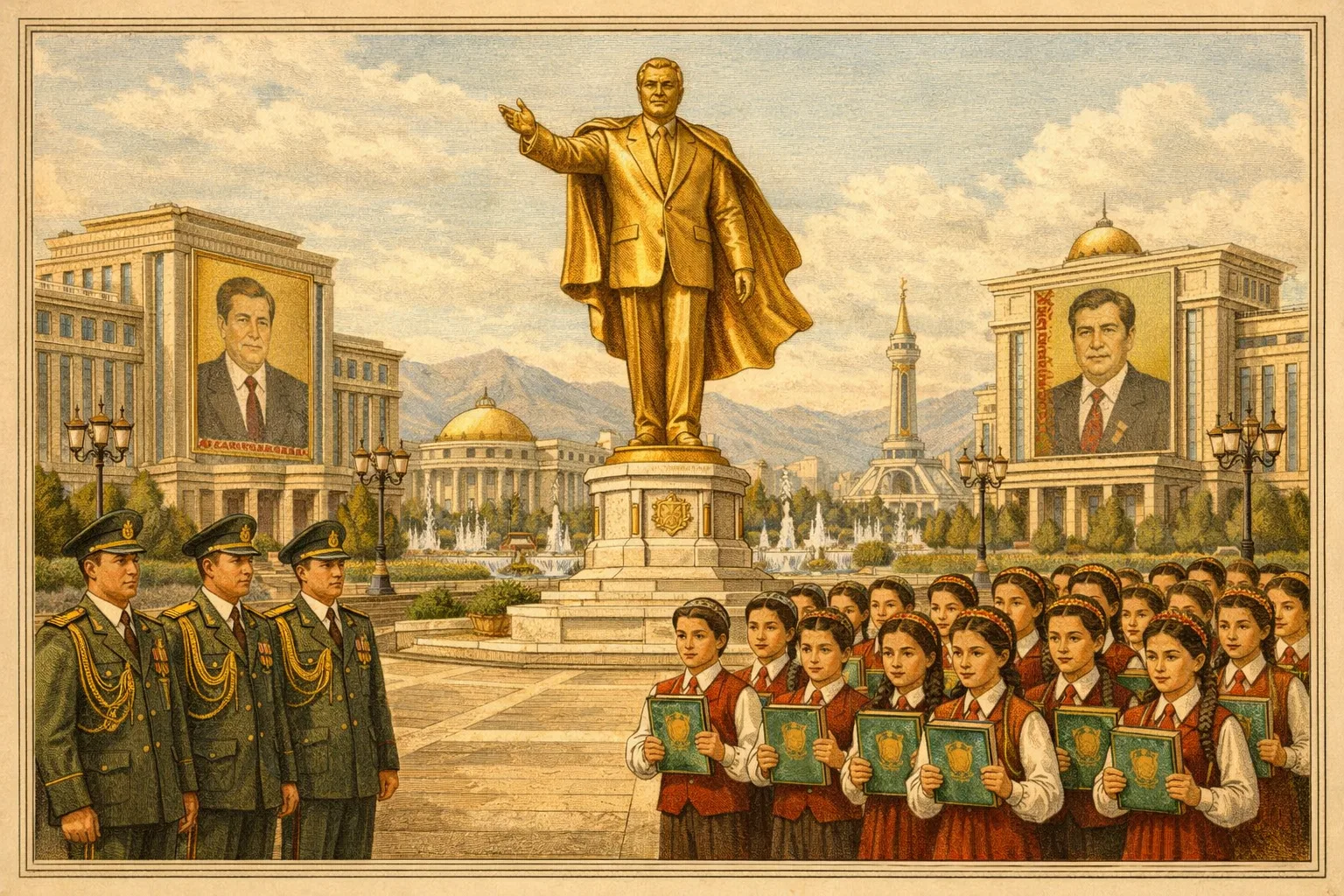
After Turkmenistan became independent from the Soviet Union in 1991, Niyazov adopted the title “Leader of All Turkmen” and placed himself at the centre of the new state’s account of history. His portraits appeared throughout public life, while monuments, ceremonies, television broadcasts and school lessons presented him as the guardian and embodiment of the nation. Scholars studying Turkmenistan have therefore treated the cult not merely as personal vanity but as a method of nation-building: loyalty to the leader was made difficult to separate from loyalty to the country itself.[Cambridge University Press & Assessment]cambridge.orgCambridge University Press & AssessmentA tale of two presidents: personality cult and symbolic…by A Polese · 2015 · Cited by 113 — Thi…
The system borrowed forms familiar from Soviet political culture—portraits, slogans, choreographed public events and heroic biography—but intensified them around a living individual. Niyazov’s image was placed on public buildings and everyday objects, while a rotating golden statue of him dominated central Ashgabat. Months and days were renamed, state employees participated in orchestrated displays of enthusiasm, and institutions were expected to repeat claims about his wisdom and historical importance.[The New Yorker]newyorker.comThe New Yorker The Land of TurkmenbashiNiyazov has created a personality cult, with his image omnipresent, and has imposed numerous whimsical bans and decrees, such as renaming…
This was not spontaneous collective delusion. Many citizens may have privately doubted or mocked official claims. The essential mechanism was compulsory performance: people learned that advancement, education, employment and safety could depend on displaying the approved attitude. In such systems, public unanimity does not prove private belief. It shows that disbelief has become costly to reveal.
That distinction matters because outsiders have often treated Niyazov’s decrees as exotic comedy. Contemporary reporting highlighted golden statues, renamed calendar months and unusual bans, but the absurdity could conceal the coercion behind them. Writers, religious communities and political critics faced surveillance, detention, professional punishment and restrictions on travel. The personality cult was entertaining only from a safe distance; inside the country, it helped define who was considered loyal, employable and socially acceptable.[hrw.org]hrw.orgHuman Rights Watch TurkmenistanHuman Rights Watch Turkmenistan
How the Ruhnama was made sacred
The clearest example of state-manufactured belief was the Ruhnama, or “Book of the Soul”, published in two volumes in 2001 and 2004. It combined autobiography, moral instruction, national mythology and Niyazov’s version of Turkmen history. Rather than allowing readers to judge the work for themselves, the state embedded it throughout education and public administration. Students studied it for examinations, public employees were expected to know it, and knowledge of the text reportedly became relevant to matters as ordinary as obtaining a driving licence.[wikipedia.org]WikipediaOpen source on wikipedia.org.
The book’s promotion deliberately approached the language and ritual of religion. Human Rights Watch reported that citizens were expected to call it the “Holy” Ruhnama, study and memorise it, and integrate its lessons into daily life. State propaganda represented Niyazov in quasi-prophetic terms, while religious institutions were pressured to give his words ceremonial prominence.[Human Rights Watch]hrw.orgHuman Rights Watch Turkmenistan: Stop Religious PersecutionHuman Rights WatchTurkmenistan: Stop Religious PersecutionSeptember 28, 2005 — 27 Sept 2005 — Citizens are required to refer to the presi…
Mosques were instructed to display the Ruhnama alongside the Quran, and churches were expected to place it beside the Bible. Passages appeared on the walls of the large mosque built in Niyazov’s home village. Religious teaching outside state-approved structures remained tightly restricted, meaning that a government-authored political text could circulate more freely than independently selected religious literature.[govinfo.gov]govinfo.govGOVPUB Y3 R27 PURL gpo22933GOVPUB Y3 R27 PURL gpo22933
Niyazov also claimed that reading the book repeatedly could bring spiritual reward, including entry into heaven. Whether ordinary people accepted such statements literally is impossible to measure in a country without free polling, open media or protected public debate. What can be demonstrated is that the state created an environment in which professions of reverence were required and contradiction was dangerous.[Wikipedia]WikipediaOpen source on wikipedia.org.
The Ruhnama therefore resembles a political scripture more than the founding text of a voluntary religious movement. There was no open conversion campaign, independent congregation or genuine choice of doctrine. Its authority came from schools, employers, police power and the president’s control of the media.
Religion under suspicion and control
Turkmenistan’s government officially presents the country as secular and permits a limited range of religious institutions. In practice, it has maintained extensive control over registration, worship, religious education, literature and contact with believers abroad. Minority communities and Muslims operating outside approved structures have faced raids, interrogation, confiscation of materials and restrictions on meeting in private homes.[state.gov]2021-2025.state.govOpen source on state.gov.
This history can look like a moral panic about dangerous sects or religious extremism, but the evidence points more strongly to routine authoritarian control than to a single, explosive popular scare. Officials have treated unregistered or independent religious activity as inherently suspect, even when no violence was alleged. Broad rules allow ordinary worship, teaching or possession of literature to be reframed as a security or public-order matter.[un.org]digitallibrary.un.orgOpen source on un.org.
The label “cult” is therefore particularly risky in the Turkmen context. Small Protestant churches, Jehovah’s Witnesses and other minority communities have sometimes been portrayed by hostile authorities as alien or socially disruptive. Such descriptions reveal the state’s attitude; they do not establish that the groups were abusive cults. Reports from religious-freedom monitors document pressure on both registered and unregistered believers, including punishment for private meetings and conscientious objection to military service.[USCIRF]uscirf.govTier1 TURKMENISTANTier1 TURKMENISTAN
The state has also managed majority Muslim life. Independent study groups have been prohibited, religious education sharply limited and pilgrimages regulated. Local shrine visitation has remained culturally important, but permitted religious practice generally operates within boundaries set by government institutions.[silkroadstudies.org]silkroadstudies.orgSilk Road Studies Religion and the Secular State in TurkmenistanSilk Road Studies Religion and the Secular State in Turkmenistan
This helps explain why Niyazov’s quasi-sacred political symbolism was so powerful. The state did not merely introduce another book into a free religious marketplace. It restricted competing sources of authority while ensuring that the president’s text occupied classrooms, offices, broadcasts and places of worship.
What changed after Niyazov—and what did not
After Niyazov died in December 2006, Gurbanguly Berdymukhamedov removed some of the most conspicuous features of his predecessor’s cult. The old calendar names were restored, the rotating statue was relocated, and the Ruhnama gradually lost its central place in education and official religious life. International observers also recorded some limited improvements in religious policy during the first years of the new presidency. U.S. Department of State-2009.state.gov[2009-2017.state.gov]2009-2017.state.govU.S. Department of State TurkmenistanU.S. Department of State Turkmenistan
Yet the political structure did not become pluralistic. Niyazov’s portraits were replaced by those of Berdymukhamedov, whose books, athletic performances, musical appearances and supposed expertise became recurring features of state media. Human Rights Watch described the transition as the replacement of one personality cult by another rather than the dismantling of the system. Academic comparisons likewise find substantial continuity beneath changes in imagery and style.[hrw.org]hrw.orgHuman Rights Watch Turkmenistan: Briefing Note for the European ParliamentHuman Rights Watch Turkmenistan: Briefing Note for the European Parliament
The second cult was generally less overtly theological. Berdymukhamedov did not reproduce the Ruhnama as an all-encompassing sacred book, but he remained the heroic centre of official narratives about health, horses, sport, culture and national progress. Public ceremonies continued to demonstrate unity through mass participation and carefully controlled spectacle.
Serdar Berdymukhamedov succeeded his father as president in 2022, but Gurbanguly retained major political influence and an elevated national role. By 2026, outside reporting still described the country as tightly controlled, with the ruling family’s authority supported by censorship, restricted political competition and continuing leader-centred symbolism.[USCIRF]uscirf.govturkmenistan continues violate religious freedomturkmenistan continues violate religious freedom
The persistence of these cults shows that the central phenomenon is institutional rather than psychological. A new leader does not need citizens to inherit every belief about his predecessor. He needs control of the same schools, broadcasters, workplaces, ceremonies and security agencies.
Coronavirus denial and the growth of rumour
Turkmenistan’s handling of coronavirus revealed another form of collective unreality. Rather than encouraging an exaggerated public fear, the government refused to acknowledge domestic transmission and tightly controlled discussion of the disease. Officials nevertheless introduced quarantines, travel restrictions, disinfection campaigns and other measures associated with a serious outbreak. The contrast between public denial and visible precautions created an environment in which citizens could not rely on official language to interpret what was happening around them.[iphronline.org]iphronline.orgOpen source on iphronline.org.
Reporters Without Borders said authorities discouraged use of the word “coronavirus” and restricted information about the pandemic. Independent reports described pressure on people discussing infections, while hospitals and communities were said to be dealing with respiratory illness that officials attributed to other causes. Turkmenistan continued to report no confirmed domestic cases even as it acquired vaccines and applied pandemic controls.[Reporters Without Borders]rsf.orgcoronavirus limits turkmenistanReporters Without BordersCoronavirus off limits in Turkmenistan31 Mar 2020 — The Turkmen authorities are avoiding use of the word “corona…
Claims that the word itself was totally banned were sometimes repeated too broadly. It appeared in some official materials, and government measures plainly recognised the international pandemic. The better-supported conclusion is not that every mention was literally prohibited, but that authorities suppressed independent reporting, avoided transparent case data and punished or intimidated some people who challenged the coronavirus-free narrative.[iphronline.org]iphronline.orgOpen source on iphronline.org.
This ambiguity is central to understanding rumour under censorship. When official announcements conflict with hospital closures, sudden deaths, mask rules or travel barriers, citizens turn to personal networks and foreign media. Some unofficial reports may be accurate, others mistaken and many impossible to verify. Information control therefore does not eliminate fear. It removes the shared evidence needed to judge fear sensibly.
The pandemic also overlapped with worsening shortages of subsidised food. Long queues, rationing and inconsistent supplies had already affected many households before 2020. Economic disruption intensified insecurity, while the government’s reluctance to acknowledge the scale of the problem limited public discussion of its causes.[hrw.org]hrw.orgHuman Rights Watch Turkmenistan: Denial, Inaction Worsen Food CrisisHuman Rights Watch Turkmenistan: Denial, Inaction Worsen Food Crisis
Why evidence from Turkmenistan is unusually difficult to assess
Turkmenistan is one of the world’s most restricted information environments. Independent domestic journalism is largely absent, foreign reporters have limited access, and citizens can face serious consequences for speaking to outside organisations. Internet filtering also blocks a large range of news, social-media and communications services. A major technical study published in 2023 identified more than 122,000 censored domains and millions of additional domains affected by broad blocking rules.[arXiv]arxiv.orgOpen source on arxiv.org.
These conditions create three recurring problems for anyone studying panics or contagious beliefs.
Public enthusiasm may be staged. Large ceremonies, recitations and displays of devotion reveal what the state demands, but not necessarily what participants privately believe.
Private fear may be under-recorded. Illness outbreaks, religious scares and local rumours can disappear from the official record if acknowledging them would embarrass the authorities.
Exile reporting is essential but hard to confirm. Independent outlets and human-rights groups often depend on anonymous sources because named witnesses could be punished. Their reports may be the best available evidence, but individual details sometimes remain unverifiable.
For this reason, dramatic stories about Turkmenistan require more caution than repetition. Widely circulated anecdotes should be distinguished from policies documented by several independent observers. The Ruhnama’s compulsory role, the persecution of independent religious communities, extensive censorship and the denial of coronavirus transmission are strongly supported. By contrast, there is little reliable evidence for a distinct national witch panic, satanic scare, UFO religion or recognised epidemic of mass psychogenic illness.

How to understand Turkmenistan’s collective-belief history
The country’s clearest contribution to the history of cults and social scares is the demonstration that collective belief can be manufactured from above. The important question is not whether millions of people sincerely thought a president was a prophet or a political book was sacred. It is how a government created the appearance of universal conviction and used that appearance to discipline society.
Several mechanisms repeatedly appear:
- Information monopoly: citizens receive an official account while access to competing explanations is restricted.
- Compulsory ritual: schools, workplaces and public events require people to perform loyalty together.
- Fusion of leader and nation: criticism of the ruler is presented as disloyalty to the country, its history or its culture.
- Sacral language: political authority borrows the vocabulary, spaces and emotional force of religion.
- Uncertainty and self-censorship: people cannot easily know what others truly think, so apparent conformity reinforces further conformity.
- Punishment of independent communities: uncontrolled religious, journalistic or civic networks are treated as possible rivals to state authority.
This pattern differs from a spontaneous crowd delusion. It is closer to what political sociologists call preference falsification: individuals conceal their actual views because public honesty is dangerous. The resulting spectacle can look like unanimous belief even when it rests on fear, habit, career incentives or simple exhaustion.
Turkmenistan also demonstrates why enforced calm can be as socially distorting as panic. During coronavirus, denial did not remove the threat. It made illness harder to discuss, weakened confidence in public information and pushed citizens towards rumours that could not be openly tested. The same information system that once required reverence for the Ruhnama later required acceptance of an implausibly disease-free national image.
Why the history still matters
The most enduring harm of Turkmenistan’s personality cults is not the survival of their strangest symbols. It is the weakening of institutions that might correct false claims. When universities, media organisations, religious bodies and professional associations must repeat the leader’s preferred story, society loses independent ways to distinguish fact from ritual.
The cult of Niyazov declined quickly after his death, showing how shallow compulsory devotion can be. Yet the ease with which it was replaced also shows that removing statues or abandoning a book is not enough. So long as public participation remains coerced and information remains controlled, new symbols can fill the same political role.[Human Rights Watch]hrw.orgOpen source on hrw.org.
Turkmenistan’s history is therefore less a tale of a population mysteriously falling under a spell than a study of how power manufactures visible agreement. Its citizens were not simply passive believers in bizarre doctrines. They lived within a system that blurred performance and conviction, turned silence into apparent consent, and made reliable knowledge—about politics, religion, food or disease—dangerously difficult to obtain.
Amazon book picks
Further Reading
Books and field guides related to When Political Loyalty Became a Public Faith. Use these as the next step if you want deeper reading beyond the article.
The Future Is History: How Totalitarianism Reclaimed Russia
Provides broader regional context for political conformity.
Endnotes
1.
Source: cambridge.org
Link:https://www.cambridge.org/core/journals/nationalities-papers/article/tale-of-two-presidents-personality-cult-and-symbolic-nationbuilding-in-turkmenistan/2E3B1CDD0D139B0F8885A666004E9A7B
Source snippet
Cambridge University Press & AssessmentA tale of two presidents: personality cult and symbolic...by A Polese · 2015 · Cited by 113 — Thi...
2.
Source: cambridge.org
Link:https://www.cambridge.org/core/books/soviet-and-postsoviet-identities/nationconstruction-in-postsoviet-central-asia/8C874CAE4F27EFD52FC54B31423E7950
Source snippet
Cambridge University Press & AssessmentNation-construction in post-Soviet Central Asia (Chapter 8)Saparmurat Niyazov, leader of Turkmenis...
3.
Source: cambridge.org
Link:https://www.cambridge.org/core/books/soviet-and-postsoviet-identities/myths-of-national-identity/3C9ED8E34538AC8AAEA4431D7458ECD5
Source snippet
Cambridge University Press & AssessmentMyths of national identity (Part III) - Soviet and Post-...received the official title of Turkmen...
4.
Source: 2009-2017.state.gov
Link:https://2009-2017.state.gov/j/drl/rls/hrrpt/2007/100622.htm
5.
Source: Wikipedia
Link:https://en.wikipedia.org/wiki/Ruhnama
6.
Source: 2009-2017.state.gov
Title: U.S. Department of State Turkmenistan
Link:https://2009-2017.state.gov/j/drl/rls/irf/2007/90236.htm
7.
Source: govinfo.gov
Title: GOVPUB Y3 R27 PURL gpo22933
Link:https://www.govinfo.gov/content/pkg/GOVPUB-Y3_R27-PURL-gpo22933/pdf/GOVPUB-Y3_R27-PURL-gpo22933.pdf
8.
Source: resolve.cambridge.org
Title: central asia and the caucasus from the first world war
Link:https://resolve.cambridge.org/core/services/aop-cambridge-core/content/view/036F77E7F66A31C99DCE1F66F102E0AD/9781139055918c18_p517-541_CBO.pdf/central_asia_and_the_caucasus_from_the_first_world_war.pdf
9.
Source: 2021-2025.state.gov
Link:https://2021-2025.state.gov/reports/2023-report-on-international-religious-freedom/turkmenistan/
10.
Source: forum18.org
Link:https://www.forum18.org/archive.php?article_id=2244
11.
Source: uscirf.gov
Title: Religious Freedom Conditions in Turkmenistan | USCIRFin our annual reports
Link:https://www.uscirf.gov/countries/turkmenistan
12.
Source: GOV.UK
Link:https://www.gov.uk/government/publications/turkmenistan-country-of-concern/turkmenistan-country-of-concern
13.
Source: uscirf.gov
Title: Tier1 TURKMENISTAN
Link:https://www.uscirf.gov/sites/default/files/Tier1_TURKMENISTAN.pdf
14.
Source: uscirf.gov
Title: turkmenistan continues violate religious freedom
Link:https://www.uscirf.gov/news-room/releases-statements/turkmenistan-continues-violate-religious-freedom
15.
Source: 2009-2017.state.gov
Title: U.S. Department of State Turkmenistan
Link:https://2009-2017.state.gov/j/drl/rls/irf/2008/108508.htm
16.
Source: 2001-2009.state.gov
Link:https://2001-2009.state.gov/g/drl/rls/rm/2008/110027.htm
17.
Source: cambridge.org
Link:https://www.cambridge.org/core/journals/international-labor-and-working-class-history/article/controlling-bazaar-fighting-precarity-and-producing-the-nation/F12BD7B6E9FBC47924D217FD56A982A6
18.
Source: iphronline.org
Link:https://iphronline.org/articles/turkmenistan-government-responds-to-covid-19-and-hurricane-with-denial-cover-ups-and-intimidation-tactics/
19.
Source: Wikipedia
Title: COVID-19-Pandemie in Turkmenistan
Link:https://de.wikipedia.org/wiki/COVID-19-Pandemie_in_Turkmenistan
20.
Source: arxiv.org
Link:https://arxiv.org/abs/2304.04835
21.
Source: Wikipedia
Title: List of mass panic cases
Link:https://en.wikipedia.org/wiki/List_of_mass_panic_cases
22.
Source: Wikipedia
Link:https://en.wikipedia.org/wiki/Turkmenistan
23.
Source: Wikipedia
Title: Saparmurat Niyazov
Link:https://en.wikipedia.org/wiki/Saparmurat_Niyazov
24.
Source: Wikipedia
Title: Mass psychogenic illness
Link:https://en.wikipedia.org/wiki/Mass_psychogenic_illness
25.
Source: Wikipedia
Title: Modern witch hunts
Link:https://en.wikipedia.org/wiki/Modern_witch_hunts
26.
Source: uscirf.gov
Title: turkmenistan ending personality cult
Link:https://www.uscirf.gov/news-room/releases-statements/turkmenistan-ending-personality-cult
27.
Source: uscirf.gov
Title: 2025 USCIRF Annual Report
Link:https://www.uscirf.gov/sites/default/files/2025-03/2025%20USCIRF%20Annual%20Report.pdf
28.
Source: uscirf.gov
Title: 2026 recommendations
Link:https://www.uscirf.gov/countries/2026-recommendations
29.
Source: uscirf.gov
Title: USCIRF 2026 AR 3326 NEW
Link:https://www.uscirf.gov/sites/default/files/2026-03/USCIRF_2026_AR_3326_NEW.pdf
30.
Source: uscirf.gov
Title: laws regulating religion central asia
Link:https://www.uscirf.gov/events/hearings/laws-regulating-religion-central-asia
31.
Source: uscirf.gov
Title: uscirf releases 2025 annual report
Link:https://www.uscirf.gov/news-room/releases-statements/uscirf-releases-2025-annual-report
32.
Source: uscirf.gov
Link:https://www.uscirf.gov/node?page=140
33.
Source: uscirf.gov
Title: annual reports
Link:https://www.uscirf.gov/annual-reports
34.
Source: uscirf.gov
Link:https://www.uscirf.gov/countries/india
35.
Source: uscirf.gov
Link:https://www.uscirf.gov/sites/default/files/resources/AR2009/turkmenistan.pdf
36.
Source: travel.state.gov
Link:https://travel.state.gov/content/travel/en/international-travel/International-Travel-Country-Information-Pages/Turkmenistan.html
37.
Source: 2009-2017.state.gov
Link:https://2009-2017.state.gov/j/drl/rls/irf/2006/72290.htm
38.
Source: 2009-2017.state.gov
Link:https://2009-2017.state.gov/j/drl/rls/irf/2010/148807.htm
39.
Source: 2009-2017.state.gov
Link:https://2009-2017.state.gov/j/drl/rls/irf/2009/127373.htm
40.
Source: 2009-2017.state.gov
Link:https://2009-2017.state.gov/j/drl/rls/irf/2008/108351.htm
41.
Source: 2009-2017.state.gov
Link:https://2009-2017.state.gov/j/drl/rls/hrrpt/2009/sca/136095.htm
42.
Source: 2009-2017.state.gov
Link:https://2009-2017.state.gov/j/drl/rls/irf/2009/127215.htm
43.
Source: cambridge.org
Link:https://www.cambridge.org/core/journals/nationalities-papers/article/turkic-poetic-heritage-as-symbol-and-spectacle-of-identity-observations-on-turkmenistans-year-of-magtymguly-celebrations/73DE5FBD7C8B0CE998E681898A381862
44.
Source: cambridge.org
Link:https://www.cambridge.org/core/services/aop-cambridge-core/content/view/73DE5FBD7C8B0CE998E681898A381862/S0090599200019322a.pdf/div-class-title-turkic-poetic-heritage-as-symbol-and-spectacle-of-identity-observations-on-turkmenistan-s-year-of-magtymguly-celebrations-div.pdf
45.
Source: resolve.cambridge.org
Title: the personality cult of saddam hussein
Link:https://resolve.cambridge.org/core/services/aop-cambridge-core/content/view/449F798ACE09557510860DB76C02D3D5/9781139042949c6_p162-192_CBO.pdf/the-personality-cult-of-saddam-hussein.pdf
46.
Source: cambridge.org
Link:https://www.cambridge.org/core/services/aop-cambridge-core/content/view/8B96ABFD5F71B723320B6A736289A823/S1557466007021365a.pdf/washington_lobbyists_for_hire_and_the_us_as_the_avatar_of_human_rights_an_undercover_report.pdf
47.
Source: open.kg
Link:https://open.kg/en/news/in-the-world/76374-mvd-tadzhikistana-obvinilo-koldunov-i-gadalok-v-sklonenii-grazhdan-k-terrorizmu.html
48.
Source: forum18.org
Link:https://www.forum18.org/archive.php?article_id=522
49.
Source: forum18.org
Link:https://www.forum18.org/archive.php?article_id=187
50.
Source: hrw.org
Title: Human Rights Watch Turkmenistan: Stop Religious Persecution
Link:https://www.hrw.org/news/2005/09/27/turkmenistan-stop-religious-persecution
Source snippet
Human Rights WatchTurkmenistan: Stop Religious PersecutionSeptember 28, 2005 — 27 Sept 2005 — Citizens are required to refer to the presi...
Published: September 28, 2005
51.
Source: rsf.org
Title: coronavirus limits turkmenistan
Link:https://rsf.org/en/coronavirus-limits-turkmenistan
Source snippet
Reporters Without BordersCoronavirus off limits in Turkmenistan31 Mar 2020 — The Turkmen authorities are avoiding use of the word “corona...
52.
Source: newyorker.com
Title: The New Yorker The Land of Turkmenbashi
Link:https://www.newyorker.com/magazine/2006/05/01/the-land-of-turkmenbashi
Source snippet
Niyazov has created a personality cult, with his image omnipresent, and has imposed numerous whimsical bans and decrees, such as renaming...
53.
Source: newyorker.com
Title: the golden man
Link:https://www.newyorker.com/magazine/2007/05/28/the-golden-man
Source snippet
He treated the country as his private domain, monopolizing its resources and employing repressive measures. His reign was marked by bizar...
54.
Source: hrw.org
Title: Human Rights Watch Turkmenistan
Link:https://www.hrw.org/legacy/wr2k7/pdfs/turkmenistan.pdf
55.
Source: newyorker.com
Link:https://www.newyorker.com/books/page-turner/shadow-of-the-ruhnama
56.
Source: digitallibrary.un.org
Link:https://digitallibrary.un.org/record/647255/?v=%5B%27%5B%22%5B%5C%27pdf%5C%27%5D%22%5D%27%5D
57.
Source: silkroadstudies.org
Title: Silk Road Studies Religion and the Secular State in Turkmenistan
Link:https://silkroadstudies.org/resources/Religion_and_the_Secular_State_in_Turkmenistan_-Victoria_Clement-10.06.20-_FINAL_wCover.pdf
58.
Source: refworld.org
Link:https://www.refworld.org/reference/annualreport/hrw/2009/63616
59.
Source: hrw.org
Title: Human Rights Watch Turkmenistan: Briefing Note for the European Parliament
Link:https://www.hrw.org/news/2011/04/26/turkmenistan-briefing-note-european-parliament-foreign-affairs-committee-and-central
60.
Source: hrw.org
Title: Human Rights Watch Turkmenistan: Denial, Inaction Worsen Food Crisis
Link:https://www.hrw.org/news/2020/09/23/turkmenistan-denial-inaction-worsen-food-crisis
61.
Source: rferl.org
Link:https://www.rferl.org/a/turkmen-inaction-worsening-food-crisis-amid-pandemic-rights-groups-warn-/30853670.html
62.
Source: rferl.org
Link:https://www.rferl.org/a/turkmenistan-further-tightens-food-rationing-amid-price-hikes-shortages/30667731.html
63.
Source: hrw.org
Link:https://www.hrw.org/world-report/2009/country-chapters/turkmenistan
64.
Source: hrw.org
Link:https://www.hrw.org/europe/central-asia/turkmenistan
65.
Source: hrw.org
Title: wr2009 web 1
Link:https://www.hrw.org/sites/default/files/related_material/wr2009_web_1.pdf
66.
Source: hrw.org
Link:https://www.hrw.org/legacy/wr2k6/wr2006.pdf
67.
Source: ebsco.com
Link:https://www.ebsco.com/research-starters/social-sciences-and-humanities/mass-hysteria
68.
Source: hrlibrary.umn.edu
Link:https://hrlibrary.umn.edu/iwraw/publications/countries/turkmenistan.htm
69.
Source: healthline.com
Title: mass hysteria
Link:https://www.healthline.com/health/mental-health/mass-hysteria
Additional References
70.
Source: youtube.com
Title: Turkmenistan’s First Dictator Niyazov: Gold Teeth, 14,000 Monuments, and Enemies
Link:https://www.youtube.com/watch?v=se3PZ5R328k
Source snippet
Turkmenistan: the North Korea of Central Asia...
71.
Source: youtube.com
Title: Inside Turkmenistan: The World’s Most Isolated Country
Link:https://www.youtube.com/watch?v=H3hYoDDVr-o
Source snippet
Turkmenistan's First Dictator Niyazov: Gold Teeth, 14,000 Monuments, and Enemies...
72.
Source: facebook.com
Link:https://www.facebook.com/kathmandupost/posts/mass-hysteria-is-a-misunderstood-psychological-phenomenon-in-which-stress-and-an/1459992042828712/
73.
Source: researchgate.net
Link:https://www.researchgate.net/publication/392838044_Factors_related_to_the_occurrence_of_mass_psychogenic_illness_in_schools_a_systematic_review
74.
Source: reddit.com
Link:https://www.reddit.com/r/history/comments/4o8dkd/examples_of_mass_hysteria_through_the_ages/
75.
Source: tandfonline.com
Link:https://www.tandfonline.com/doi/full/10.1080/03071840902818704
76.
Source: theinternationalnetwork.org
Link:https://www.theinternationalnetwork.org/in-the-news
77.
Source: study.com
Link:https://study.com/learn/lesson/mass-hysteria-moral-panic.html
78.
Source: apothecaries.org
Link:https://www.apothecaries.org/wp-content/uploads/2019/06/Mass-psychogenic-illness-and-how-to-respond.pdf
79.
Source: factsanddetails.com
Link:https://factsanddetails.com/central-asia/Turkmenistan/sub8_7a/entry-4805.html
Topic Tree
Follow this branch
Related pages 192
- Antigua and Barbuda
- Argentina Belief Scares
- Azerbaijan Belief
- Bahrain Beliefs
- North Korea
- +187 more in sidebar