Within Germany's Strange Panics
How Bamberg and Würzburg Built Witch Panics
The Bamberg and Würzburg trials reveal how rulers, prisons and judicial procedure turned local accusations into mass persecution.
On this page
- Prince bishoprics, war and political authority
- The Drudenhaus and organised prosecution
- Johannes Junius and the widening circle of victims
Page outline Jump by section
Introduction
The witch persecutions in Bamberg and Würzburg stand out not simply because of the number of people executed, but because they demonstrate how government, courts and prison systems could transform scattered accusations into organised campaigns of mass persecution. During the late 1620s, the two neighbouring prince-bishoprics in the Holy Roman Empire became among the deadliest centres of witch hunting in Europe. Their rulers did not merely react to popular fears. They created administrative machinery that collected accusations, imprisoned suspects, extracted confessions under torture and generated ever-expanding lists of alleged accomplices.[OUP Academic]academic.oup.comOUP AcademicWhy Early Modern Mass Incarceration Matters: The Bamberg Malefizhaus, 1627–31 | Journal of Social History | Oxford AcademicJa…
Rather than viewing these events as examples of spontaneous “mass hysteria”, historians increasingly describe them as institutional panics. Fear of witchcraft certainly existed among ordinary people, but it became catastrophic because political authorities, legal procedures and religious leadership reinforced one another. Bamberg and Würzburg show how persecution can become self-sustaining when the justice system itself is designed to produce more suspects than it can ever clear.[OUP Academic]academic.oup.comOUP AcademicWhy Early Modern Mass Incarceration Matters: The Bamberg Malefizhaus, 1627–31 | Journal of Social History | Oxford AcademicJa…
Why these prince-bishoprics became centres of persecution
Both Bamberg and Würzburg were ecclesiastical territories ruled by powerful prince-bishops who exercised both religious and secular authority. Their campaigns unfolded during the Thirty Years’ War (1618–1648), when famine, military destruction, plague and economic hardship placed extraordinary strain on communities. Crop failures and disease were readily interpreted through a religious framework in which the Devil and his supposed human servants were believed to be active forces in the world.[MDPI]mdpi.comDebating the Devil’s Clergy. Demonology and the Media in Dialogue with Trials (14th to 17th Century)…
The political structure of the Holy Roman Empire also mattered. Individual territories possessed considerable judicial autonomy. A prince-bishop determined how aggressively local courts pursued witchcraft, meaning neighbouring regions could experience dramatically different levels of persecution. In Bamberg under Prince-Bishop Johann Georg Fuchs von Dornheim and in Würzburg under Prince-Bishop Philipp Adolf von Ehrenberg, rulers actively encouraged intensive prosecutions rather than restraining them.[MDPI]mdpi.comDebating the Devil’s Clergy. Demonology and the Media in Dialogue with Trials (14th to 17th Century)…
The result was not isolated prosecutions but sustained administrative campaigns. Once courts accepted the idea that hidden conspiracies of witches threatened Christian society, every confession seemed to reveal another network waiting to be uncovered.
How the legal system created expanding witch panics
The crucial engine of persecution was judicial procedure rather than popular rumour alone.
Under inquisitorial criminal procedure, investigators sought confessions rather than relying solely on independent evidence. Torture was legally regulated in theory, but once courts accepted that witchcraft represented an exceptional crime, those safeguards were frequently weakened or ignored. Confessions obtained under torture routinely included the names of supposed accomplices, who were then arrested and subjected to the same process.[Hanover College History Department]history.hanover.eduCollege History DepartmentbambergHanover College History Departmentbamberg…
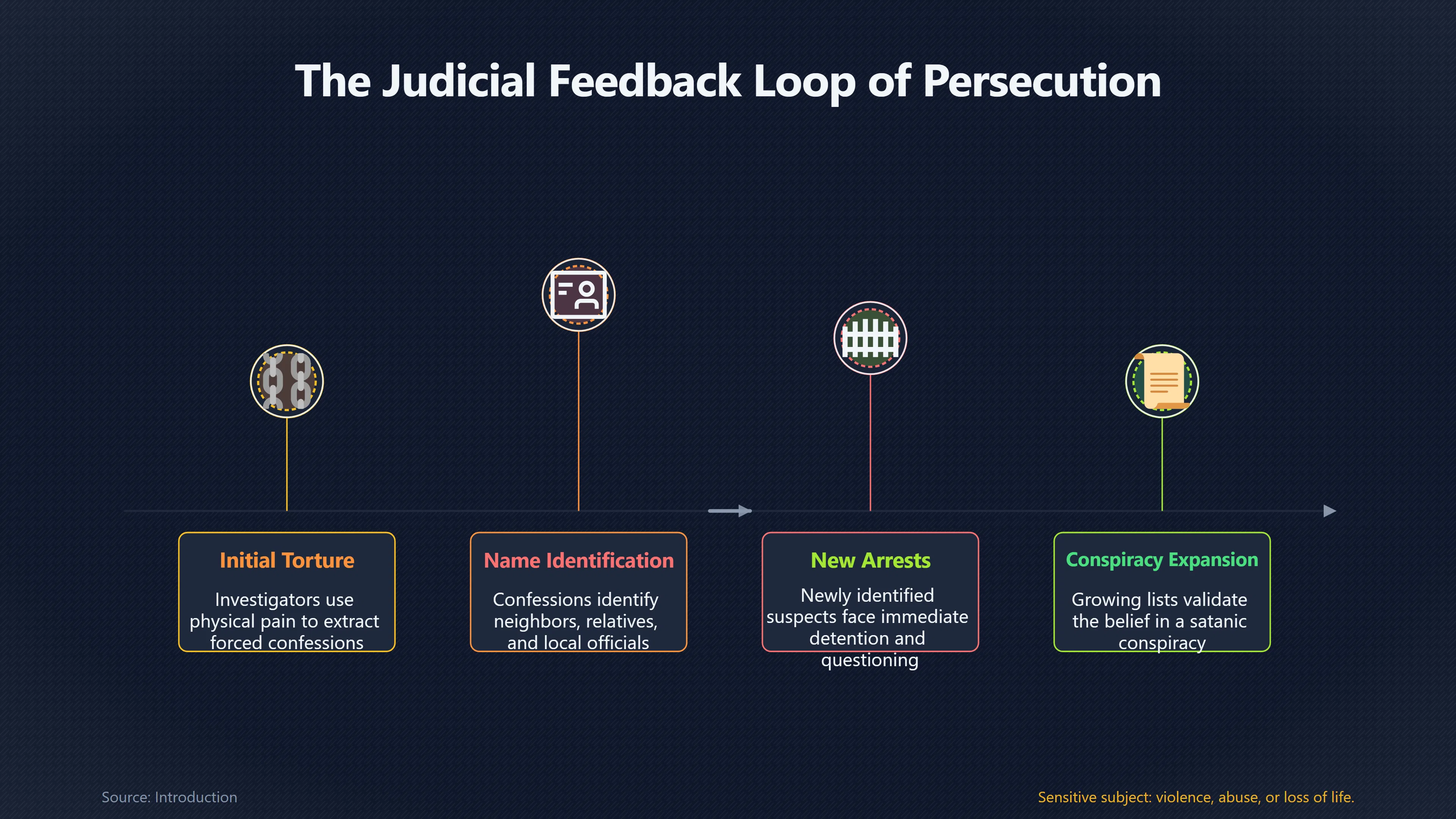
This created a powerful feedback loop:
- suspects confessed after torture;
- confessions identified neighbours, relatives and local officials;
- new arrests produced new denunciations;
- expanding lists appeared to confirm the existence of a vast satanic conspiracy.
Each confession therefore strengthened belief in the conspiracy while simultaneously supplying investigators with their next suspects. Modern historians regard this as one of the defining mechanisms behind large-scale witch hunts.[OUP Academic]academic.oup.comOUP AcademicWhy Early Modern Mass Incarceration Matters: The Bamberg Malefizhaus, 1627–31 | Journal of Social History | Oxford AcademicJa…
The process also explains why persecutions spread beyond those already regarded as marginal or socially vulnerable. Once denunciations became the principal form of evidence, virtually anyone could be drawn into the investigations.
The Drudenhaus and organised prosecution
One of the clearest symbols of Bamberg’s systematic approach was the construction of the Malefizhaus, commonly known as the Drudenhaus or “witch prison”, in 1627.
Recent scholarship argues that this purpose-built prison represented far more than a place to hold suspects. It was designed to facilitate prolonged isolation, repeated interrogation and the extraction of confessions. Instead of temporary detention, prisoners experienced an organised carceral regime that allowed investigators to process large numbers of accused people simultaneously.[OUP Academic]academic.oup.comOUP AcademicWhy Early Modern Mass Incarceration Matters: The Bamberg Malefizhaus, 1627–31 | Journal of Social History | Oxford AcademicJa…
The prison illustrates an important historical point. Mass witch persecutions depended not only on beliefs about magic but also on physical institutions:
- specialised prisons;
- trained interrogators and executioners;
- extensive written records;
- coordinated judicial officials;
- financial resources supplied by territorial government.
These bureaucratic structures allowed persecution to continue even when the number of suspects grew into the hundreds. The machinery of imprisonment became as significant as the ideology of witchcraft itself.[OUP Academic]academic.oup.comOUP AcademicWhy Early Modern Mass Incarceration Matters: The Bamberg Malefizhaus, 1627–31 | Journal of Social History | Oxford AcademicJa…
Johannes Junius and the widening circle of victims
The experience of Bamberg mayor Johannes Junius demonstrates how these prosecutions escaped all social boundaries.
Junius was a respected burgomaster rather than a marginal figure. Trial records show that he repeatedly denied practising witchcraft before torture was applied. Eventually he confessed and named others, following the pattern seen in numerous contemporary cases. Shortly before his execution in 1628, he secretly wrote a letter to his daughter describing how torture had forced innocent prisoners into false confessions. The letter survives and remains one of the most important first-hand testimonies from the European witch hunts.[hanover.edu]history.hanover.eduCollege History DepartmentbambergHanover College History Departmentbamberg…
His account illustrates several recurring features of the Bamberg prosecutions:
- prisoners understood that denying guilt brought further torture;
- confession offered little hope of survival;
- naming additional suspects became a means of ending unbearable pain;
- the process converted respected citizens into apparent proof of an expanding conspiracy.
The significance of Junius’s case lies precisely in his social standing. If a senior civic official could be condemned, then nobody appeared beyond suspicion. This reinforced public belief that witches had infiltrated every level of society.[University of Portsmouth]researchportal.port.ac.ukUniversity of PortsmouthMales, masculine honor and witch hunting in seventeenth-century Germany - University of Portsmouth…
Why the accused kept multiplying
One striking feature of both Bamberg and Würzburg was the steady widening of prosecutions.
Many European witch hunts began with accusations against poorer women or individuals already viewed with suspicion. In these prince-bishoprics, however, investigations increasingly reached merchants, councillors, clergy, children and members of elite families. Even high-ranking church officials were denounced during the later stages of the persecutions.[MDPI]mdpi.comDebating the Devil’s Clergy. Demonology and the Media in Dialogue with Trials (14th to 17th Century)…
Historians see this as evidence that the legal process had become detached from ordinary standards of proof. Once denunciations generated further denunciations, social status no longer provided protection. Instead, prominence could increase suspicion because influential individuals were imagined as leaders within the supposed satanic conspiracy.
This expanding circle also undermined the administration itself. Experienced officials, judges and advisers became suspects, reducing the government’s own capacity to scrutinise or restrain the prosecutions.[MDPI]mdpi.comDebating the Devil’s Clergy. Demonology and the Media in Dialogue with Trials (14th to 17th Century)…
Why the persecutions eventually collapsed
The campaigns did not end because belief in witchcraft suddenly disappeared.
Several factors combined to halt them. Critics increasingly questioned the reliability of confessions obtained through torture, while appeals reached higher imperial courts that challenged the legality of local procedures. The advance of Swedish armies during the Thirty Years’ War disrupted political authority in both bishoprics, making continued persecution impossible. Imperial intervention also imposed growing pressure on local rulers to restrain the trials.[Reddit]reddit.comWhat was the legal process like for being accused of witchcraft in early 17th-century Germany?…
These developments exposed an important weakness in the machinery of persecution. It depended upon stable political institutions. Once those institutions fractured, the system rapidly lost its ability to sustain continuous arrests and executions.
Why Bamberg and Würzburg remain important
Bamberg and Würzburg remain central to understanding collective fear because they demonstrate that witch panics were not simply episodes of irrational popular belief.
Instead, they reveal how institutions can amplify fear through administrative routines. Courts, prisons, interrogation methods and official authority transformed rumours into legally sanctioned “evidence”, allowing persecution to grow even as it consumed respected members of society.
For historians of Germany, these trials therefore represent more than local tragedies. They illustrate the danger created when extraordinary threats are assumed to justify extraordinary legal procedures. Once confession replaced evidence and accusation became self-validating, the justice system itself generated the appearance of an ever-expanding conspiracy. The enduring lesson is that organised persecution often depends less on the intensity of public fear than on the willingness of institutions to convert that fear into official policy.[oup.com]academic.oup.comOUP AcademicWhy Early Modern Mass Incarceration Matters: The Bamberg Malefizhaus, 1627–31 | Journal of Social History | Oxford AcademicJa…
Amazon book picks
Further Reading
Books and field guides related to How Bamberg and Würzburg Built Witch Panics. Use these as the next step if you want deeper reading beyond the article.

The witch-hunt in early modern Europe
Covers Bamberg, Würzburg and institutional witch persecutions.


Endnotes
1.
Source: academic.oup.com
Link:https://academic.oup.com/jsh/article-pdf/56/4/719/50501804/shac066.pdf
Source snippet
OUP AcademicWhy Early Modern Mass Incarceration Matters: The Bamberg Malefizhaus, 1627–31 | Journal of Social History | Oxford AcademicJa...
2.
Source: mdpi.com
Link:https://www.mdpi.com/2077-1444/10/12/648
Source snippet
Debating the Devil’s Clergy. Demonology and the Media in Dialogue with Trials (14th to 17th Century)...
3.
Source: reddit.com
Link:https://www.reddit.com/r/AskHistorians/comments/1l1gzqa
Source snippet
What was the legal process like for being accused of witchcraft in early 17th-century Germany?...
4.
Source: history.hanover.edu
Title: College History Departmentbamberg
Link:https://history.hanover.edu/texts/bamberg.html
Source snippet
Hanover College History Departmentbamberg...
5.
Source: staatsbibliothek-bamberg.de
Link:https://www.staatsbibliothek-bamberg.de/article/junius-brief/
6.
Source: reddit.com
Link:https://www.reddit.com/r/AskHistorians/comments/12ed96g
Source snippet
How dangerous was it to deny witchcraft or defend/provide support to accused at the heights of witch panics?...
7.
Source: staatsbibliothek-bamberg.de
Title: Die Hexenverfolgungen im Hochstift Bamberg und der Junius-Brief
Link:https://www.staatsbibliothek-bamberg.de/en/article/die-hexenverfolgungen-im-hochstift-bamberg-und-der-junius-brief/
Source snippet
November 23, 2021 — ARTICLE DIE HEXENVERFOLGUNGEN IM HOCHSTIFT BAMBERG UND DER JUNIUS-BRIEF 11/23/2021 Weitere Meldungen zum Thema: * Bam...
Published: November 23, 2021
8.
Source: staatsbibliothek-bamberg.de
Title: Die Hexenverfolgungen im Hochstift Bamberg und der Junius-Brief
Link:https://www.staatsbibliothek-bamberg.de/article/die-hexenverfolgungen-im-hochstift-bamberg-und-der-junius-brief/
9.
Source: history.hanover.edu
Link:https://history.hanover.edu/courses/excerpts/244bamb.html
10.
Source: researchportal.port.ac.uk
Link:https://researchportal.port.ac.uk/en/publications/males-masculine-honor-and-witch-hunting-in-seventeenth-century-ge/
Source snippet
University of PortsmouthMales, masculine honor and witch hunting in seventeenth-century Germany - University of Portsmouth...
Additional References
11.
Source: historisches-lexikon-bayerns.de
Title: E N:Persecution of witches
Link:https://www.historisches-lexikon-bayerns.de/Lexikon/EN%3APersecution_of_witches
Source snippet
EN:Persecution of witches - Historisches Lexikon BayernsFebruary 25, 2025 — EN * Revision History * * * # EN:Persecution of witches FROM...
Published: February 25, 2025
12.
Source: youtube.com
Title: The Witch Trials Were A Scam: How They Monetized Fear | Grim History Uncovered
Link:https://www.youtube.com/watch?v=50lXeBZOECY
Source snippet
Würzburg Castle Tourist Guide - Germany - Travel & Discover...
13.
Source: cambridge.org
Title: Primary sources CH11
Link:https://www.cambridge.org/features/wiesnerhanks/downloads/primary_sources/Primary_sources_CH11.pdf
Source snippet
Cambridge University Press & AssessmentWiesner‐Hanks: Chapter Eleven: Religious Consolidation and Renewal, 1600‐1789...
14.
Source: youtube.com
Link:https://www.youtube.com/watch?v=XJJW7xe788U
Source snippet
The Witch Trials Were A Scam: How They Monetized Fear | Grim History Uncovered...
15.
Source: youtube.com
Title: Würzburg Castle Tourist Guide
Link:https://www.youtube.com/watch?v=mJTG_Y89yhQ
Source snippet
Witch Trials Teaser Trailer - Assassin's Creed Hexe...
16.
Source: tandfonline.com
Link:https://www.tandfonline.com/doi/abs/10.1080/01639625.1989.9967814
17.
Source: sacred-texts.com
Link:https://sacred-texts.com/pag/twp/twp08.htm
18.
Source: youtube.com
Title: Europe’s Witch Trials: Deadlier Than Salem
Link:https://www.youtube.com/watch?v=Bt1dlKN_LF0
Source snippet
The Horrific Prison Built for Witches in 1627...
19.
Source: youtube.com
Title: Witch Trials Teaser Trailer
Link:https://www.youtube.com/watch?v=grYSr82nhjY
20.
Source: journals.sagepub.com
Link:https://journals.sagepub.com/doi/10.1177/1097184X03257436
Topic Tree