Within Hungary's Collective Fears
How Szeged Turned Drought Into a Witch Panic
Drought, social conflict and coercive courts turned local suspicions into Hungary's most notorious witch prosecutions.
On this page
- Why witchcraft accusations spread across Hungary
- The Szeged prosecutions of 1728 29
- How courts transformed rumours into conspiracy
Page outline Jump by section
Introduction
The Hungarian witch trials were not random explosions of superstition. They were legal persecutions that grew from everyday disputes but became far more dangerous when courts transformed local rumours into organised criminal investigations. The most famous example was the Szeged witch panic of 1728–1729, the largest concentrated series of witchcraft prosecutions in Hungarian history. Triggered during a period of severe drought, crop failure and social strain, the trials show how environmental crisis, political conflict and judicial procedure combined to turn suspicion into a deadly conspiracy theory. Rather than simply reflecting popular belief, the Szeged prosecutions demonstrate how authorities actively shaped, expanded and legitimised accusations through interrogation, coercion and formal legal process. Modern historians therefore see the episode less as spontaneous “mass hysteria” than as an interaction between community fears and institutions that gave those fears official authority.[SZTE Repository of Dissertations]doktori.bibl.u-szeged.huSZTE Repository of Dissertations EnglishSZTE Repository of DissertationsEnglish AbstractAugust 28, 2023…

Why witchcraft accusations spread across Hungary
Early modern Hungary experienced hundreds of witchcraft prosecutions between the sixteenth and eighteenth centuries, although their intensity varied considerably by region and period. Most accusations began with ordinary neighbourhood conflicts rather than dramatic claims about secret satanic organisations.
Typical accusations emerged after events that people struggled to explain, including:
- sudden illness or death
- livestock dying without an obvious cause
- failed medical treatment
- quarrels between neighbours
- damaged crops or food shortages
- unexplained bad luck following threats or arguments
Those accused were frequently older women, healers, midwives or socially marginal people, but respected members of the community could also become suspects. The accusations reflected existing tensions rather than identifying a separate group of “witches”. A failed cure or an angry exchange could later be reinterpreted as proof of harmful magic when misfortune followed.[SZTE Repository of Dissertations]doktori.bibl.u-szeged.huSZTE Repository of Dissertations EnglishSZTE Repository of DissertationsEnglish AbstractAugust 28, 2023…
The decisive step came when magistrates accepted these suspicions as criminal evidence. Once an investigation began, witnesses were encouraged to connect isolated events into a larger story. Confessions obtained under coercion often introduced ideas borrowed from European demonological literature, including meetings with the Devil, flying, or organised gatherings of witches. These claims rarely appeared spontaneously in village disputes but became increasingly prominent once judicial procedures shaped the questioning.[SZTE Repository of Dissertations]doktori.bibl.u-szeged.huSZTE Repository of Dissertations EnglishSZTE Repository of DissertationsEnglish AbstractAugust 28, 2023…
The Szeged prosecutions of 1728–1729
The Szeged witch panic stands apart because of both its scale and its unusually rich documentation. Recent archival research identifies at least twenty-five individual proceedings, around fifteen death sentences and hundreds of people involved as witnesses, officials and defendants, making it Hungary’s largest concentrated witch-hunt.[SZTE Repository of Dissertations]doktori.bibl.u-szeged.huSZTE Repository of Dissertations EnglishSZTE Repository of DissertationsEnglish AbstractAugust 28, 2023…
The immediate background was a severe drought affecting the Great Hungarian Plain. Crop failures, food shortages and disease placed enormous pressure on the town. Communities facing repeated disasters naturally searched for explanations, but the drought alone did not produce a witch panic. The crucial turning point came when civic authorities accepted witchcraft as a legal explanation for the crisis.
Among those prosecuted were:
- elderly women already associated with folk healing
- neighbours involved in longstanding disputes
- respected townspeople
- an elderly former town judge, whose prosecution demonstrated that even social status offered little protection once the investigations gathered momentum
The widening social range of the accused is one reason historians regard Szeged as different from many smaller Hungarian cases. Instead of remaining isolated neighbourhood disputes, accusations expanded into an alleged network of conspirators supposedly working together with demonic forces to harm the community.[u-szeged.hu]doktori.bibl.u-szeged.huSZTE Repository of Dissertations EnglishSZTE Repository of DissertationsEnglish AbstractAugust 28, 2023…

How courts transformed rumours into conspiracy
The Szeged panic illustrates how judicial systems could manufacture coherence from scattered fears.
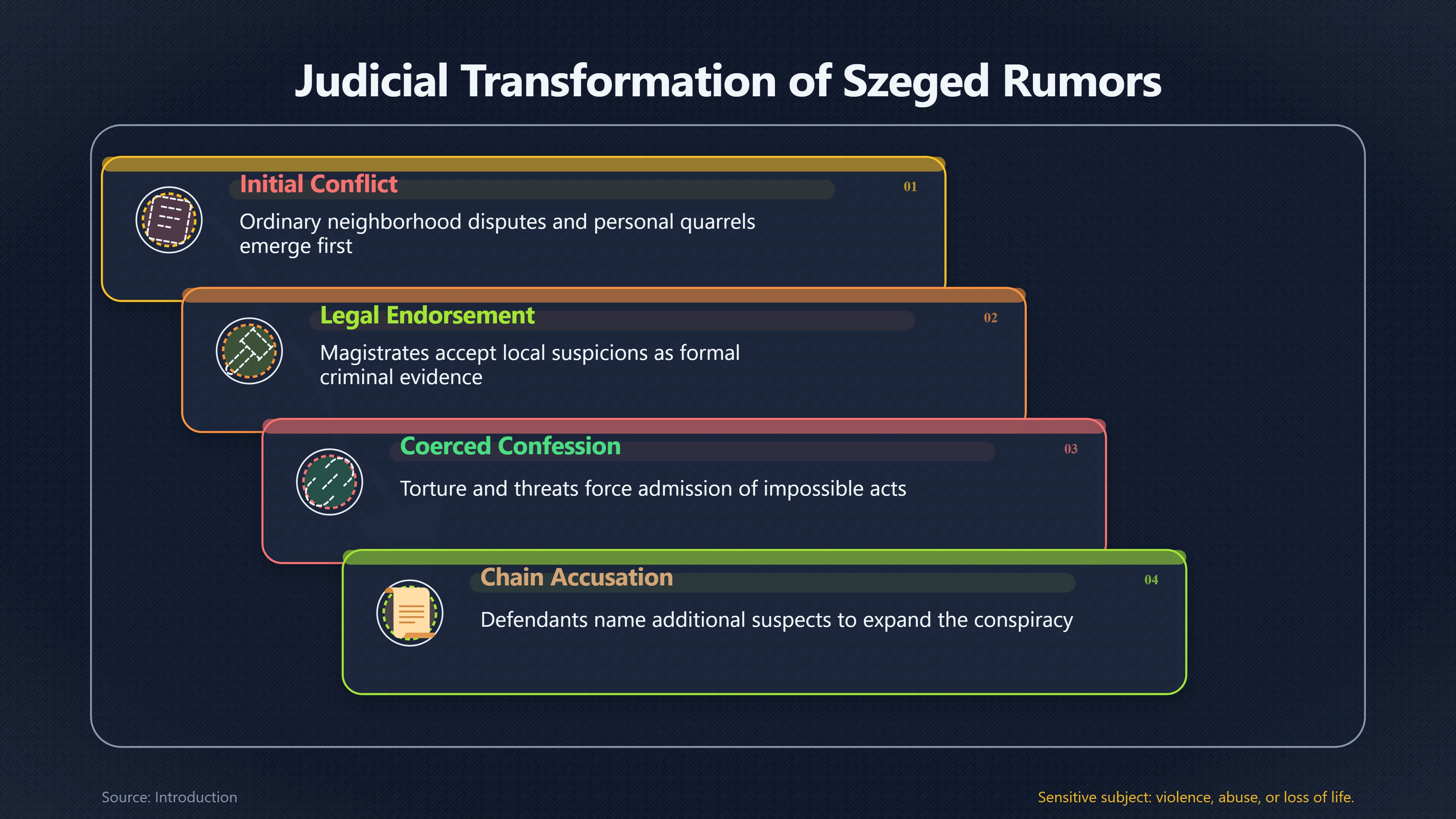
At the beginning, witnesses usually described familiar conflicts: arguments, curses, suspicious behaviour or unexplained illness. During legal proceedings, however, interrogators increasingly sought evidence of a broader conspiracy.
Several mechanisms reinforced one another.
Confessions under coercion. Torture and the threat of execution encouraged prisoners to admit impossible acts and identify additional suspects. Every new confession appeared to confirm the previous one, allowing the investigation to expand.
Imported demonological ideas. Court records reveal the influence of learned European legal traditions concerning diabolical witchcraft. Rather than recording only local folklore, interrogators introduced concepts such as pacts with the Devil and organised witch gatherings, giving prosecutions an intellectual framework recognised across parts of Europe.[SZTE Repository of Dissertations]doktori.bibl.u-szeged.huSZTE Repository of Dissertations EnglishSZTE Repository of DissertationsEnglish AbstractAugust 28, 2023…
Chain accusations. Defendants frequently named other supposed witches, voluntarily or under pressure. This transformed isolated allegations into an ever-growing conspiracy that seemed increasingly credible simply because more names appeared in the records.
Judicial authority. Once town officials formally endorsed the investigation, rumours acquired legal legitimacy. Ordinary disagreements became criminal evidence, while executions reinforced the impression that witchcraft had been objectively proven.
This process helps explain why historians increasingly distinguish between popular belief and organised persecution. Belief in harmful magic existed before the trials, but courts created the large-scale conspiracy.
More than a drought: politics and local power
Older accounts often presented the Szeged trials primarily as a response to environmental disaster. Recent research argues for a more complicated explanation.
Political struggles within the town played an important role alongside economic hardship. Local rivalries, conflicts between civic factions and intervention by higher authorities all influenced how the prosecutions developed. The Hungarian Chancellery in Vienna eventually investigated aspects of the proceedings, illustrating that the trials were not viewed simply as routine criminal cases.[SZTE Publikáció]publicatio.bibl.u-szeged.huSZTE PublikációBRANDL GERGELYSZTE PublikációBRANDL GERGELY
This political dimension helps explain why Szeged became far larger than most Hungarian witch prosecutions. Environmental stress created anxiety, but institutional decisions determined how that anxiety was channelled. Similar droughts elsewhere did not automatically produce comparable witch-hunts.
Why the Szeged panic remains historically important
The Szeged prosecutions occupy a distinctive place in Hungarian history because they are exceptionally well documented. Court records, witness testimony and later investigations allow historians to reconstruct not only who was accused but also how the legal process evolved from scattered rumours into organised persecution. Recent scholarship has re-examined the surviving documents in greater detail than ever before, showing how the investigations unfolded over several years rather than as a single isolated trial.[SZTE Repository of Dissertations]doktori.bibl.u-szeged.huSZTE Repository of Dissertations EnglishSZTE Repository of DissertationsEnglish AbstractAugust 28, 2023…
The case also illustrates a broader pattern seen across parts of early modern Europe. Witch-hunts were most likely to become lethal when several conditions overlapped:
- severe social or environmental stress
- widespread belief that harmful magic could explain misfortune
- legal procedures allowing coercive interrogation
- authorities willing to interpret accusations as evidence of organised satanic crime
Without the machinery of the courts, neighbourhood suspicions often remained local disputes. Once legal institutions endorsed the accusations, however, they acquired extraordinary force.
Myths and modern interpretation
Modern historians reject the idea that the Szeged panic proves that ordinary Hungarians collectively descended into irrationality. Instead, the episode demonstrates how belief, fear and institutional power interacted.
Equally, scholars reject older ideas that the victims belonged to an organised pagan religion or secret witch cult. No reliable evidence supports such claims. The people executed were individuals drawn into legal proceedings that increasingly interpreted ordinary conflicts through the language of demonology.[SZTE Repository of Dissertations]doktori.bibl.u-szeged.huSZTE Repository of Dissertations EnglishSZTE Repository of DissertationsEnglish AbstractAugust 28, 2023…
For this reason, the Szeged witch panic is remembered not simply as a story about superstition, but as a warning about how courts, political pressures and social crisis can convert rumours into apparently convincing conspiracies. It remains one of Hungary’s clearest examples of how official institutions can magnify collective fear into organised persecution.
Amazon book picks
Further Reading
Books and field guides related to How Szeged Turned Drought Into a Witch Panic. Use these as the next step if you want deeper reading beyond the article.
Extraordinary Popular Delusions and the Madness of Crowds
Rating: 4.0/5 from 5 Google Books ratings
Adds broad context on collective fear and rumor.

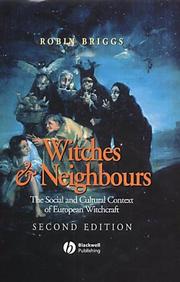
The witch-hunt in early modern Europe
Explains legal and social processes behind European witch hunts.

Endnotes
1.
Source: doktori.bibl.u-szeged.hu
Title: SZTE Repository of Dissertations English
Link:https://doktori.bibl.u-szeged.hu/id/eprint/11872/3/Brandl_Abstract_2023.pdf
Source snippet
SZTE Repository of DissertationsEnglish AbstractAugust 28, 2023...
Published: August 28, 2023
2.
Source: publicatio.bibl.u-szeged.hu
Title: SZTE PublikációBRANDL GERGELY
Link:https://publicatio.bibl.u-szeged.hu/29912/1/A_varos_a_boszorkany_es_a_kancellaria_Ho.pdf
3.
Source: doktori.bibl.u-szeged.hu
Link:https://doktori.bibl.u-szeged.hu/id/eprint/11872/
Source snippet
SZTE Repository of DissertationsA szegedi boszorkányperek története és forrásai (1726-1744) - SZTE Doktori Repozitórium...
4.
Source: ek.szte.hu
Link:https://www.ek.szte.hu/event/brandl-gergely-demonologia-es-tortura-alatti-vallomasok-a-nagy-szegedi-boszorkanyuldozes-1728-1729-idejen/
Source snippet
június hónapban – SZTE Klebelsberg Könyvtár és LevéltárMay 7, 2025 — * Ez az esemény elmúlt. BRANDL GERGELY: DÉMONOLÓGIA ÉS TORTÚRA ALATT...
Published: May 7, 2025
5.
Source: arts.u-szeged.hu
Title: jogszeruseg szamos
Link:https://arts.u-szeged.hu/esemenyek/bolcseszfeszt-2019/jogszeruseg-szamos
Source snippet
Tudományegyetem | A jogszerűség számos megítélése – Perjogi kérdések a nagy Szegedi boszorkányper (1728-1729) esetébenApril 27, 2019 — A...
Published: April 27, 2019
6.
Source: publicatio.bibl.u-szeged.hu
Link:https://publicatio.bibl.u-szeged.hu/29912/
7.
Source: acta.bibl.u-szeged.hu
Link:https://acta.bibl.u-szeged.hu/35938/
8.
Source: epa.oszk.hu
Link:https://epa.oszk.hu/00800/00861/00070/pdf/
Additional References
9.
Source: researchgate.net
Link:https://www.researchgate.net/publication/404499206_Towards_a_Comparative_Study_of_Polish_and_Hungarian_Witchcraft_Persecutions_Historiographical_and_Legal_Perspectives
Source snippet
December 1, 2025 — Article PDF Available TOWARDS A COMPARATIVE STUDY OF POLISH AND HUNGARIAN WITCHCRAFT PERSECUTIONS: HISTORIOGRAPHICAL A...
Published: December 1, 2025
10.
Source: youtube.com
Title: The Witch-Hunt in Early Modern Europe: A Discussion with Brian Levack
Link:https://www.youtube.com/watch?v=eSvFMkcO2d4
Source snippet
Europe's Witch Trials: Context for Salem Part 1...
11.
Source: youtube.com
Title: Teofilo Ruiz – “The Witch Craze in Medieval and Early Modern Europe”
Link:https://www.youtube.com/watch?v=xkkg-ke_oEA
Source snippet
A History of Scottish Witches with Mary W. Craig...
12.
Source: youtube.com
Title: A History of Scottish Witches with Mary W. Craig
Link:https://www.youtube.com/watch?v=sxCgptDAhck
Source snippet
Torture and Terror: The Chilling History of the Medieval Inquisitions...
13.
Source: youtube.com
Title: Europe’s Witch Trials: Context for Salem Part 1
Link:https://www.youtube.com/watch?v=oY–nodAvU8
Source snippet
Teofilo Ruiz – "The Witch Craze in Medieval and Early Modern Europe"...
14.
Source: researchgate.net
Link:https://www.researchgate.net/publication/341432724_Sz_Kristof-Witch-Hunting_in_Early_Modern_Hungary
15.
Source: academic.oup.com
Link:https://academic.oup.com/edited-volume/34335/chapter-abstract/291373333
Source snippet
"Levack (ed.) [https://doi.org/10.1093/oxfordhb/9780199578160.001.0001..."](https://doi.org/10.1093/oxfordhb/9780199578160.001.0001...")...
16.
Source: youtube.com
Title: Torture and Terror: The Chilling History of the Medieval Inquisitions
Link:https://www.youtube.com/watch?v=zxpsSM0UOww
17.
Source: Wikipedia
Title: Szeged witch trials
Link:https://en.wikipedia.org/wiki/Szeged_witch_trials
18.
Source: real.mtak.hu
Link:https://real.mtak.hu/119822/
Topic Tree